 Created by renowned Harvard health care professionals.



Written by Jeff Conley, President, First Hand Medical · Medically reviewed by Dr. Benjamin E. Bierbaum, MD, orthopedic surgeon and hand specialist, clinical professor of orthopedic surgery, Harvard Medical School · Last reviewed: November 2026
Table of Contents
What Doctors Look for in a Treatment for Carpal Tunnel Syndrome
People suffering with Carpal Tunnel Syndrome are eager to find an effective treatment for carpal tunnel syndrome, and many hope for a “cure.” Most want answers to the following questions:
- “What are my Treatment options?”
- “How effective are the various options?”
- “How much downtime is involved?”
- “What are the risks and potential complications?”
- “What are the expenses involved?” and finally,
- “How does the treatment work?”
Often a person is looking for a quick and easy permanent fix to this frustrating and often chronic condition. The truth is there is no permanent “cure” for Carpal Tunnel. Carpal Tunnel Symptoms return even after a successful surgery. So, what are the best options?
Since the condition is recurring, it is important to find a treatment for carpal tunnel syndrome that has high patient satisfaction, with minimal risks, minimal time commitment and can be applied when needed at a reasonable cost. There are a host of options that are being promoted in the medical community and online. We will review most of them here in order of which best fits the above criteria or is most commonly encountered and explain why. One thing to keep in mind is that people have widely varying responses to the various treatment options, so it is important to keep the range of possibilities and time frames in mind when reviewing these treatments.
Our doctors judge each treatment for carpal tunnel syndrome by whether it relieves the pressure behind the symptoms. Swelling and entrapped inflammation in and around the carpal tunnel squeeze the median nerve and restrict blood flow and lymphatic fluid transport. The nine tendons that bend the fingers and thumb, powered by the forearm muscles, pass through the tunnel beside the nerve, so a good treatment should also protect forearm, thumb and finger strength rather than weaken it.
Carpal Tunnel Treatment Options: What Doctors Review
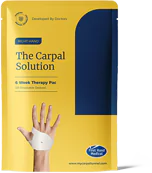
The Carpal Solution Therapy
– The best first line treatment option for CTS is called the Carpal Solution Passive Stretching Therapy. Some people call it the Carpal Tunnel Solution. It has 97% patient satisfaction over 21 years and 4.9 out of 5 stars on independent review sites like Google Reviews, and over 100,000 people have used it over two decades. It is a natural passive stretching therapy applied by a disposable stretching device which is worn during sleep. It was developed by Doctors working with Patients. The therapy is safe and effective.
The Carpal Solution comes in a Six Week Therapy package. Some people (about 20%) see relief of their worst symptoms within a few days of starting….. Read More
Most people are better from their worst symptoms in two to three weeks, and about 90% get complete remission in six weeks. Neurologists, including Dr. James S. Zu, MD, PhD, of Edison, New Jersey, call the Carpal Solution a better first line of defense. As a treatment for carpal tunnel syndrome, it works with your body: its targeted passive stretching relieves pressure on the median nerve and lets blood and lymph flow freely to clear out the swelling.
For general medical background on carpal tunnel treatment options, see the NINDS fact sheet on carpal tunnel syndrome.
Rigid Hand Braces or Wrist Splints – are the most commonly used home treatment for carpal tunnel syndrome and are easily found in pharmacies and drug stores. They are also readily available online at a low prices. These devices are designed to immobilize the hand and wrist and prevent movement. Immobilization can limit some of the pain and discomfort associated with movement initially, but in the long run it makes CTS worse for most people.
 Immobilization is an effective way to treat a broken bone or a sprained joint over a short six week period, but it is not an effective treatment option for a chronic condition like Carpal Tunnel Syndrome.
Rigid immobilizing braces and wrist splints will cause muscle atrophy, muscle imbalance, and can injure the soft tissue of the hand…… Read More
A splint holds the wrist in a neutral position, which can reduce pain from movement, but it does not promote healing from carpal tunnel syndrome. It causes muscle atrophy and stiffness, and its tight compression restricts blood circulation and lymphatic fluid exchange, which slows the dispersion of entrapped swelling, the root cause of carpal tunnel syndrome. Our medical team has observed that splints give some relief at first but aggravate symptoms in the long run. Immobilization is great for fractures and sprains, but not for carpal tunnel syndrome.
Immobilization also weakens muscle quickly. In one study, about 8% of muscle size and 23% of strength were lost after 14 days in a cast (Wall et al., Acta Physiologica, 2014). See our doctors’ position on wrist splints.
Corticosteroid Injections – are a treatment for carpal tunnel syndrome that should be considered under certain circumstances. Corticosteroids are a class of steroid hormones that are naturally produced by all vertebrates (animals with backbones including humans) in low concentrations. Analogues of these steroids can be synthesized in laboratories in highly concentrated forms. It is the laboratory synthesized steroids that are used in medicine, since the laboratory is the only cost effective way to concentrate these compounds.
These compounds are powerful medications and should be used judiciously. Even though they are produced naturally by the human body at low concentrations, when used as an anti-inflammatory agent, the dosage is hundreds up to a thousand times greater than the amounts which are produced by the body naturally.
There are numerous potential side effects associated with these natural steroids including….. Read More
Oral Pain Medication – is often recommended by doctors as a stop-gap in hopes of offering some immediate relief to the suffering patient, but for a chronic condition like CTS, Oral Pain Medication presents many pitfalls. First and foremost, Oral Pain Medication is not very effective in treating this frustrating hand condition. While it can take the edge off the most intense pain, it will not eliminate the symptoms and there are so many side effects.
 There are many different types of oral pain meds, all with their own set of potential complications and long-term issues when used for chronic pain like Carpal Tunnel Syndrome.
The most common type of oral pain med is….. Read More
Therapies That Support Your Treatment for Carpal Tunnel Syndrome
The Carpal Solution is the anchor of our doctors’ approach, and several other therapies can help it work faster. None of them replaces the nightly stretching, but each can add to it.
- Physical and occupational therapy: a therapist can check your posture, workstation and hand use, and teach gentle daytime stretches (up to 6 sets of 10, holding each stretch for 15 seconds with 30 seconds of rest).
- An anti-inflammatory diet: because entrapped inflammation is the root cause of carpal tunnel syndrome, eating to lower systemic inflammation supports healing. Our protocol draws on Dr. Valter Longo’s The Longevity Diet, Dr. Nicole Avena’s Why Diets Fail and Max Lugavere’s Genius Foods.
- TENS and dry needling: some people find these helpful for pain while the soft tissue heals.
- Sleep posture: pillows that keep the wrists in a neutral position overnight help without the downsides of a splint.
One caution while you heal: skip grip strengtheners, squeeze balls and therapy putty. They add tension to the tissue you are trying to relax. Save hand strengthening and aerobic exercise for after remission. Combining these habits with the Carpal Solution makes for a more complete treatment for carpal tunnel syndrome at home.
Passive stretching beats exercise alone for one simple reason: long-term discipline is most people’s weak point. The Carpal Solution does the stretching for you while you sleep, so your treatment for carpal tunnel syndrome keeps working even on busy days.
How to Choose a Treatment for Carpal Tunnel Syndrome
Our doctors suggest asking the same six questions about any treatment for carpal tunnel syndrome: does it relieve the pressure on the median nerve, how well do patients like it, how much downtime does it need, what are the risks, what does it cost, and can you use it again if symptoms return? A good treatment for carpal tunnel syndrome scores well on all six. That is why our doctors put conservative, at-home care first and keep surgery for last.
Insurance can help too. The Carpal Solution’s billing code is HCPCS L3924 (Hand Finger Orthosis), and many people are reimbursed 70 to 80% of the cost.
Comparing Each Treatment for Carpal Tunnel Syndrome
No single treatment for carpal tunnel syndrome suits everyone, and people respond differently. The table below sums up how our doctors weigh each option: how it works, how much downtime it needs and what the drawbacks are.
| Treatment | How it works | Downtime | Main drawbacks | Our doctors’ view |
|---|---|---|---|---|
| Carpal Solution | Targeted passive stretching worn during sleep relieves pressure on the median nerve | None | Takes a six-week commitment of nightly wear | Best first line: 97% patient satisfaction over 21 years |
| Rigid splints and braces | Immobilize the wrist in a neutral position | None | Muscle atrophy, stiffness, restricted blood and lymph flow | Short-term relief from movement only, not healing |
| Steroid injections | Powerful anti-inflammatory medication injected near the nerve | Minimal | Side effects; relief is often temporary | Consider only under certain circumstances |
| Oral pain medication | Dulls the most intense pain | None | Does not eliminate symptoms; side effects with long-term use | A stop-gap at best |
| Surgery | Cuts the transverse carpal ligament to open the tunnel | Weeks of recovery | Patient satisfaction lower than 69%; symptoms often return | The last resort |
Surgery: The Last Resort
Conservative care comes first, and surgery is the last-resort treatment for carpal tunnel syndrome. Carpal tunnel surgery has a patient satisfaction rate lower than 69%, because about 31% of patients report lingering or recurring symptoms, and no patient is satisfied with lingering symptoms. Even after a successful surgery, symptoms often return: in one study, 57% had at least some symptoms come back within 5.5 years (Nancollas 1995, reviewed in Louie, Earp and Blazar, 2012). Our doctors estimate 80 to 90% within 10 years, based on clinical experience, not statistically researched. Second surgeries have a patient satisfaction rate between 16% and 40%. Read more about recurrence after carpal tunnel surgery.
Treatment While You Wait for an Appointment
Everyone waits in the healthcare system: for an appointment with your doctor, a neurologist or a hand surgeon. The average wait for a new-patient physician appointment is 31 days (AMN Healthcare, 2025). Our doctors’ two decades of clinical experience is that people with three or more of the common carpal tunnel symptoms can be about 95% confident they have CTS. You should still get an in-person evaluation and formal diagnosis, but you can start a safe, natural treatment for carpal tunnel syndrome at home while you wait. See waiting for carpal tunnel treatment.
A note on the word “cure.” Carpal tunnel syndrome is chronic and recurring and cannot be cured, but the Carpal Solution is the next best thing, controlling symptoms at home without downtime, risks, scar tissue or complications.
Treatment for Carpal Tunnel Syndrome: Frequently Asked Questions
What is the best first treatment for carpal tunnel syndrome?
Our doctors recommend starting with conservative, non-invasive care. The Carpal Solution is their first choice because it relieves pressure on the median nerve every night while you sleep, with no downtime, no drugs and no scar tissue. Other therapies, such as physical therapy and an anti-inflammatory diet, can speed it along.
How long does treatment for carpal tunnel syndrome take?
With the Carpal Solution, most people are better from their worst symptoms in two to three weeks, and about 90% get complete remission in six weeks. About 10% of people, usually those with excess systemic inflammation, are 40 to 70% better at six weeks and reach full remission in 10 to 12 weeks.
Is a wrist splint a good treatment for carpal tunnel syndrome?
A splint can reduce pain from movement at first, but it does not promote healing. Over time it causes muscle atrophy and restricts blood and lymph flow, which slows the healing process. Our doctors recommend pillows to keep the wrists neutral during sleep instead.
Do steroid injections or pain pills fix carpal tunnel syndrome?
They can calm pain or swelling for a while, but they do not correct the soft tissue tightness behind the pressure on the nerve, and both carry side effects with repeated use. Our doctors view them as short-term options rather than a long-term treatment for carpal tunnel syndrome.
When should I consider surgery?
Surgery is the last resort, after conservative treatment for carpal tunnel syndrome has been given a fair trial, or sooner if your doctor finds constant numbness, weakness or thinning of the thumb muscles. Carpal tunnel surgery has a patient satisfaction rate lower than 69%, so it is worth trying a safer treatment for carpal tunnel syndrome first.
Can carpal tunnel come back after treatment?
Yes. Carpal tunnel syndrome is chronic and recurring. After the Carpal Solution, remission usually lasts 5 to 7 years for most people, though results vary widely. Many people use the Carpal Solution from once a week to once every six months to help prevent symptoms from returning.
When Healing Needs a Doctor’s Help and Professional Medical Evaluation
- Constant numbness that does not improve or loss of feeling in the fingertips that does not improve in 4 to 8 weeks.
- Extreme loss of the muscle at the base of the thumb, with loss of grip strength that does not improve over 6 to 8 weeks.
- Worsening symptoms over 6 to 8 weeks while using the best conservative treatments
- Symptoms that begin suddenly after hand or wrist trauma, a fracture or severe sprain from a fall or auto accident.
- Odd Symptoms that are not consistent with the Carpal Tunnel Symptoms listed on this website, that might be indicative of other nerve issues. A nerve conductivity study can clear up the confusion with minimal costs and not too much pain and no risk.
These signs may mean more advanced nerve involvement or a different condition and deserve professional medical evaluation and in person consultation. Home treatment can be used alongside professional in-person medical care while you wait for the healthcare delivery system to fit you into their schedule. There is no reason to wait doing nothing. You can start proven natural conservative treatment with good patient reviews while you wait for your appointments. If your symptoms start improving over 6 to 8 weeks, then you know you are on the right track and surgery is not necessary.

Order Your Six Week Carpal Tunnel Treatment Now
The ONLY treatment for carpal tunnel that comes with a no questions asked 30-Day Patient Satisfaction Guarantee and in-house dedicated pain relief team.