Created by renowned Harvard health care professionals.


Wrist Pain From Lifting: CrossFit, Weightlifting and Carpal Tunnel
Wrist pain from lifting is common in CrossFit and weightlifting. Learn when it is a simple strain, when numbness and tingling point to carpal tunnel, and what to do.


Written by Jeff Conley, President, First Hand Medical · Medically reviewed by Dr. Michael E. Ruff, MD, orthopedic hand surgeon and associate clinical professor of orthopedic surgery, Ohio State University · Last reviewed: November 2026
Wrist pain from lifting is one of the most common reasons lifters and CrossFit athletes cut a workout short.
Weight training wrist pain that comes with tingling in the thumb, index or middle finger points to the median nerve rather than a simple strain. Sometimes it is a strained tendon or a sprain that settles down with a few days of rest. But when the pain comes with numbness, tingling, a weak grip or hands that fall asleep at night, it is often carpal tunnel syndrome, and it will not go away just by skipping a few sessions.
Staying fit is key to a healthy lifestyle. Daily exercise keeps arteries and veins flexible, and healthy blood circulation in the hands and wrists is an important pillar of preventing carpal tunnel syndrome. Lifting weights is recommended for people of all fitness levels because it strengthens bones and lowers the risk of osteoporosis and osteomalacia. Controlled resistance training lets you build muscle without the contact injuries of other sports.
The goal of this article is to keep you lifting. Below you will learn why weightlifting wrist pain happens, how to tell carpal tunnel from other wrist injuries, nine ways to protect your wrists in the gym, and the natural, doctor-developed treatment that a world-level bench press competitor used to get back on the platform without surgery.

Can Lifting Weights Cause Carpal Tunnel?
Yes. Lifting weights does not cause carpal tunnel syndrome for most people, but heavy, repetitive gripping can trigger it or make it worse, and many men and women who train hard in weightlifting, bodybuilding and CrossFit develop it. Lifting heavy loads with a tight grip, over and over, puts an intense kind of repetitive stress on the hand and wrist, and that is where most wrist pain from lifting begins.
Here is why. The muscles that bend your fingers and thumb are in your forearm, not your hand. Their nine tendons travel through the carpal tunnel at the base of your palm, right beside the median nerve. Every time you squeeze a barbell, dumbbell, kettlebell or pull-up bar, those tendons slide and load inside that narrow tunnel. When the soft tissue becomes irritated and swollen, the swelling and entrapped inflammation squeeze the median nerve and restrict blood flow and lymphatic fluid transport. The nerve becomes irritated, short of oxygen and compressed. The result is hand numbness, tingling, pain, loss of fine motor skills and a debilitating loss of grip strength and dexterity.
Wrist position matters too. In a classic study, pressure inside the carpal tunnel of people with carpal tunnel syndrome averaged about 32 mmHg with the wrist straight, rising to about 94 mmHg with the wrist fully bent forward and about 110 mmHg with it fully bent back (Gelberman, Journal of Bone and Joint Surgery, 1981). Many lifts hold the wrist bent back under load, which is why wrist pain from lifting so often shows up first in the front squat, the bench press and the push-up. Where the pain sits is a useful clue, and our wrist pain location chart maps the top, thumb side, pinky side and underside of the wrist.
Is Your Wrist Pain From Lifting Carpal Tunnel or Something Else?
Not all wrist pain after lifting is carpal tunnel syndrome. A sharp pain on one spot after a heavy rep, swelling after a fall from the rings or pain on the thumb side when you twist your wrist can be a sprain, tendon irritation or another injury. Carpal tunnel syndrome usually shows up as:
- Numbness or tingling in the thumb, index, middle and part of the ring finger
- Hands that fall asleep at night or wake you up
- A weaker grip, dropping things or trouble with buttons and small objects
- Aching in the wrist and forearm that gets worse with gripping
Our doctors’ experience over two decades is that people with three or more of the carpal tunnel symptoms listed on this website can be about 95% confident they have carpal tunnel syndrome. That is clinical experience, not a published statistic. You should still get an in-person evaluation and a formal diagnosis from a doctor, but with that confidence you can start a natural, non-invasive treatment while you wait for your appointment. See a doctor promptly for constant numbness, weakness or thinning of the muscle at the base of the thumb.
CrossFit Wrist Pain: Why High-Intensity Training Is Hard on the Wrists
Many CrossFit movements load the wrists in extension: front squats, cleans, push-ups, burpees, handstands and kettlebell work, often at high speed and for many repetitions against the clock. In a CrossFit class it is easy to push through discomfort to finish a workout. A 2022 review of the research found that the rate of shoulder, elbow and wrist injury in CrossFit is higher than in traditional weight training and closer to elite gymnastics and Olympic-style lifting (Nicolay, Current Reviews in Musculoskeletal Medicine, 2022). Another systematic review found hand and wrist problems made up between 4% and 33% of CrossFit injuries across studies (Brandsema, International Journal of Sports and Exercise Medicine, 2022).
If wrist pain from lifting comes with tingling or numbness, scale the movement and give your wrists time to recover. Switching between prescribed and scaled loads without a plan has been linked to injury, so build up the load gradually with a coach watching your form. The NINDS carpal tunnel syndrome fact sheet explains the condition in more detail.
Wrist Pain Lifting Weights? Don’t Lose Your Edge
Wrist pain, hand numbness, a weak grip and sore, achy hands make it hard to get through a normal day, let alone push yourself to new levels of strength in the gym. When pain is present, workouts we used to love become a chore and something most of us start to avoid. Interruptions in a fitness program can set back long-term goals for any athlete.
With fitness, muscle melts away like butter on a warm summer afternoon when we stop training. Hard-earned strength starts to slip within two or three weeks. Research backs this up: after just 14 days in a cast, healthy adults lost about 8% of their muscle size and about 23% of their strength (Wall, Acta Physiologica, 2014). Once you lose that edge, it is much harder to get it back, so the goal is to fix wrist pain from lifting without stopping altogether. That is why you want a treatment that heals your hands while you keep training, not one that takes you out of the gym for weeks.
It also helps to know what you are up against. Whether you are waiting for a doctor’s appointment, a nerve test or a hand surgeon, the wait is real: the average wait for a new-patient appointment with a physician in the U.S. is about 31 days (AMN Healthcare survey, 2025). There is no reason to spend that time doing nothing. Read more in The Waiting in Healthcare.
How to Prevent Wrist Pain From Lifting: 9 Tips
- Do more repetitions with less weight while your wrists are sore, and build the load back gradually.
- Keep your wrists in a neutral, straight position when lifting weights. Stack the bar over your forearm bones instead of letting it pull your hand back.
- Avoid hyperflexion and hyperextension of the wrist. Use a wider front-rack grip, dumbbells with a neutral grip, or push-up handles to keep your wrists straight.
- Do not over-squeeze. Grip the bar firmly but no tighter than the lift needs, and relax your grip between reps.
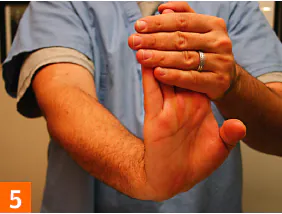
- Gently stretch your fingers and wrists before and after lifting: up to 6 sets of 10 a day, holding each stretch about 15 seconds and resting 30 seconds between stretches.
- Wear padded lifting gloves to protect your hands from calluses, knocks and sudden impact.
- Skip grip trainers, squeeze balls and putty while you are healing. Your grip comes back on its own with normal hand use once the pressure is off the median nerve.
- If you do not have carpal tunnel syndrome but think you may be susceptible, wear the Carpal Solution as a preventive treatment anywhere from one night a week to once every six months.
- If you already have carpal tunnel syndrome, start the Carpal Solution Six Week Nighttime Stretching Therapy developed by doctors. Most people are better from their worst symptoms in two to three weeks.
Wrist Pain After Lifting: A Natural Plan to Heal and Keep Training
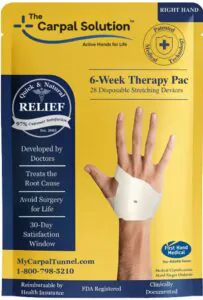
The Carpal Solution is a nighttime passive stretching therapy developed by doctors. You wear it while you sleep, so treating wrist pain from lifting does not take time away from your training. Its targeted passive stretching restores flexibility to the injured soft tissue, relieves pressure on the median nerve, relieves restrictions on blood circulation and lets lymph fluid flow freely to clear out the swelling. It is your body that does the healing; the Carpal Solution just jump-starts the natural healing that excess pressure from inflammation and swelling has held back.
The six-week protocol gives you over 220 hours of targeted stretching. Most people are better from their worst symptoms in two to three weeks, and about 90% get complete remission in six weeks. About 10%, usually people with extra systemic inflammation, are 40 to 70% better at six weeks and reach full remission in 10 to 12 weeks. Over 100,000 people have used the Carpal Solution over two decades, with 97% patient satisfaction over 21 years and 4.9 out of 5 stars on independent review sites like Google Reviews. Many customers come back to reorder it for prevention. See how to apply the Carpal Solution.
Daytime stretching is a bonus that speeds things up if it fits your day, and compression gloves worn during the day can increase blood circulation and protect your hands from everyday bumps. What you should avoid while healing are grip-strengthening gadgets.

Once your symptoms are in remission, aerobic exercise is a better use of your time than extra grip work, and you can return to full training. If symptoms linger, our Persistent Symptoms Protocol adds home techniques such as cold water plunges, deep tissue massage, hydration and deep diaphragm breathing.
A Champion Lifter’s Patient Experience
An amateur powerlifter competing at the international level was told surgery was her only option, with no lifting at all for six weeks, right before her nationals and about two and a half months before the world competition. She used the Carpal Solution every night, noticed a difference by the end of week three, and by week six her hand was fine. In her words: “I could not have even competed without this amazing stretching therapy.” Read her full Patient Experience: Power Lifting Champion “Cures” Carpal Tunnel Without Surgery. For more on training with sore hands, see working out with carpal tunnel, the 10,000 hour rule and carpal tunnel and the yoga instructor’s Patient Experience.
What About Wrist Splints and Surgery?
Splints are the right tool for fractures and sprains, where holding a joint still lets it heal. For carpal tunnel, a splint mostly shields the wrist from painful movement, at two separate costs: unused muscles weaken (muscle atrophy), and restricted blood circulation and lymph flow reduce the nutrients needed for healing and slow the clearing of inflammation, so soft tissue heals more slowly. Use one only for temporary relief, not long term.
For a lifter with wrist pain from lifting, that atrophy is the last thing you want. Read our doctors’ position on wrist splints.
Surgery should be the last resort. Carpal tunnel surgery has a patient satisfaction rate lower than 69%: about 31% of patients report lingering or recurring symptoms afterward, and no patient is satisfied with lingering symptoms. Even after a successful surgery, symptoms often return: in one study, 57% had at least some symptoms come back within 5.5 years (Nancollas, 1995). Our doctors estimate 80 to 90% within 10 years from two decades of clinical experience; that estimate has not been statistically researched. Surgery also means weeks away from the bar. Read recurrence after surgery and 6 Carpal Tunnel Surgery Myths.
When Healing Needs a Doctor’s Help and Professional Medical Evaluation
- Constant numbness that does not improve or loss of feeling in the fingertips that does not improve in 4 to 8 weeks.
- Extreme loss of the muscle at the base of the thumb, with loss of grip strength that does not improve over 6 to 8 weeks.
- Worsening symptoms over 6 to 8 weeks while using the best conservative treatments
- Symptoms that begin suddenly after hand or wrist trauma, a fracture or severe sprain from a fall or auto accident.
- Odd Symptoms that are not consistent with the Carpal Tunnel Symptoms listed on this website, that might be indicative of other nerve issues. A nerve conductivity study can clear up the confusion with minimal costs and not too much pain and no risk.
These signs may mean more advanced nerve involvement or a different condition and deserve professional medical evaluation and in person consultation. Home treatment can be used alongside professional in-person medical care while you wait for the healthcare delivery system to fit you into their schedule. There is no reason to wait doing nothing. You can start proven natural conservative treatment with good patient reviews while you wait for your appointments. If your symptoms start improving over 6 to 8 weeks, then you know you are on the right track and surgery is not necessary.
Wrist Pain From Lifting: FAQ
Can lifting weights cause carpal tunnel?
Heavy, repetitive gripping with the wrist bent under load can trigger carpal tunnel syndrome or make it worse, especially when training volume jumps quickly. Good wrist position, sensible loading and nighttime passive stretching lower the risk.
Is it safe to keep lifting weights with carpal tunnel?
Most people can keep training if they lighten the load, keep the wrists neutral and stop sets that bring on numbness or tingling. Start the Carpal Solution at night so your hands heal while you keep your fitness. See a doctor for the warning signs listed above.
Why do I get wrist pain after lifting?
Wrist pain after lifting usually comes from the wrist being bent back under load, a grip that is tighter than needed, or a sudden jump in weight or volume. If the pain comes with numbness, tingling or night symptoms, the median nerve is likely involved.
How do I stop CrossFit wrist pain?
Scale the movements that hurt, use a wider front-rack grip or push-up handles, warm up with gentle wrist stretches and build volume gradually. If you have carpal tunnel symptoms, add the six-week nighttime protocol.
How long does weightlifting wrist pain take to heal?
A minor strain that causes wrist pain from lifting often settles within days to a few weeks. With carpal tunnel syndrome, most people using the Carpal Solution are better from their worst symptoms in two to three weeks, and about 90% get complete remission in six weeks.
Do I need surgery to get back to lifting?
Usually not. Conservative treatment comes first, and surgery is the last resort. Carpal tunnel surgery has a patient satisfaction rate lower than 69%, and it takes you out of the gym for weeks.
References
- Gelberman RH, et al. The carpal tunnel syndrome: a study of carpal canal pressures. Journal of Bone and Joint Surgery (Am). 1981;63(3):380-383.
- Nicolay RW, Moore LK, DeSena TD, Dines JS. Upper extremity injuries in CrossFit athletes: a review of the current literature. Current Reviews in Musculoskeletal Medicine. 2022;15(5):402-410. PubMed 35867271.
- Brandsema CJ, Mehrab M, Mathijssen NMC. Most common injuries in CrossFit training: a systematic review. International Journal of Sports and Exercise Medicine. 2022;8:228.
- Mehrab M, et al. Risk factors for musculoskeletal injury in CrossFit: a systematic review. International Journal of Sports Medicine. 2023;44(4):247-257.
- Wall BT, et al. Acta Physiologica. 2014. doi:10.1111/apha.12190 (muscle size and strength loss after 14 days of immobilization).
- Nancollas MP, et al. Long-term results of carpal tunnel release. Journal of Hand Surgery (British). 1995;20(4):470-474.
- AMN Healthcare. 2025 Survey of Physician Appointment Wait Times.