 Created by renowned Harvard health care professionals.


Six Week Carpal Tunnel Protocol: The 28-Night Plan, What to Expect and Why It Works
The six week carpal tunnel protocol is a nightly stretching routine that gives soft tissue the time it needs to heal.
Carpal tunnel syndrome is caused by excess inflammation that gets trapped in the carpal tunnel. The trapped swelling puts pressure on the median nerve, causing carpal tunnel symptoms, and it also restricts blood circulation and lymphatic fluid exchange, the main paths your body uses to clear inflammation.
That sets up a cycle that cannot heal itself without a natural treatment to jump-start the healing process and get the swelling moving again. Natural healing takes time, but it is worth it to avoid the risks and downtime of carpal tunnel surgery. For general medical background, see the NINDS fact sheet on carpal tunnel syndrome.

Written by Jeff Conley, President of First Hand Medical · Medically reviewed by Michelle Robin, DC, chiropractor and wellness expert, founder of Your Wellness Connection in Kansas City · Last reviewed: November 2026
Table of Contents
The six week carpal tunnel protocol is the treatment schedule doctors developed for the Carpal Solution: gentle stretching of the hand and wrist at night while you sleep, for 28 nights spread across six weeks. It was worked out through years of treating individual patients, and it fits what most people need to put carpal tunnel symptoms in remission.
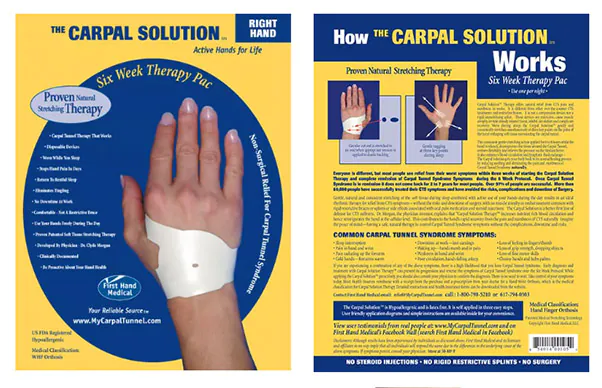
The Carpal Solution was developed by doctors and medical device designers using medical-grade materials to give the soft tissue around the carpal tunnel a steady, gentle stretch. It has 97% patient satisfaction over 21 years, a 4.9 out of 5 star rating, and has been used by over 100,000 people over two decades.

What Is the Six Week Carpal Tunnel Protocol?
You place the Carpal Solution stretching device on your hand before bed and set the tension following the step-by-step application instructions. It takes about a minute the first time and about 20 seconds once you are used to it. You sleep in it for six to eight hours, then take it off in the morning.
Because the stretching happens during sleep, the six week carpal tunnel protocol does not take time out of your day. There is no clinic visit, no downtime from work and nothing to schedule around. Over the six weeks the device delivers over 220 hours of gentle, targeted stretching.
The Schedule: 28 Nights Over 6 Weeks
| Weeks | How often | Nights | Purpose |
|---|---|---|---|
| Weeks 1 and 2 | Every night | 14 | Break the cycle of trapped swelling and start dispersing it |
| Weeks 3 to 6 | Every other night | 14 | Keep the stretch going while the soft tissue heals |
| Total | 28 | Over 220 hours of stretching |
The every-night start matters. In the first two weeks the goal is to get ahead of the swelling that has built up inside the carpal tunnel. Once that cycle is broken, every other night is enough to keep the tissue moving in the right direction while it heals. The nights off give the hand time to recover between stretches.
RIGHT HAND INSTRUCTIONS:
Apply the Carpal Solution before Retiring to Bed in 3 Easy Steps
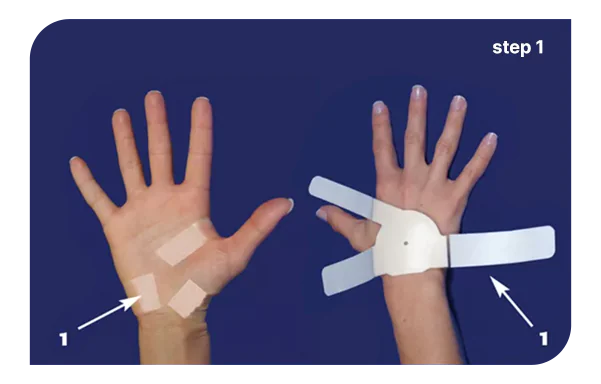
STEP 1: Place the Carpal Solution on the Back of the hand as shown with adhesive side down. Attach 1st strap below little finger securing it on the palm. Tear away excess tape to prevent overlap of straps on palm.
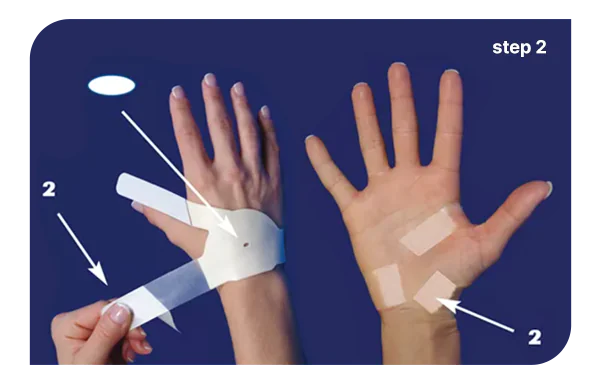
STEP 2: Self apply the appropriate tension to the Carpal Solution with 2nd strap below the thumb and attached on palm side of hand as shown. Adjust tension by stretching circular hole on back of hand in the elastic centerpiece to an oval shape. The diameter should be at least 1.5 times the original.
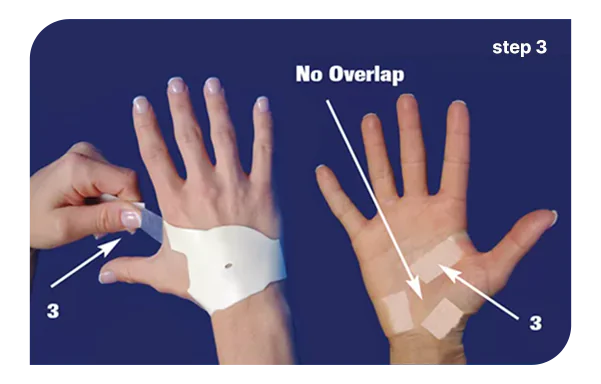
STEP 3: Self apply the appropriate tension to the Carpal Solution with 3rd strap above the thumb. Tear-away straps should be aligned so there is no overlap of straps on palm side of hand. The Carpal Solution begins to relieve symptoms usually within twenty minutes of placement.
Why 28 Nights Fit the Six Week Carpal Tunnel Protocol
So, why only wear it for 28 nights over a six week treatment period which would seem to be 42 nights?
The answer is: 28 Nights of Treatment over 6 Weeks Is Exactly What Most People Need!
Learn more about the Doctors who contributed to the development of the Carpal Solution Treatment System.
People often ask why the kit covers 28 nights rather than 42. The answer is that 28 nights over six weeks is what most people need. Our doctors matched the amount of product to the treatment that works for most patients, which keeps the cost down.
Meet the doctors, surgeons and medical experts who helped develop the Carpal Solution and its protocol. To pair the protocol with daytime stretches, see our day-and-night exercise program.
Why Six Weeks? How Soft Tissue Heals
Carpal tunnel syndrome is a soft tissue problem. The linings of the nine tendons that pass through the carpal tunnel become irritated and swollen from repeated use. The swelling gets trapped in the tight space and presses on the median nerve, and it also restricts blood circulation and lymphatic fluid exchange. That trapped swelling is the root cause of the numbness, tingling and night pain.

Soft tissue heals in stages. After the first few days, the body spends roughly the next six weeks clearing out swelling and laying down new tissue. Sprains and strains follow the same pattern, which is why so many soft tissue injuries take about six weeks to settle. The six week carpal tunnel protocol is built around that window.
Gentle stretching during sleep helps open the carpal tunnel, lets the trapped swelling disperse and restores nutrient-rich blood flow to the injured tissue. Healing is not a straight line. It can take time to break the cycle of swelling, but once you get ahead of it, the body’s ability to clear it speeds up and healing happens faster. Be patient and give your body time. See our carpal tunnel healing timeline for more detail.
5 Stages of Response: What to Expect During the Protocol
Everyone has a different level of inflammation, so people respond on different schedules. Here is how patients typically respond to the six week carpal tunnel protocol:
- First 10 days: about 10 to 15% of patients feel relief from their worst symptoms. Many notice better sleep early on.
- Weeks 2 to 3: about 60 to 70% feel relief from their worst symptoms. Around week 3 is when most people feel the biggest change.
- Weeks 4 to 5: another 10 to 15% feel their worst symptoms ease.
- By week 6: about 90% of people get complete remission in six weeks.
- Weeks 8 to 12: about 10% of people need longer to reach remission.
Once your worst symptoms ease, you know the treatment is working, and you can continue with confidence until you reach full remission.
If You Have Persistent Symptoms
About 10% of people have what doctors call persistent symptoms. These people tend to carry higher levels of inflammation, and it often takes them more than three weeks to start seeing improvement. Once they start getting better, they are usually 40 to 70% better at the end of the six week carpal tunnel protocol.
If that is you, do not stop at six weeks. Continue the Carpal Solution for a total of about 10 to 12 weeks, following the same every-other-night pattern, until you reach remission. People with high overall inflammation simply need a longer course to get ahead of the swelling. If you are unsure whether to continue, call our consultants at 1-800-798-5210.
How to Track Your Progress
Progress is easier to see when you write it down. Keep a simple log during the six week carpal tunnel protocol and check it once a week:
- Night waking. How many times did numbness or pain wake you up?
- Morning numbness. Are your fingers numb or tingling when you wake up, and for how long?
- Pain score. Rate your worst hand and wrist pain from 0 to 10.
- Grip and dropping things. Note any trouble opening jars, holding a cup or buttoning a shirt.
- Daytime triggers. Which activities brought symptoms on, such as typing, driving or holding a phone?
Most people see the night symptoms improve first, then the daytime ones. A week-by-week log shows the trend even when a single bad day makes it feel like nothing is changing.
Bring your log to any doctor visit as well. A clear record of how your night waking, numbness and grip changed over the six weeks gives your doctor far more to work with than a description from memory, and it helps you decide whether to continue for the longer 8-to-12-week course.
7 Tips to Get the Most From the Six Week Carpal Tunnel Protocol
- Do not skip nights in weeks 1 and 2. Steady nightly stretching early on is what breaks the swelling cycle.
- Set the tension correctly. The circle in the elastic centerpiece should stretch into an oval at least 1.5 times its original size.
- Put a reminder by the bed. Keep the kit on the nightstand and mark treatment nights on a calendar for weeks 3 to 6.
- Ease off the heaviest hand work. You do not need to stop working, but shorter sessions and more breaks help while the tissue heals.
- Add gentle daytime stretches. They support what the nightly stretching is doing.
- Keep your log. Weekly notes show progress that is easy to miss day to day.
- Finish the full course. Stopping as soon as you feel better can leave swelling behind. Complete all 28 nights.
After the Protocol: Staying in Remission
Carpal tunnel syndrome is a chronic, recurring condition. After the six week carpal tunnel protocol, symptoms usually stay in remission for 5 to 7 years for most people. Everyone is different, depending on hand use and personal inflammation: some people have gone as long as 17 years between treatments, and others as little as 1 year.
A short prevention treatment helps keep symptoms away. Depending on how hard you use your hands, that can be anywhere from once a week to once every six months. If symptoms do come back, you simply repeat the protocol at home.
The Carpal Solution is the next best thing to a permanent solution for this chronic, recurring condition: a home treatment you can repeat whenever symptoms return, with no downtime, virtually no risks, no scar tissue and no complications.
The Six Week Carpal Tunnel Protocol Compared With Surgery
Medicine starts with conservative treatment, and the six week carpal tunnel protocol is that first step. There is nothing structurally wrong in carpal tunnel syndrome that requires cutting; the problem is trapped swelling, which responds to stretching.
Carpal tunnel surgery has a patient satisfaction rate lower than 69%: about 31% of patients report lingering or recurring symptoms after surgery, and no patient is satisfied with lingering symptoms (Bland, Muscle & Nerve, 2001). A surgery that leaves symptoms behind is not a successful surgery. Second surgeries are needed in 16% to 40% of cases.
Even after a successful surgery, symptoms often come back. How often carpal tunnel symptoms come back after a “successful surgery” has rarely been studied beyond a few years. The highest published rate is 57% of patients with at least some symptoms returning within five and a half years (Nancollas et al., 1995, reviewed in Louie, Earp and Blazar, Hand, 2012).
Based on two decades of clinical experience with patients, our doctors estimate that symptoms return for 80 to 90% of patients within 10 years of surgery. This is not a statistically researched figure. It is their best estimate until the work is done to follow carpal tunnel patients for 10 years or more, as other orthopedic fields do for hip and knee replacements.
Why so little certainty? Published recurrence rates range from about 4% to 57%, a spread that shows how poorly this question has been studied. Studies define recurrence differently, follow patients for only a few years and lose many of them along the way. The lowest figures count only repeat operations, a biased approach that ignores patient satisfaction and the patient’s perspective, so they are not credible. Read more about carpal tunnel recurrence after surgery
Getting to surgery also means waiting for appointments, a nerve test, insurance approval and an opening in a surgeon’s schedule. The average new-patient wait is 31 days (AMN Healthcare, 2025). The six week carpal tunnel protocol can relieve the sleep loss, numbness and pain while you wait. Read about relief while waiting for carpal tunnel treatment. If you have already had surgery, wait 3 months before starting the protocol.
Imagine getting better through your body’s own healing, at home, while you sleep. Follow the six week carpal tunnel protocol consistently, track how your symptoms change from week to week, and learn how the Carpal Solution works.
When Healing Needs a Doctor’s Help and Professional Medical Evaluation
- Constant numbness that does not improve or loss of feeling in the fingertips that does not improve in 4 to 8 weeks.
- Extreme loss of the muscle at the base of the thumb, with loss of grip strength that does not improve over 6 to 8 weeks.
- Worsening symptoms over 6 to 8 weeks while using the best conservative treatments
- Symptoms that begin suddenly after hand or wrist trauma, a fracture or severe sprain from a fall or auto accident.
- Odd Symptoms that are not consistent with the Carpal Tunnel Symptoms listed on this website, that might be indicative of other nerve issues. A nerve conductivity study can clear up the confusion with minimal costs and not too much pain and no risk.
These signs may mean more advanced nerve involvement or a different condition and deserve professional medical evaluation and in person consultation. Home treatment can be used alongside professional in-person medical care while you wait for the healthcare delivery system to fit you into their schedule. There is no reason to wait doing nothing. You can start proven natural conservative treatment with good patient reviews while you wait for your appointments. If your symptoms start improving over 6 to 8 weeks, then you know you are on the right track and surgery is not necessary.
Frequently Asked Questions About the Six Week Carpal Tunnel Protocol
How many nights is the six week carpal tunnel protocol?
28 nights: every night for the first two weeks (14 nights), then every other night for weeks 3 to 6 (14 nights).
Why not wear it every night for all six weeks?
The first two weeks of nightly stretching break the cycle of trapped swelling. After that, every other night keeps the healing going and gives the hand recovery time between stretches. Our doctors found 28 nights is what most people need.
When will I notice a difference?
About 10 to 15% of people feel relief from their worst symptoms in the first 10 days, and most feel the biggest change in two to three weeks. About 90% get complete remission in six weeks by the end of week 6.
What if I am not better after six weeks?
About 10% of people have persistent symptoms and are usually 40 to 70% better at six weeks. Continue the protocol for a total of about 10 to 12 weeks to reach remission.
How long does remission last?
Usually 5 to 7 years for most people, ranging from 1 to 17 years. A prevention treatment from once a week to once every six months helps keep symptoms away.
Can I do the protocol after carpal tunnel surgery?
Yes. Wait 3 months after surgery before starting the six week carpal tunnel protocol.
Can I do daytime exercises during the protocol?
Yes. Gentle daytime stretches pair well with the nightly protocol. See our day-and-night exercise program for a routine.

Order Your Six Week Carpal Tunnel Treatment Now
The ONLY treatment for carpal tunnel that comes with a no questions asked 30-Day Satisfaction Window and in-house dedicated pain relief team.

