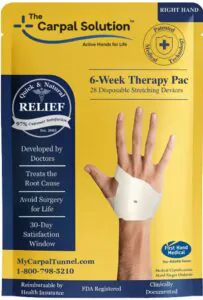
 Created by renowned Harvard health care professionals.


Carpal Solution Mechanism of Action: How This Carpal Tunnel Treatment Works
Carpal tunnel syndrome is caused by entrapped inflammation and swelling that create pressure on the median nerve in the carpal tunnel. The body is normally very good at dispersing excess inflammation and lymph fluid. But once the cycle starts, pressure from the swelling restricts blood flow and lymph fluid transport, the body’s main ways of clearing inflammation, and the syndrome becomes a vicious cycle. The Carpal Solution’s passive stretching restores flexibility to the injured soft tissue, opens up blood circulation and relieves the restricted lymphatic channels, so your body’s natural healing can disperse the inflammation. Most people are better from their worst symptoms in two to three weeks, and over 90% reach remission by 6 weeks.

Written by Julie Sunberg, Director of Marketing and Customer Service at First Hand Medical · Medically reviewed by Joseph E. Scherger, MD, MPH, family physician, clinical professor at UC San Diego School of Medicine and co-chair of the First Hand Medical advisory board · Last reviewed: November 2026
What is the Carpal Solution mechanism of action? In plain terms: it gently stretches and decompresses the soft tissue around the carpal tunnel while you sleep. That relieves pressure on the median nerve, frees blood circulation and lets lymph fluid clear out the swelling, so your body’s natural healing can take over.
This page explains the anatomy behind carpal tunnel and blood flow, walks through a simple skin temperature demonstration our team used to show the effect, and is honest about what that demonstration can and cannot prove.
On this page:
- The Short Answer
- Carpal Tunnel and Blood Flow: The Anatomy
- Cold Hands: A Clue to Blood Flow
- The Skin Temperature Demonstration
- What Our Doctors Concluded
- What the Demonstration Does Not Prove
- Why Splints Work Against Circulation
- What This Means for Your Recovery
- When to See a Doctor
- FAQ
The Carpal Solution Mechanism of Action: The Short Answer
To understand the Carpal Solution mechanism of action, start with pressure, because that is where carpal tunnel syndrome begins. Swelling and entrapped inflammation in the soft tissue in and around the carpal tunnel squeeze the median nerve, and the same pressure can restrict blood flow and lymphatic fluid transport through the area.
The nerve becomes irritated and short of oxygen and compressed by the swelling, which leads to numbness, tingling, pain, weakness and the night waking so many people know too well.
The Carpal Solution is a soft, Hypoallergenic (No Latex) device worn during sleep. It applies a gentle, sustained stretch that decompresses and reshapes the soft tissue around the carpal tunnel for 6 to 8 hours a night. Over the six-week protocol, that adds up to over 220 hours of targeted passive stretching.
The targeted passive stretching restores flexibility to the injured soft tissue and relieves pressure on the median nerve, relieves restrictions on blood circulation and allows free flow of lymph fluid to clear out the swelling naturally. As pressure comes down, blood flows more freely, swelling can disperse, and pressure is relieved off the nerve.
In this way the Carpal Solution restores your body’s natural healing processes. It is your body that does the healing. The Carpal Solution just jump-starts the natural healing that is preempted by the excessive pressure from the excess inflammation and swelling.
That is the Carpal Solution mechanism of action in short: relieve the pressure, restore flexibility to the injured soft tissue, restore blood circulation and lymph flow, and let your body do the healing as it normally would.

The rest of this page on the Carpal Solution mechanism of action shows the reasoning and evidence behind it, starting with the anatomy.
Carpal Tunnel and Blood Flow: The Anatomy
The carpal tunnel is a narrow passage at the base of the palm. Its floor and sides are the small wrist bones, and its roof is a tough band called the transverse carpal ligament. The tunnel cannot stretch outward, so anything that takes up extra room inside it raises the pressure on everything else.
Ten structures share that tight space: the median nerve and nine tendons. Four tendons of the flexor digitorum superficialis, four of the flexor digitorum profundus, and the flexor pollicis longus bend the fingers and thumb. The muscles that drive those tendons are in the forearm, which is why carpal tunnel can bring forearm aching, weakness and, over time, forearm muscle atrophy along with hand symptoms.
When it comes to carpal tunnel and blood flow, blood reaches the hand mainly through the radial and ulnar arteries. The radial artery runs on the thumb side of the wrist, and the ulnar artery runs on the little-finger side through Guyon’s canal, right beside the carpal tunnel. In the palm they join to form the palmar arches that feed the fingers. In some people a third vessel, a persistent median artery, travels through the carpal tunnel itself alongside the median nerve.
The persistent median artery is more common than once thought. A 2025 cadaver study found it in 43% of the arms examined, with 15% being the type that passes through the carpal tunnel into the palm (Ellis et al., PLOS ONE, 2025). Normally this artery fades before birth, so its presence varies from person to person.
The median nerve also has its own tiny blood vessels running inside it. Research going back decades shows that people with carpal tunnel syndrome have higher pressure inside the tunnel than people without it, and that sustained pressure reduces blood flow within the nerve and leads to swelling inside it (Lundborg et al., 1983).
In volunteers, steady pressure of 30 mmHg in the carpal tunnel began to disturb nerve function after about 90 minutes (Lundborg et al., Journal of Hand Surgery, 1982).
Carpal tunnel and blood flow are closely tied: when pressure rises, circulation to and within the nerve suffers.
The same pressure slows the lymphatic drainage that would normally clear swelling away, so swelling and pressure feed each other.
Cold Hands: A Clue to Carpal Tunnel and Blood Flow
Cold extremities are a well-known sign of restricted blood circulation in medicine. When blood vessels are constricted, or even slightly obstructed by outside pressure, less blood reaches the hand or foot. The drop in temperature is most noticeable at the skin surface.
A room at about 70 degrees Fahrenheit (F) is comfortable for normal activity, but it is well below average body temperature of about 98 degrees F. In that setting, if the vessels feeding a hand are constricted and the person is not moving much, the skin of that hand will be cooler and may feel chilled. Many people with carpal tunnel notice exactly this: hands that feel cold, especially at night.
Because skin temperature tracks circulation so closely, it offers a simple, non-invasive window into carpal tunnel and blood flow. That made it a practical way to test the Carpal Solution mechanism of action.
The Skin Temperature Demonstration
Our team relied on this principle to show the Carpal Solution mechanism of action at work. A patient with carpal tunnel syndrome had hand skin temperature monitored before and after the device was applied.
The patient lay completely still, fully clothed, in a comfortable position on an exam table. The arms rested horizontally across the abdomen, with the hand slightly elevated and resting in the air. This steadied metabolic activity and ruled out extra circulation from movement, gravity or body heat. The room was held at a constant 69 degrees F.
To test the Carpal Solution mechanism of action, thermocouples, small temperature sensors, were fastened with surgical tape to the palm of the hand and the underside of the forearm. After five minutes in this position, the starting readings were recorded. Then a Carpal Solution was placed on the hand with carpal tunnel syndrome, and the readings were taken again after twenty minutes.
| Reading | Before the Carpal Solution | After 20 minutes | Change |
|---|---|---|---|
| Palm of the hand | 80.8°F | 85.8°F | +5.0°F |
| Underside of the forearm | 86.4°F | 85.8°F | −0.6°F |
| Gap between forearm and hand | 5.6°F | 0°F | Gap closed |
Before treatment, the hand was 5.6 degrees cooler than the forearm. Twenty minutes after the Carpal Solution was applied, the hand had warmed by five degrees, the forearm had cooled slightly by 0.6 degrees, and both read the same 85.8 degrees F. With the other factors held steady, the most likely explanation is that more blood was reaching the hand, which is exactly what the Carpal Solution mechanism of action predicts.
What Our Doctors Concluded About the Carpal Solution Mechanism of Action
Our doctors concluded that the rapid rise in hand skin temperature came from less restricted blood flow, because external pressure in and around the carpal tunnel had decreased. They suggest that this happens through decompression of the soft tissue around the carpal tunnel, which relieves outside pressure on the arteries. The same decompression frees the flow of lymph fluid, so swelling can clear naturally.
They also concluded that a slight reduction in pressure in the soft tissue around the tunnel, enough to increase blood circulation, will relieve pressure on the median nerve by the same mechanism.
In their words, this is how the Carpal Solution therapy alleviates the pain and symptoms of carpal tunnel syndrome and revitalizes the hand naturally with well-circulated blood that is rich in oxygen and nutrients. It is the body that does the healing; the Carpal Solution jump-starts it by removing the excess pressure that holds healing back.
Our team sees the demonstration as a simple but powerful proof of principle for the Carpal Solution mechanism of action. It supports the potential to decompress and reshape the soft tissue in the hand to relieve pressure on the vessels, nerve and tendons passing through and around the carpal tunnel. Because skin temperature is easy to measure without needles, independent investigators can repeat this test on patients with carpal tunnel syndrome.
What the Carpal Solution Mechanism of Action Demonstration Does Not Prove
A single demonstration of the Carpal Solution mechanism of action on one patient is not a clinical trial. It shows a change in one person under controlled conditions, and it illustrates the proposed mechanism; it does not measure pressure inside the carpal tunnel or blood flow inside the nerve directly. Skin temperature can also be affected by things the setup tried to control, such as room temperature, movement and how long someone has been lying still.
For results across a group of people, see our carpal tunnel clinical study results, where 82% of participants found relief and most improved grip strength in two weeks. For general background on the condition, see the NINDS carpal tunnel syndrome fact sheet, and talk with your doctor about how this applies to you.
Why Splints Work Against Carpal Tunnel and Blood Flow
The Carpal Solution mechanism of action is the opposite of a rigid splint. A splint holds the wrist in a neutral position, which can reduce pain from movement, but it does not promote healing from carpal tunnel syndrome. It causes muscle atrophy and stiffness, and a tight splint compresses the hand, wrist and forearm, restricting blood circulation and lymphatic fluid exchange.
For carpal tunnel and blood flow, that matters because entrapped inflammation is the root cause of carpal tunnel syndrome. Anything that slows the dispersion of swelling and entrapped lymphatic fluid slows natural healing. Our medical team has observed that splints give some relief at first but aggravate symptoms in the long run. Immobilization is great for fractures and sprains, not for carpal tunnel syndrome.
Disuse also weakens muscle quickly. In one study of healthy young men, 14 days in a cast cost about 8% of muscle size and 23% of strength (Wall et al., Acta Physiologica, 2014). For carpal tunnel, that loss lands on the forearm muscles that drive the finger and thumb tendons, and on the thumb muscles the median nerve supplies.

What the Carpal Solution Mechanism of Action Means for Your Recovery
Because the Carpal Solution mechanism of action relieves pressure gradually, night after night, and your body does the healing, recovery follows a steady pattern. Most people are better from their worst symptoms in two to three weeks. About 90% get complete remission in six weeks. About 10% have higher systemic inflammation, are 40 to 70% better at six weeks and reach full remission in 10 to 12 weeks.
| Stage | Schedule | What most people notice |
|---|---|---|
| Weeks 1–2 | Every night | Most people are better from their worst symptoms in two to three weeks. |
| Weeks 3–6 | Every other night | About 90% of people get complete remission in six weeks. |
| Higher inflammation | 10 to 12 weeks | About 10% of people are 40 to 70% better at six weeks and reach full remission in 10 to 12 weeks. |
| After remission | Once a week to once every six months | Prevention nights keep symptoms away. |
Neurologists, including Dr. James S. Zu, MD, PhD, of Edison, New Jersey, call the Carpal Solution a better first line of defense for carpal tunnel syndrome. It has 97% patient satisfaction over 21 years and 4.9 out of 5 stars on independent review sites like Google Reviews, and over 100,000 people have used it over two decades.

Helping Circulation During the Day
Compression gloves worn during the day support carpal tunnel and blood flow too: they can spur natural healing by increasing blood circulation, and they insulate the hand from everyday bumps and bruises. Compression gloves by day with the Carpal Solution at night is one of the best combination therapies.
Daytime stretches are a bonus, not a requirement: up to 6 sets of 10, holding each stretch 15 seconds and resting 30 seconds. While you are healing, skip grip exercises, squeeze balls and putty, which add pressure inside the carpal tunnel. Passive stretching at night does the heavy lifting because it does not depend on daily discipline.
Keeping Symptoms Away
After remission, prevention nights from once a week to once every six months help keep pressure from building again. Remission usually lasts 5 to 7 years for most people, ranging from 1 to 17 years depending on hand use and personal inflammation. If you have had carpal tunnel surgery, wait 3 months after surgery before starting.
How It Compares With Surgery
Surgery cuts the transverse carpal ligament to make more room in the tunnel. It is a much bigger step. Carpal tunnel surgery has a patient satisfaction rate lower than 69%: about 31% of patients report lingering or recurring symptoms, and no patient is satisfied with lingering symptoms. Second surgeries have a patient satisfaction rate between 16% and 40%.
Even after a successful surgery, symptoms often return: 57% had at least some symptoms come back within 5.5 years in one study (Nancollas, 1995, reviewed by Louie et al., 2012), and our doctors estimate 80 to 90% within 10 years from clinical experience (not a statistically researched figure). Surgery should be the last resort.
Many people also face a wait for care; the average new-patient appointment wait is 31 days (AMN Healthcare, 2025). You can start relieving pressure at home while you wait. Read about relief while waiting for carpal tunnel treatment, learn how the Carpal Solution works day to day, or see insurance coverage: it is billed under HCPCS code L3924, many plans reimburse 70 to 80%, and it comes with a 30-Day Satisfaction Window.
When Healing Needs a Doctor’s Help and Professional Medical Evaluation
- Constant numbness that does not improve or loss of feeling in the fingertips that does not improve in 4 to 8 weeks.
- Extreme loss of the muscle at the base of the thumb, with loss of grip strength that does not improve over 6 to 8 weeks.
- Worsening symptoms over 6 to 8 weeks while using the best conservative treatments
- Symptoms that begin suddenly after hand or wrist trauma, a fracture or severe sprain from a fall or auto accident.
- Odd Symptoms that are not consistent with the Carpal Tunnel Symptoms listed on this website, that might be indicative of other nerve issues. A nerve conductivity study can clear up the confusion with minimal costs and not too much pain and no risk.
These signs may mean more advanced nerve involvement or a different condition and deserve professional medical evaluation and in person consultation. Home treatment can be used alongside professional in-person medical care while you wait for the healthcare delivery system to fit you into their schedule. There is no reason to wait doing nothing. You can start proven natural conservative treatment with good patient reviews while you wait for your appointments. If your symptoms start improving over 6 to 8 weeks, then you know you are on the right track and surgery is not necessary.
Carpal Solution Mechanism of Action: FAQ
How does the Carpal Solution relieve carpal tunnel symptoms?
The Carpal Solution mechanism of action is simple: it applies a gentle, sustained stretch during sleep that decompresses the soft tissue around the carpal tunnel. That restores flexibility to the injured soft tissue and relieves pressure on the median nerve and nearby blood vessels, so circulation improves and lymph fluid can clear the swelling. Your body then does the healing.
What is the connection between carpal tunnel and blood flow?
Pressure inside the carpal tunnel is higher in people with carpal tunnel syndrome, and sustained pressure reduces blood flow within the median nerve. So carpal tunnel and blood flow are linked: restoring circulation helps the nerve get the oxygen and nutrients it needs to recover.
Why do my hands feel cold with carpal tunnel?
Cold hands can be a sign of restricted circulation. In our skin temperature demonstration, a hand with carpal tunnel syndrome warmed by five degrees within twenty minutes of applying the Carpal Solution. Cold hands also have other causes, so mention them to your doctor.
Is the skin temperature demonstration a clinical trial?
No. It was a single-patient demonstration under controlled conditions, meant to illustrate the proposed mechanism. Our separate two-week study of 11 people reports group results for sleep and grip strength.
How is this different from a wrist splint?
A splint immobilizes the wrist and can compress the hand and forearm, restricting circulation and causing muscle atrophy. The Carpal Solution stretches and decompresses the soft tissue instead, without holding the wrist rigid.
How long until I notice a difference?
Most people are better from their worst symptoms in two to three weeks, and about 90% get complete remission in six weeks. About 10% are 40 to 70% better at six weeks and reach full remission in 10 to 12 weeks.
RIGHT HAND INSTRUCTIONS:
Apply the Carpal Solution before Retiring to Bed in 3 Easy Steps
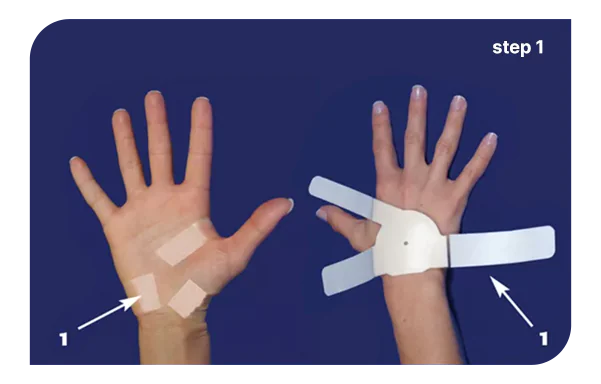
STEP 1: Place the Carpal Solution on the Back of the hand as shown with adhesive side down. Attach 1st strap below little finger securing it on the palm. Tear away excess tape to prevent overlap of straps on palm.
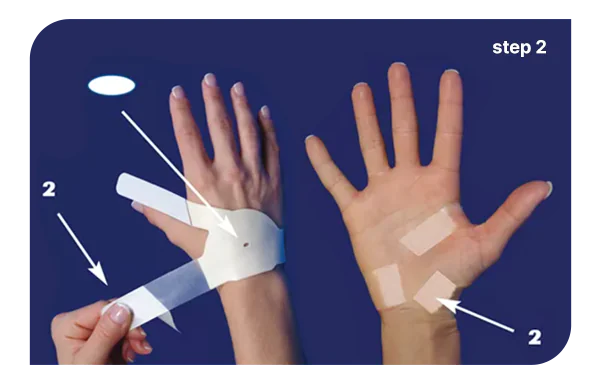
STEP 2: Self apply the appropriate tension to the Carpal Solution with 2nd strap below the thumb and attached on palm side of hand as shown. Adjust tension by stretching circular hole on back of hand in the elastic centerpiece to an oval shape. The diameter should be at least 1.5 times the original.
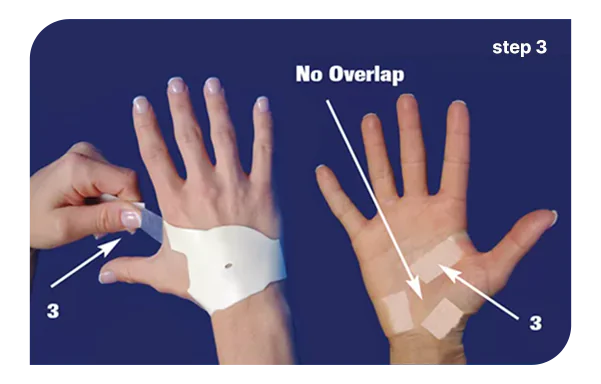
STEP 3: Self apply the appropriate tension to the Carpal Solution with 3rd strap above the thumb. Tear-away straps should be aligned so there is no overlap of straps on palm side of hand. The Carpal Solution begins to relieve symptoms usually within twenty minutes of placement.

Order Your Six Week Carpal Tunnel Treatment Now
The ONLY treatment for carpal tunnel that comes with a no questions asked 30-Day Satisfaction Window and in-house dedicated pain relief team.