 Created by renowned Harvard health care professionals.


Testing for Carpal Tunnel Syndrome: Exams, Self-Tests and Nerve Studies
Testing for carpal tunnel syndrome starts with your symptoms and a quick office exam. Our doctors find that people with three or more classic symptoms can be about 95% confident it is carpal tunnel, though a doctor should still confirm it. Here is how each test works and when you need one.


Written by Julie Sunberg, Director of Marketing and Customer Service at First Hand Medical · Medically reviewed by Joseph E. Scherger, MD, MPH, family physician and clinical professor at UC San Diego School of Medicine · Last reviewed: November 2026
Testing for Carpal Tunnel Syndrome: Where It Starts
Testing for carpal tunnel syndrome usually starts with your symptoms and a physical exam, not a machine. A doctor asks where the numbness and tingling are, when they happen and what makes them worse, then checks the hand and wrist with a few simple maneuvers. Only some people go on to an electrical nerve test, and most of them are people being considered for surgery, because the nerve study is the usual carpal tunnel test before surgery.
This page walks through each kind of testing for carpal tunnel syndrome: the symptom checklist, the office exam, self-tests at home, nerve conduction studies, EMG and ultrasound. It also covers the carpal tunnel test before surgery that many insurers ask for, and what to do while you wait for an appointment. For general medical background, see the NINDS carpal tunnel syndrome fact sheet.
Your Symptoms Are the First Test
Carpal tunnel syndrome has a recognizable pattern. Common signs include numbness or tingling in the thumb, index, middle and part of the ring finger; waking at night with hands that feel asleep; shaking the hands to get feeling back; dropping things; a weaker grip; and aching that can run up into the forearm. The little finger is usually spared, because it gets its feeling from a different nerve.
Our doctors’ two decades of clinical experience is that people with three or more of the symptoms listed on our carpal tunnel symptoms page can be about 95% confident they have carpal tunnel syndrome. That is clinical experience, not a published statistic. You should still get an in-person evaluation and a formal diagnosis from a doctor, and see one promptly for constant numbness, weakness or thinning of the muscles at the base of the thumb.
With that level of confidence, you do not have to put your life on hold while testing for carpal tunnel syndrome is scheduled. You can start a natural, non-invasive treatment developed by doctors, such as the Carpal Solution, while you wait for the appointment.
Clinical Exams in the Doctor’s Office
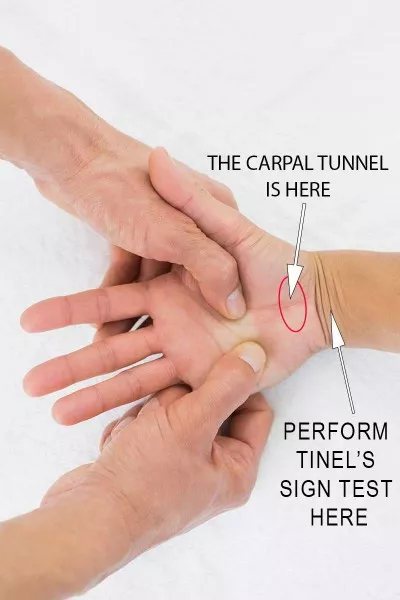
Most testing for carpal tunnel syndrome happens in a regular office visit. The doctor takes a history, looks at both hands, and runs a few quick provocative tests that try to reproduce your symptoms by putting extra pressure on the median nerve.
| Test | What the doctor does | What it suggests |
|---|---|---|
| Tinel’s sign | Taps lightly over the median nerve at the front of the wrist | Tingling shooting into the fingers points to an irritated nerve |
| Phalen’s maneuver | Has you press the backs of your hands together with wrists bent for about a minute | Numbness or tingling in the thumb-side fingers points to carpal tunnel |
| Carpal compression test | Presses a thumb over the carpal tunnel for up to 30 seconds | Symptoms that appear under pressure point to a squeezed nerve |
| Sensation and strength checks | Tests feeling in each fingertip and the strength of the thumb | Lost feeling, weak thumb or thinning thumb muscles suggest a more advanced case |
None of these tests is perfect on its own, which is why doctors read them together with your symptom history. Our page on how carpal tunnel syndrome is diagnosed goes further into the diagnostic process.
Self-Tests You Can Do at Home

Some of the same maneuvers used in testing for carpal tunnel syndrome can be done at home to confirm your intuition before you see a doctor. Phalen’s maneuver is the best known: let your wrists hang bent with the backs of your hands pressed together, and notice whether numbness or tingling shows up in the thumb, index or middle finger within about a minute. You can find step-by-step directions in our self-test for carpal tunnel and our guide to the carpal tunnel self test at home.
A home self-test is a useful first step in testing for carpal tunnel syndrome, but it does not replace an exam. Neck problems, other nerve conditions and arthritis can cause similar feelings, and a doctor can sort those out.
Nerve Conduction Study and EMG

If you want to be absolutely sure about the diagnosis, or if surgery is being considered and you need a carpal tunnel test before surgery, a doctor may refer you to a neurologist for electrodiagnostic testing. Neurologists are medical doctors who specialize in the nerves. There are two parts, and they are often done at the same visit.
A nerve conduction study measures how quickly and how strongly the median nerve carries an electrical signal across the wrist. Small electrodes are placed on the skin, a mild electrical pulse is applied, and the speed of the signal is compared with known standards for a healthy nerve. If the nerve is being squeezed in the carpal tunnel, the signal slows down. The neurologist uses the results to judge how much the nerve is affected, if at all.
An electromyogram (EMG) is a separate test. A thin needle electrode is placed in certain muscles, often the muscles at the base of the thumb, to see whether the nerve supplying them has been damaged. People describe the experience very differently: some say it was uncomfortable or painful, and others say it was no problem.
A normal result does not always rule carpal tunnel syndrome out, especially in mild cases, and an abnormal result tells the doctor how far along the problem is. For more detail, see our article on whether you should get a nerve conduction study.
Ultrasound and Other Imaging
Ultrasound is increasingly used in testing for carpal tunnel syndrome. It is quick, painless and uses no radiation. On ultrasound, a doctor can measure the median nerve and look for the swelling that pressure causes, and can see the structures crowded into the tunnel around it: the median nerve and nine tendons, four flexor digitorum superficialis, four flexor digitorum profundus and the flexor pollicis longus (Journal of Ultrasound, 2012).
Those tendons belong to the forearm muscles that bend your fingers and thumb. That is why carpal tunnel is not only a wrist problem: tight, swollen tendons from overworked forearm muscles take up room the nerve needs, and weakness can show up in the forearm, thumb and fingers. X-rays and MRI are not usually needed, but a doctor may order them to rule out arthritis, a fracture or another cause.
How Reliable Is Testing for Carpal Tunnel Syndrome?
No single test is perfect. Office maneuvers like Tinel’s sign and Phalen’s maneuver are quick and free, but they can be positive in people without carpal tunnel and negative in people who have it. Nerve studies are more objective, yet mild cases can still look normal. Ultrasound depends on the skill of the person holding the probe.
That is why the most reliable testing for carpal tunnel syndrome combines several pieces: your symptom pattern, the physical exam and, when surgery is on the table, the carpal tunnel test before surgery. When those pieces agree, the diagnosis is firm. When they disagree, your doctor may repeat the exam later or look for another cause, such as a pinched nerve in the neck.
For most people, the practical takeaway is simple. Classic symptoms plus a positive office exam are usually enough to start conservative care, and the nerve study matters most if you and your doctor are considering a carpal tunnel test before surgery.
The Carpal Tunnel Test Before Surgery
The most common reason people get a nerve conduction study is that it is the carpal tunnel test before surgery. Many health insurers require a nerve conduction study of the median nerve before they will cover a carpal tunnel release, and surgeons generally want one to confirm the diagnosis and its severity.
The truth is that unless you plan to have carpal tunnel surgery, you usually do not need the carpal tunnel test before surgery at all. Most people with the common symptoms can move forward with natural therapy without waiting for an EMG. The cost varies widely depending on how many nerves are tested and where it is done; health insurance usually covers most of it apart from co-pays and deductibles, so ask your provider for an estimate.
If you are getting a carpal tunnel test before surgery, it is worth knowing how surgery turns out. Carpal tunnel surgery has a patient satisfaction rate lower than 69%: about 31% of patients report lingering or recurring symptoms after surgery, and no patient is satisfied with lingering symptoms. A surgery that leaves symptoms is not a successful surgery. Second surgeries have a patient satisfaction rate of only 16 to 40%. That is why our doctors consider surgery a last resort, after conservative care.
Even after a successful surgery, symptoms often return. The highest published rate is 57% of patients with at least some symptoms returning within five and a half years (Nancollas et al., 1995, reviewed in Louie, Earp and Blazar, Hand, 2012). Based on two decades of clinical experience, our doctors estimate that symptoms return for 80 to 90% of patients within 10 years; this is not a statistically researched figure, but their best estimate until patients are followed for 10 years or more, as other orthopedic fields do for hip and knee replacements.
Why so little certainty? Published recurrence rates range from about 4% to 57%, which shows how poorly the question has been studied. Studies define recurrence differently, follow patients for only a few years and lose many along the way, and the lowest figures count only repeat operations, ignoring the patient’s perspective. Read more about carpal tunnel recurrence after surgery.
The Waiting: What to Do Between Tests
Testing for carpal tunnel syndrome often means waiting: for a first appointment, a referral to a neurologist, the nerve test itself, insurance approval and, for some, an opening in a busy surgeon’s schedule. The average wait for a new-patient physician appointment is 31 days (AMN Healthcare, 2025), and that is before any specialist referral.
The sleep loss, numbness, pain and dropped coffee cups do not wait politely while the paperwork moves. A safe, non-invasive treatment can relieve those symptoms in the meantime. Our guide to relief while waiting for carpal tunnel treatment covers the options, and if your symptoms include constant numbness, weakness or thumb muscle thinning, tell your doctor’s office so they can see you sooner.
After Testing for Carpal Tunnel Syndrome: Starting Treatment

Testing for carpal tunnel syndrome tells you what is happening; it does not fix it. To understand treatment, start with pressure. Swelling and entrapped inflammation in the soft tissue in and around the carpal tunnel squeeze the median nerve and restrict blood flow and lymphatic fluid transport, so the nerve becomes irritated, short of oxygen and compressed.
The Carpal Solution’s targeted passive stretching restores flexibility to the injured soft tissue, relieves pressure on the median nerve, frees blood circulation and lets lymph fluid flow to clear out the swelling. It is your body that does the healing; the Carpal Solution just jump-starts the natural healing that excess inflammation and swelling had shut down. You wear it while you sleep, and the six-week protocol adds up to over 220 hours of targeted stretching.
Most people are better from their worst symptoms in two to three weeks, and over 90% resolve in six weeks. About 10% need 8 to 12 weeks and are usually 50 to 70% better at six weeks. The Carpal Solution has 97% patient satisfaction over 21 years, a 4.9 out of 5 star rating on independent review sites like Google Reviews, and over 100,000 people have used it over two decades. Neurologists, including Dr. James S. Zu, MD, PhD, of Edison, New Jersey, call it “a better first line of defense.”
A splint holds the wrist in a neutral position, which can reduce pain from movement, but it does not promote healing from carpal tunnel syndrome. It causes muscle atrophy and stiffness, and its tight compression restricts blood circulation and lymphatic fluid exchange, slowing the dispersion of entrapped swelling, the root cause of the condition. Immobilization costs muscle fast: healthy adults lost about 8% of muscle size and 23% of strength after 14 days in a cast (Wall et al., 2014).
When Healing Needs a Doctor’s Help and Professional Medical Evaluation
- Constant numbness that does not improve or loss of feeling in the fingertips that does not improve in 4 to 8 weeks.
- Extreme loss of the muscle at the base of the thumb, with loss of grip strength that does not improve over 6 to 8 weeks.
- Worsening symptoms over 6 to 8 weeks while using the best conservative treatments
- Symptoms that begin suddenly after hand or wrist trauma, a fracture or severe sprain from a fall or auto accident.
- Odd Symptoms that are not consistent with the Carpal Tunnel Symptoms listed on this website, that might be indicative of other nerve issues. A nerve conductivity study can clear up the confusion with minimal costs and not too much pain and no risk.
These signs may mean more advanced nerve involvement or a different condition and deserve professional medical evaluation and in person consultation. Home treatment can be used alongside professional in-person medical care while you wait for the healthcare delivery system to fit you into their schedule. There is no reason to wait doing nothing. You can start proven natural conservative treatment with good patient reviews while you wait for your appointments. If your symptoms start improving over 6 to 8 weeks, then you know you are on the right track and surgery is not necessary.
Testing for Carpal Tunnel Syndrome FAQ
Can I test for carpal tunnel at home?
You can do simple self-tests like Phalen’s maneuver, and a symptom checklist is surprisingly informative. Home testing for carpal tunnel syndrome is a starting point, though, and a doctor should confirm the diagnosis.
Is the nerve test painful?
The nerve conduction part uses brief electrical pulses on the skin, and the EMG part uses a thin needle in the muscle. Some people find it uncomfortable or painful and others hardly notice it.
Do I need a carpal tunnel test before surgery?
Usually, yes. Many insurers require a nerve conduction study before they will pay for a carpal tunnel release. If you are not planning surgery, you usually do not need one to start natural treatment.
Can my nerve test be normal if I have carpal tunnel?
Yes. Mild cases can show normal results, so doctors weigh your symptoms and exam along with the test. Normal results with classic symptoms are a reason to keep treating, not to ignore the problem.
Should I wait for test results before starting treatment?
You do not have to. A natural, non-invasive treatment like the Carpal Solution can start while testing for carpal tunnel syndrome is scheduled, unless your doctor tells you otherwise. Keep your appointment so the diagnosis is confirmed.

Order Your Six Week Carpal Tunnel Treatment Now
The ONLY treatment for carpal tunnel that comes with a no questions asked 30-Day Patient Satisfaction Guarantee and in-house dedicated pain relief team.


