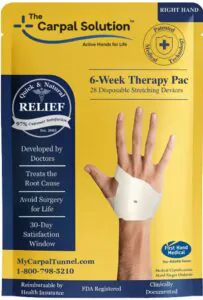
 Created by renowned Harvard health care professionals.


Carpal Tunnel Splints vs. The Carpal Solution: Night-by-Night Results
How bad is your carpal tunnel? Our doctors explain the three levels of carpal tunnel severity, how they are measured, and which treatment fits each, with a night-by-night look at splints vs the Carpal Solution.


Written by Julie Sunberg, Director of Marketing and Customer Service at First Hand Medical · Clinically reviewed by Alan Ward, MOT, OTR, Master Occupational Therapist and Vice President of Precision Rehabilitation · Last reviewed: November 2026
Table of Contents
How bad is your carpal tunnel, and which treatment fits? This guide explains carpal tunnel severity, from mild to moderate to severe, then compares splints with the Carpal Solution night by night. If your symptoms feel worse at night, you are not imagining it.
For a broader comparison beyond splints, see our guide to the Best wrist brace for carpal tunnel.
For many people, bedtime is when the tingling, numbness, burning, and aching become hardest to ignore. That is also why wrist splints are often one of the first things people try. They seem simple, familiar, and easy to wear while sleeping.
But many people find that while splints may help a little at first, the results do not last, and in some cases, symptoms become even more frustrating over time.
Our doctors find that splints can help a bit at first, but immobilizing any limb causes muscle atrophy over time, so rigid splints are best used briefly, for example during heavy lifting. A splint holds the wrist in a neutral position, which can reduce pain from movement, but it does not promote healing from carpal tunnel syndrome. It causes muscle atrophy and stiffness, and its tight compression restricts blood circulation and lymphatic fluid exchange, which slows the dispersion of entrapped swelling, the root cause of carpal tunnel syndrome.
Our medical team has observed that splints give some relief at first but aggravate symptoms in the long run. Immobilization is great for fractures and sprains, but not for carpal tunnel syndrome. In one study, healthy adults lost about 8% of muscle size and 23% of strength after just 14 days in a cast (Wall et al., Acta Physiologica, 2014). For what the research shows about night splints, read Carpal Tunnel Night Splint and Sleep Brace Guide.
That is where The Carpal Solution takes a different approach.
Instead of treating carpal tunnel as just a nerve problem, our doctors see it as a problem of trapped inflammation. In that explanation, inflammation creates pressure that pinches the nerve, reduces healthy blood flow, and blocks lymphatic channels, making it harder for the body to resolve the problem on its own.
This article walks through what happens night by night with splints versus The Carpal Solution, which option may help, and why so many people looking for real relief move beyond restrictive braces.
Carpal Tunnel Severity: Mild, Moderate or Severe?
Carpal tunnel severity is usually described in three levels: mild, moderate and severe. Knowing where you are helps you choose the right treatment, and it explains why a splint may help one person for a few nights and do little for someone else.
Carpal Tunnel Levels: The 3 Levels of Carpal Tunnel Syndrome
- Mild: numbness and tingling in the thumb, index and middle fingers that come and go, often at night or after heavy hand use, and shake out quickly. Strength is normal. See mild carpal tunnel treatment.
- Moderate: symptoms most nights and many days, waking you more than once, with clumsiness, dropping things or a weaker pinch or grip.
- Severe: numbness that stays, pain that limits daily tasks, real weakness, or thinning of the thumb muscles. See muscle atrophy and grip loss.
How Doctors Measure Carpal Tunnel Syndrome Severity
Doctors grade carpal tunnel syndrome severity three ways. Your symptoms come first, often scored with the Boston Carpal Tunnel Questionnaire, a short symptom and hand-function survey developed at Brigham and Women’s Hospital (Levine et al., Journal of Bone and Joint Surgery, 1993) that works as a carpal tunnel severity scale. The exam adds strength, sensation and thumb-muscle checks. Nerve conduction studies and EMG then show how much the median nerve has slowed. The three do not always agree, and in medicine the patient’s experience matters most.
What Is Moderate Carpal Tunnel?
Moderate carpal tunnel syndrome is the level where most people start looking for help: sleep is disrupted, symptoms show up during the day, and there may be early weakness, but the thumb muscles have not wasted. It is also the level where conservative care does its best work, because the soft tissue still responds well once the pressure on the nerve is relieved.
Moderate Carpal Tunnel Treatment
For moderate carpal tunnel treatment, our doctors recommend conservative-first care that follows medicine’s “do no harm” principle. The Carpal Solution relieves pressure on the median nerve with targeted passive stretching while you sleep: about 90% of people get complete remission in 6 weeks, and most are better from their worst symptoms in two to three weeks. A splint can ease pain from movement for a few nights, but it does not promote healing; the night-by-night comparison below shows the difference.
Moderate to Severe Carpal Tunnel
With moderate to severe carpal tunnel, or constant numbness, weakness or thumb muscle thinning, tell your doctor’s office promptly so they can see you sooner. Even then, surgery is not the only option, and it has a patient satisfaction rate lower than 69%. Read about severe carpal tunnel without surgery.
Why Carpal Tunnel Often Feels Worse at Night

Nighttime symptoms are one of the most common complaints with carpal tunnel syndrome. You finally stop moving, try to rest, and suddenly your hand is buzzing, numb, stiff, painful, or weak. Many people wake up and have to shake out their hands just to get temporary relief.
That pattern matters because it shows how ongoing irritation can build into a repeating cycle. The real problem is not just the nerve itself; it is the trapped inflammation surrounding the area, which also interferes with the body’s natural healing response.
The American Academy of Orthopaedic Surgeons lists night splinting among the first nonsurgical treatments people try. For how braces compare with surgery, read Is Carpal Tunnel Surgery Necessary?
What Splints Do at Night
Splints are meant to hold the wrist in a controlled position while you sleep. On the surface, that sounds logical. If wrist position affects symptoms, then keeping the wrist stable should reduce irritation.
And sometimes it does, at least at first.
Splints help in the beginning. But our doctors warn that relying on them long term can work against you, because immobilization leads to muscle atrophy over time.
So the question is not whether a splint can help for a night or two. The real question is whether it is a good long-term answer for a chronic, recurring problem.
Carpal Tunnel Splints vs The Carpal Solution: Night by Night
Here is how carpal tunnel splints vs the Carpal Solution compare over the first few weeks, based on what our doctors and patients have seen over more than two decades. Everyone is different, so use this as a general guide rather than a promise.
Night 1 to Night 3
With a splint:
You may notice some early relief. The wrist feels supported, movement is limited, and nighttime irritation may seem more manageable.
With The Carpal Solution:
You begin using a non-restrictive option designed to help the body address the trapped inflammation pattern underlying carpal tunnel symptoms. Instead of immobilizing the area, it gently stretches the soft tissue at the base of the hand while you sleep, helping to open up circulation and lymph flow. That is why our doctors recommend the Carpal Solution over restrictive splints and other conservative treatments.
Night 4 to Night 7
With a splint:
This is when many people start to realize that support comes with trade-offs. The brace can feel bulky, rigid, awkward, or frustrating to sleep in. It may reduce motion, but it does not necessarily address why symptoms keep returning.
With The Carpal Solution:
This is where the difference in philosophy becomes clearer. The Carpal Solution is a better option for people who do not want to rely on restrictive splints, risky medications, injections or surgery.
Week 2 and Beyond
With a splint:
Relief may plateau. Some people find they are still waking up with numbness or tingling, just with a brace on. Long-term splint use can actually make things worse and is better reserved for situations like heavy lifting, not as an ongoing answer night after night.
With The Carpal Solution:
In our doctors’ two decades of clinical experience, most people get relief of their worst symptoms in two to three weeks, and about 90% get complete remission in six weeks, which delivers over 220 hours of targeted stretching. About 10% of people, those with excess systemic inflammation, are 40 to 70% better at six weeks and reach full remission in 10 to 12 weeks. Remission usually lasts 5 to 7 years for most people, ranging from 1 to 17 years depending on hand use and inflammation.
Why the Carpal Solution Is Different From a Splint
A splint is mainly about restriction. It tries to limit motion.
The Carpal Solution has a different goal. It is designed for people who want relief without depending on restrictive braces or other short-term, invasive, or frustrating treatment options. With the Carpal Solution, you avoid:
- No risky oral pain medication
- No restrictive splints
- No steroid injections
- No carpal tunnel surgery
That makes carpal tunnel splints vs the Carpal Solution more than a comfort comparison. It is really a difference in treatment philosophy.
Do Splints Work for Carpal Tunnel?
Sometimes, for a while. Do splints work for carpal tunnel over the long run? Studies show night splints can ease symptoms in the short term, but they hold the wrist still rather than treating the soft tissue, and immobilization weakens muscles over time. That is the heart of the carpal tunnel splints vs the Carpal Solution question.
Who Nighttime Splints May Help
To be fair, splints are not useless. Splints may help people who:
- Need short-term support
- Want temporary nighttime stabilization
- Are doing heavy lifting and need occasional protection
But even then, splints are not a smart long-term solution.
Who the Carpal Solution Helps
The Carpal Solution may be a better fit for people who:
- Wake up with numbness, tingling, burning, or pain
- Have already tried a wrist splint and felt underwhelmed
- Want something non-invasive
- Want to avoid injections or surgery
- Are tired of treatments that only take the edge off
- Want a more logical approach to a chronic, recurring condition
Who the Carpal Solution May Not Be For
It may not be the best fit for people who:
- Want only temporary symptom masking
- Prefer a rigid brace, no matter the downsides
- Are looking only for a quick fix without consistent use
- Have already decided that surgery is their first and only option
A Simple Usage Walkthrough
How People Often Use a Splint
They strap it on before bed, hope it prevents wrist movement, and see whether symptoms are quieter by morning.
That simplicity is part of the appeal, but it is also the limitation. It is still a restrictive brace, and it is not something to rely on for long-term results.
How People Use the Carpal Solution
They use it as directed as part of a consistent nighttime routine, to address the underlying pattern of trapped inflammation that contributes to their symptoms.
The key difference is expectation. With a splint, the goal is usually temporary control. With The Carpal Solution, the goal is to move toward real relief with a non-invasive approach aligned with how the condition is explained.

The Carpal Solution vs. Traditional Splints
How to Switch From a Splint to the Carpal Solution
- Keep your appointment. If you are waiting to see a doctor, keep the appointment and tell your doctor you are switching from a splint.
- Start on a regular night. Apply the Carpal Solution before bed as directed, and set the tension so it feels like a gentle, comfortable stretch, never painful.
- Wear it every night for six weeks. Consistency is what adds up to over 220 hours of targeted stretching.
- Add daytime stretches if you can. Up to 6 sets of 10, holding each stretch for 15 seconds with 30 seconds of rest. Skip grip, squeeze-ball and putty exercises while you heal.
- Track your nights. Note how often you wake up with numbness. Most people notice their worst symptoms ease in two to three weeks.
- Keep it going. After remission, maintenance nights from once a week to once every six months help keep symptoms away.
What Changes When You Switch
Carpal tunnel splints vs the Carpal Solution is really a choice between holding the wrist still and gently stretching the tissue that is causing the pressure. People who switch often tell us the first difference they notice is comfort: no bulky, rigid shell to fight in bed. The bigger difference comes over weeks, as the stretching helps restore flexibility and circulation in the soft tissue around the carpal tunnel.
Can I Use a Splint During the Day and the Carpal Solution at Night?
For short periods, yes. If a job involves heavy lifting or forceful gripping, a splint can give occasional protection during those tasks. At night, the Carpal Solution does the stretching work while you sleep. Avoid wearing a rigid splint all day, every day, since immobilization weakens the muscles over time.
What If I Have Already Had Carpal Tunnel Surgery?
Wait 3 months after surgery before starting the Carpal Solution, so the surgically disturbed tissue can heal first. After that, it can help with lingering symptoms.
What About Injections and Surgery?
Whichever side of the carpal tunnel splints vs the Carpal Solution choice you lean toward, conservative care comes first, and surgery should be the last resort. Carpal tunnel surgery has a patient satisfaction rate lower than 69%: about 31% of patients report lingering or recurring symptoms, and no patient is satisfied with lingering symptoms (Bland, Muscle & Nerve, 2001). About 8% of patients say they are worse after surgery (Bland, Muscle & Nerve, 2007).
Everyone waits in healthcare, too. The average wait for a new-patient physician appointment is 31 days (AMN Healthcare, 2025). Rather than spend those weeks in a rigid splint, many people start the Carpal Solution while they wait for their appointment. Learn more in The Waiting in Healthcare.
Final Thoughts on Carpal Tunnel Splints vs The Carpal Solution
A wrist splint may seem like the easy nighttime answer, and for a few nights, it may even feel helpful. But that early relief does not make it the right long-term option. Splints are restrictive, may worsen the problem over time, and do nothing to stretch the soft tissue or relieve trapped inflammation.
The Carpal Solution is the stronger choice: a non-invasive treatment with 97% patient satisfaction over 21 years and 4.9 out of 5 stars on independent review sites like Google Reviews. Carpal tunnel is not just something to brace and endure; it is something to understand and address more intelligently. If you are ready to address the root of the problem without restrictive braces, Order The Carpal Solution today.
When you compare Carpal tunnel splints vs The Carpal Solution over a full week, the difference in approach becomes clear. See where night splints rank among the Natural remedies for carpal tunnel our doctors rated.
When Healing Needs a Doctor’s Help and Professional Medical Evaluation
- Constant numbness that does not improve or loss of feeling in the fingertips that does not improve in 4 to 8 weeks.
- Extreme loss of the muscle at the base of the thumb, with loss of grip strength that does not improve over 6 to 8 weeks.
- Worsening symptoms over 6 to 8 weeks while using the best conservative treatments
- Symptoms that begin suddenly after hand or wrist trauma, a fracture or severe sprain from a fall or auto accident.
- Odd Symptoms that are not consistent with the Carpal Tunnel Symptoms listed on this website, that might be indicative of other nerve issues. A nerve conductivity study can clear up the confusion with minimal costs and not too much pain and no risk.
These signs may mean more advanced nerve involvement or a different condition and deserve professional medical evaluation and in person consultation. Home treatment can be used alongside professional in-person medical care while you wait for the healthcare delivery system to fit you into their schedule. There is no reason to wait doing nothing. You can start proven natural conservative treatment with good patient reviews while you wait for your appointments. If your symptoms start improving over 6 to 8 weeks, then you know you are on the right track and surgery is not necessary.