 Created by renowned Harvard health care professionals.


Carpal Solution Treatment Notes: Why a Few Millimeters and the Persistent Median Artery Matter
A few millimeters of extra space in and around the carpal tunnel can matter. These treatment notes explain the clinical observations behind the Carpal Solution, including the persistent median artery.


Written by Jeff Conley, President, First Hand Medical · Medically reviewed by William Shucart, MD, neurosurgeon, clinical professor of neurosurgery at New England Medical Center and former chair of neurosurgery at Tufts · Last reviewed: November 2026
These Carpal Solution treatment notes explain one clinical observation behind the therapy: a few millimeters of extra space in and around the carpal tunnel can matter a great deal for people living with carpal tunnel syndrome. They also cover an anatomy variation many people have never heard of, the persistent median artery, and what the research says about its role.
On this page:
- Why a Few Millimeters Matter
- What Is a Persistent Median Artery?
- What the Research Says
- How the Carpal Solution Creates Space
- Why Splints Do Not Create Space
- What These Notes Mean for Your Treatment
- References
- When to See a Doctor
- FAQ
Carpal Solution Treatment Notes: Why a Few Millimeters Matter
The carpal tunnel is a narrow passage at the base of the palm. Its floor and sides are the small wrist bones, and its roof is the transverse carpal ligament, a tough band that does not stretch outward. Ten structures share this space: the median nerve and nine tendons that bend the fingers and thumb.
Those nine tendons are four from the flexor digitorum superficialis, four from the flexor digitorum profundus, and one from the flexor pollicis longus. The muscles that pull them sit in the forearm, which is why carpal tunnel often brings forearm aching and weakness, and over time forearm muscle atrophy, along with hand symptoms.
When the space is crowded by swelling or entrapped inflammation, the pressure rises on everything inside. Studies have measured higher pressure inside the carpal tunnel in people with carpal tunnel syndrome than in people without it, and sustained pressure reduces blood flow within the median nerve and causes swelling inside it (Lundborg et al., 1983). The nerve is squeezed and starved of oxygen, and numbness, tingling, pain and weakness follow.
The original investigator behind these Carpal Solution treatment notes put it this way: a few millimeters of extra space in and around the carpal tunnel, where important nerves, vessels and tendons work in close proximity, can be the difference between chronic pain and restful relief leading to active vitality.
That idea shapes the whole therapy. The Carpal Solution does not cut anything to make room. It applies gentle, consistent stretching at night to help open space in the soft tissue around the tunnel. You can read more about how the Carpal Solution works and the common causes of carpal tunnel syndrome.
What Is a Persistent Median Artery?
A persistent median artery is a blood vessel that most people lose before birth but some people keep. While a baby develops in the womb, the hand’s blood supply changes in stages. The first main supply comes through the anterior interosseous artery. The median artery, which runs alongside the median nerve through the carpal tunnel, then takes over. Finally the radial and ulnar arteries become the principal blood supply of the hand in most people, and the median artery normally shrinks away.
When the median artery does not shrink away, it is called a persistent median artery. It can stay in the forearm only, or continue through the carpal tunnel into the palm next to the median nerve. In that second pattern it takes up space inside the tunnel.
How large can it be? In a color Doppler ultrasound study, two patients with carpal tunnel syndrome each had a persistent median artery about 3 mm in diameter in the affected hand, confirmed at surgery. Among 50 volunteers without symptoms, 13 people (26%) had one, with an average diameter of only 1.1 mm (Gassner et al., Journal of Ultrasound in Medicine, 2002). In 10 of the 16 hands with the artery, it came with a split or high-dividing median nerve.
A 3 mm artery is nearly three times the average size, and in a tunnel where a few millimeters matter, that extra bulk can add to the crowding. That is why the persistent median artery is a useful example in these Carpal Solution treatment notes.
Persistent Median Artery and Carpal Tunnel: What the Research Says
How common is a persistent median artery? It depends on how and where researchers look. Ultrasound and cadaver studies report a very wide range, from about 2% to 27% in earlier work. A 2025 cadaver study found one in 43% of the arms examined, with 15% being the type that passes through the carpal tunnel into the palm (Ellis et al., PLOS ONE, 2025). Some researchers think the artery is becoming more common over time.
Does it cause carpal tunnel syndrome? Sometimes. Case reports describe sudden, severe carpal tunnel symptoms when a persistent median artery becomes enlarged, clogged by a clot (thrombosed) or calcified. In surgery patients at one large center, a persistent median artery was found in 8.3% of open carpal tunnel releases, and the surgeons noted it can occasionally cause an acute presentation.
For most people, though, simply having the artery does not seem to raise the risk. An ultrasound study of 1,026 wrists in manual laborers found a persistent median artery in 3.7% of wrists and no link with definite carpal tunnel syndrome (Walker et al., 2013). Another study found no difference in how often the artery appeared in people with and without carpal tunnel syndrome.
The honest summary: a persistent median artery may be a contributing factor in some people, especially when it is large, but it is one piece of a bigger picture. The more common driver is swelling and entrapped inflammation in the soft tissue around the tunnel, often from repetitive hand use, and that is what the Carpal Solution is designed to address.
A word of caution: if you have sudden, severe pain, swelling or numbness at the wrist, especially in one hand with no obvious cause, see a doctor promptly. A clotted persistent median artery is rare, but it needs medical evaluation.
How the Carpal Solution Creates Space
The Carpal Solution is a soft, Hypoallergenic (No Latex) device worn during sleep. It applies a gentle, sustained stretch that decompresses and reshapes the soft tissue around the carpal tunnel for 6 to 8 hours a night. Over the six-week protocol, that adds up to over 220 hours of targeted passive stretching.
As pressure in the soft tissue comes down, blood flows more freely, swelling can disperse, and the median nerve gets the room it needs. In a skin temperature demonstration described on our Carpal Solution mechanism of action page, a hand with carpal tunnel syndrome warmed by five degrees within twenty minutes of applying the device, a sign of better circulation.
Whether or not someone has a persistent median artery, the goal is the same: a few more millimeters of breathing room for everything inside the tunnel. Neurologists, including Dr. James S. Zu, MD, PhD, of Edison, New Jersey, call the Carpal Solution a better first line of defense for carpal tunnel syndrome.

Why Splints Do Not Create Space
A splint holds the wrist in a neutral position, which can reduce pain from movement, but it does not promote healing from carpal tunnel syndrome. It causes muscle atrophy and stiffness, and a tight splint compresses the hand, wrist and forearm, restricting blood circulation and lymphatic fluid exchange. That slows the dispersion of swelling and entrapped lymphatic fluid, the root cause of carpal tunnel syndrome.
Our medical team has observed that splints give some relief at first but aggravate symptoms in the long run. Immobilization is great for fractures and sprains, not for carpal tunnel syndrome. In one study of healthy young men, 14 days in a cast cost about 8% of muscle size and 23% of strength (Wall et al., Acta Physiologica, 2014).

What These Carpal Solution Treatment Notes Mean for Your Treatment
These Carpal Solution treatment notes are background information, not a diagnosis. Every hand is different, and a doctor can tell you whether a persistent median artery or another condition is involved. An ultrasound with color Doppler is the usual way to see the artery.
In our clinical experience, if you have three or more classic symptoms, such as night numbness, tingling in the thumb, index and middle fingers, and a weakening grip, it is about 95% likely to be carpal tunnel syndrome. You should still get an in-person evaluation, but you can start a natural, non-invasive treatment while you wait. The average wait for a new-patient appointment is 31 days (AMN Healthcare, 2025); read about relief while waiting for carpal tunnel treatment.
When you start, use the Carpal Solution as directed and be patient while your body adjusts. This is the schedule most people follow:
| Stage | Schedule | What most people notice |
|---|---|---|
| Weeks 1–2 | Every night | Most people are better from their worst symptoms in two to three weeks. |
| Weeks 3–6 | Every other night | About 90% of people get complete remission in six weeks. |
| Higher inflammation | 10 to 12 weeks | About 10% of people are 40 to 70% better at six weeks and reach full remission in 10 to 12 weeks. |
| After remission | Once a week to once every six months | Prevention nights keep symptoms away. |
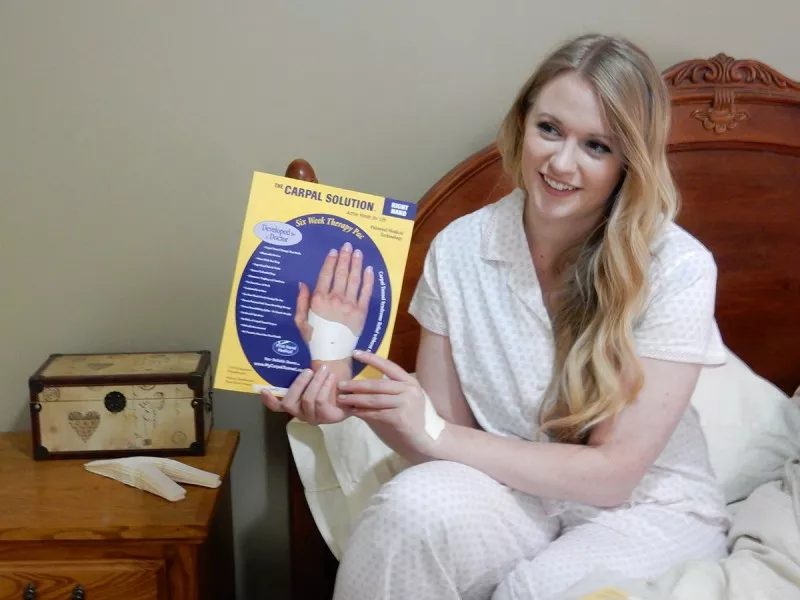
Daytime stretches are a bonus: up to 6 sets of 10, holding each for 15 seconds and resting 30 seconds. While you are healing, skip grip exercises, squeeze balls and putty, which add pressure inside the carpal tunnel. Compression gloves worn during the day can spur natural healing by increasing blood circulation and insulate the hand from everyday bumps and bruises; gloves by day with the Carpal Solution at night is one of the best combination therapies.
Remission usually lasts 5 to 7 years for most people, ranging from 1 to 17 years. If you have had carpal tunnel surgery, wait 3 months after surgery before starting. The Carpal Solution has 97% patient satisfaction over 21 years and 4.9 out of 5 stars, comes with a 30-Day Satisfaction Window, and is billed under HCPCS code L3924; many plans reimburse 70 to 80% (see insurance coverage).
If Surgery Comes Up
During carpal tunnel release, surgeons look for and protect a persistent median artery. Surgery should still be the last resort. Carpal tunnel surgery has a patient satisfaction rate lower than 69%: about 31% of patients report lingering or recurring symptoms, and no patient is satisfied with lingering symptoms. Second surgeries have a patient satisfaction rate between 16% and 40%.
Even after a successful surgery, symptoms often return: 57% had at least some symptoms come back within 5.5 years in one study (Nancollas, 1995, reviewed by Louie et al., 2012), and our doctors estimate 80 to 90% within 10 years from clinical experience (not a statistically researched figure).
Keep these Carpal Solution treatment notes in mind as you follow the nightly routine, and talk with your doctor if your symptoms do not improve. The NINDS fact sheet on carpal tunnel syndrome offers general medical background.
References
Persistent median artery and carpal tunnel pressure
- Gassner EM, Schocke M, Peer S, Schwabegger A, Jaschke W, Bodner G. Persistent median artery in the carpal tunnel: color Doppler ultrasonographic findings. J Ultrasound Med 2002;21:455-61.
- Fumiere E, Dugardeyn C, Roquet ME, Delcour C. US demonstration of a thrombosed persistent median artery in carpal tunnel syndrome.
- Walker FO, et al. Bifid median nerves and persistent median arteries in Latino manual laborers. 2013. PMC3836559.
- Ellis C, Thibault D, Lencke J, Hemric LD. Prevalence and anatomical significance of the persistent median artery: a cadaveric study. PLOS ONE 2025;20(3).
- Lundborg G, Myers R, Powell H. Nerve compression injury and increased endoneurial fluid pressure: a “miniature compartment syndrome.” J Neurol Neurosurg Psychiatry 1983. PMC491778.
- Wall BT, et al. Muscle disuse during immobilization. Acta Physiologica 2014. doi:10.1111/apha.12190.
Conservative treatment options reviewed in the original trial notes
- Gerritsen AA, de Krom MC, Struijs MA, Scholten RJ, de Vet HC, Bouter LM. Conservative treatment options for carpal tunnel syndrome: a systematic review of randomised controlled trials. J Neurol 2002;249:272-80.
- Spooner GR, Desai HB, Angel JF, Reeder BA, Donat JR. Using pyridoxine to treat carpal tunnel syndrome. Randomized control trial. Can Fam Physician 1993;39:2122-7.
- Chang MH, Chiang HT, Lee SS, Ger LP, Lo YK. Oral drug of choice in carpal tunnel syndrome. Neurology 1998;51:390-3.
- Pal B, Mangion P, Hossain MA, Wallace AS, Diffey BL. Should diuretics be prescribed for idiopathic carpal tunnel syndrome? Results of a controlled trial. Clin Rehabil 1988;2:299-301.
- Stransky M, Rubin A, Lava NS, Lazaro RP. Treatment of carpal tunnel syndrome with vitamin B6: a double-blind study. South Med J 1989;82:841-2.
- Herskovitz S, Berger AR, Lipton RB. Low-dose, short-term oral prednisone in the treatment of carpal tunnel syndrome. Neurology 1995;45:1923-5.
- Viera AJ. Management of carpal tunnel syndrome. American Family Physician, July 15, 2003.
When Healing Needs a Doctor’s Help and Professional Medical Evaluation
- Constant numbness that does not improve or loss of feeling in the fingertips that does not improve in 4 to 8 weeks.
- Extreme loss of the muscle at the base of the thumb, with loss of grip strength that does not improve over 6 to 8 weeks.
- Worsening symptoms over 6 to 8 weeks while using the best conservative treatments
- Symptoms that begin suddenly after hand or wrist trauma, a fracture or severe sprain from a fall or auto accident.
- Odd Symptoms that are not consistent with the Carpal Tunnel Symptoms listed on this website, that might be indicative of other nerve issues. A nerve conductivity study can clear up the confusion with minimal costs and not too much pain and no risk.
These signs may mean more advanced nerve involvement or a different condition and deserve professional medical evaluation and in person consultation. Home treatment can be used alongside professional in-person medical care while you wait for the healthcare delivery system to fit you into their schedule. There is no reason to wait doing nothing. You can start proven natural conservative treatment with good patient reviews while you wait for your appointments. If your symptoms start improving over 6 to 8 weeks, then you know you are on the right track and surgery is not necessary.
Carpal Solution Treatment Notes: FAQ
What is a persistent median artery?
It is a blood vessel that supplies the hand before birth and normally shrinks away. In some people it remains, and in some of them it runs through the carpal tunnel beside the median nerve.
Does a persistent median artery cause carpal tunnel syndrome?
Sometimes, especially when it is large, clotted or calcified. Large studies, however, have not found that simply having one raises the risk for most people. Swelling and entrapped inflammation in the soft tissue are the more common cause.
How would I know if I have one?
You would not feel it. A doctor can see it with an ultrasound and color Doppler. Sudden, severe pain or swelling at the wrist needs prompt medical attention.
Can the Carpal Solution help if I have a persistent median artery?
The Carpal Solution works by gently decompressing the soft tissue around the carpal tunnel, which creates room for everything inside, including the nerve and any vessels. Talk with your doctor about your specific anatomy.
Why do a few millimeters matter so much?
The carpal tunnel is rigid and tightly packed with the median nerve and nine tendons. Small increases in swelling raise the pressure on the nerve, and small decreases can bring real relief.
How soon will I notice a difference?
Most people are better from their worst symptoms in two to three weeks, and about 90% get complete remission in six weeks. About 10% are 40 to 70% better at six weeks and reach full remission in 10 to 12 weeks.

Order Your Six Week Carpal Tunnel Treatment Now
The ONLY treatment for carpal tunnel that comes with a no questions asked 30-Day Satisfaction Window and in-house dedicated pain relief team.