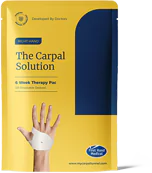
 Created by renowned Harvard health care professionals.


How the Carpal Solution Works: A Gentle Carpal Tunnel Stretcher
The Carpal Solution is a gentle carpal tunnel stretching device worn during sleep. It relieves pressure on the median nerve, frees circulation and lymph flow, and lets your body heal. Here is how it works, how to apply it and what to expect.


Written by Julie Sunberg, Director of Marketing and Customer Service at First Hand Medical · Medically reviewed by Benjamin E. Bierbaum, MD, orthopedic surgeon and clinical professor of orthopedic surgery at Harvard Medical School · Last reviewed: November 2026
This page explains how the Carpal Solution works as a carpal tunnel stretcher, step by step: what it is, how it is worn at night, what the gentle stretching does inside the wrist, and what results to expect. For the overview, see how the Carpal Solution works; for the science, see the Carpal Solution mechanism of action.
On this page:
- What the Carpal Solution Is
- Why Pressure Is the Problem
- How the Stretch Works
- Applying It in Three Steps
- Why Passive Stretching for Carpal Tunnel Works
- Why a Long, Gentle Stretch Works
- Tips for Best Results
- What to Expect, Week by Week
- How It Compares With Splints and Surgery
- When to See a Doctor
- FAQ
What the Carpal Solution Is: A Gentle Carpal Tunnel Stretcher
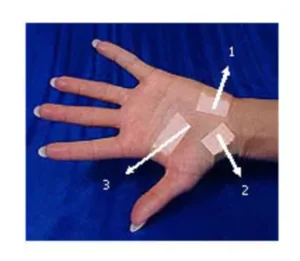
The Carpal Solution was developed by doctors, led by Dr. Clyde E. Morgan, DC, a musculoskeletal expert and co-founder of First Hand Medical. It is a soft, Hypoallergenic (No Latex) carpal tunnel stretching device with an elastic centerpiece that sits on the back of the hand and three tear-away straps that attach on the palm.
Once applied, it gently tugs at three key points on the palm surrounding the carpal tunnel at the same time. You wear it during sleep, for 6 to 8 hours, while the hand is relaxed and in a restorative state. In the morning you take it off and go about your day. There is no rigid plastic, no metal stay and nothing that locks the wrist in place.
Some people call it a carpal tunnel stretcher or a hand stretcher, others a soft carpal tunnel brace or a home remedy for carpal tunnel, because it is used in the comfort of home before bed. Unlike a splint, though, its job is not to hold the wrist still. Its job is to stretch.
Why Pressure Is the Problem
Carpal tunnel syndrome starts with pressure, which is exactly what a carpal tunnel stretching device is designed to relieve. Swelling and entrapped inflammation in the soft tissue in and around the carpal tunnel squeeze the median nerve and restrict blood flow and lymphatic fluid transport through the area. The nerve becomes irritated, short of oxygen and compressed by the swelling, which leads to numbness, tingling, pain, weakness and night waking.
The carpal tunnel is a narrow, rigid passage. It holds the median nerve and nine tendons that bend the fingers and thumb: four flexor digitorum superficialis, four flexor digitorum profundus and one flexor pollicis longus. The muscles that pull those tendons sit in the forearm, which is why carpal tunnel can bring forearm aching, weakness and, over time, forearm and thumb muscle atrophy.
Injured soft tissue also loses flexibility and contracts, pinching the space even more. Once this cycle starts, swelling restricts circulation, poor circulation slows the clearing of swelling, and the syndrome keeps itself going.
How the Carpal Solution Works: The Stretch, Step by Step
As a carpal tunnel stretcher, the Carpal Solution applies consistent, gentle pulling for 6 to 8 hours while the hand is relaxed decompresses and gradually stretches and reshapes the soft tissue around the carpal tunnel. This targeted passive stretching restores flexibility to the injured soft tissue and relieves pressure on the median nerve.
As the pressure comes down, externally constricted blood vessels can return to full blood flow, and lymph fluid can flow freely again to clear out the swelling. Dr. Morgan explains that nutrient-rich, oxygen-rich circulation reinvigorates the hand naturally and helps the body recover. Built-up fluids and swelling from injured tissue can be dispersed.
It is your body that does the healing. The Carpal Solution just jump-starts the natural healing that excess pressure from inflammation and swelling had held back. In a skin temperature demonstration, a hand with carpal tunnel syndrome warmed by five degrees within twenty minutes of applying the device, a sign of better circulation; see the mechanism of action page for details.

Applying the Carpal Tunnel Stretcher in Three Steps
Applying a carpal tunnel stretching device is a little different from anything you have done before, but it takes about a minute once you have done it a few times:
- Place it on the back of the hand, adhesive side down, and attach the first strap below the little finger, securing it on the palm. Tear away excess tape so the straps do not overlap on the palm.
- Set the tension with the second strap, below the thumb, attached on the palm side. Stretch the circular hole in the elastic centerpiece on the back of the hand into an oval at least 1.5 times its original diameter.
- Attach the third strap above the thumb, again keeping the straps from overlapping on the palm.
See the step-by-step pictures and video on how to apply the Carpal Solution. A tip from many users: rest your arm on a pillow at night so the hand stays relaxed.
Why Passive Stretching for Carpal Tunnel Works
Passive stretching for carpal tunnel means the stretch is applied to you, rather than you doing an exercise. That difference matters. Long-term discipline is most people’s weak point: daily exercise routines are easy to skip, especially when hands hurt. Passive stretching for carpal tunnel happens while you sleep, every night, without willpower.
Passive stretching for carpal tunnel also delivers far more stretching than any exercise program could. Over the six-week protocol, the Carpal Solution provides over 220 hours of targeted passive stretching. No other approach can duplicate that consistency in six weeks.
Daytime stretches are a welcome bonus, up to 6 sets of 10, holding each for 15 seconds and resting 30 seconds. While you are healing, skip grip exercises, squeeze balls and putty, which add pressure inside the carpal tunnel. Compression gloves worn during the day can spur natural healing by increasing blood circulation and insulate the hand from everyday bumps and bruises; compression gloves by day with the Carpal Solution at night is one of the best combination therapies.
Why a Long, Gentle Stretch Beats a Short, Hard One
Soft tissue such as ligaments, fascia and the connective tissue around tendons responds to how a stretch is applied, not just how hard. A brief, forceful stretch mostly triggers the body’s protective tension, and the tissue springs back. A light stretch held for hours allows the tissue to relax and lengthen gradually, a property physiologists call viscoelasticity.
That is the principle behind passive stretching for carpal tunnel. The Carpal Solution applies a light, steady load for 6 to 8 hours while the muscles are relaxed in sleep, so the soft tissue around the tunnel can loosen and remodel without strain. Night after night, the small gains add up.
It also explains why a carpal tunnel stretcher worn at night can do what a few minutes of daytime stretching cannot. Five minutes of stretches, done perfectly, is still five minutes. Six to eight hours of gentle tension, every night, is a different dose entirely, delivered while you rest.
Finally, sleep is when the body does much of its repair. Pairing that repair time with relief of pressure on the median nerve, and with freer blood and lymph flow, gives the hand the best conditions to heal. That is how a simple carpal tunnel stretching device can make such a difference to sleep, numbness and grip.

Tips for Getting the Most From Your Carpal Tunnel Stretching Device
- Apply it to clean, dry skin. Lotion and oils weaken the adhesive straps. Wash and dry your hands before bed.
- Check the tension. The circle on the back of the hand should stretch into an oval about 1.5 times its original size. Too loose and the stretch is weak; it should feel gentle, never painful.
- Keep the straps apart on the palm. Overlapping straps can pinch; tear away excess tape so each one lies flat.
- Use a pillow. Resting your forearm on a pillow keeps the hand relaxed so the passive stretching for carpal tunnel can do its work.
- Treat both hands if both are affected. Many people have symptoms in both hands, often worse in the dominant one.
- Stay consistent. The benefit builds night after night. Follow the schedule even after your symptoms start to ease.
- Track your progress. Each morning, note how often your hands woke you and how numb they felt. Seeing the trend keeps you motivated.
Who Uses a Carpal Tunnel Stretching Device
People of every age and job reach for a carpal tunnel stretching device when their hands are their livelihood or their joy: office workers and web designers, dentists and surgeons, musicians, mechanics, hairdressers, new parents and retirees who want to keep gardening, knitting and playing with grandchildren. What they share is a need to keep using their hands without downtime.
Because the stretch is gentle and passive, it also suits people who cannot tolerate rigid splints at night, people who want to avoid medication, and people who are waiting for a doctor’s appointment or trying to stay off the path to surgery. It is safe to repeat whenever symptoms return, which matters for a condition that tends to come back.
When Passive Stretching for Carpal Tunnel May Take Longer
Even with passive stretching for carpal tunnel, about 10% of people have higher systemic inflammation and need 8 to 12 weeks instead of 6. Conditions such as diabetes, thyroid disease or arthritis can slow recovery, and heavy hand use during treatment can too. If you are improving but not finished at six weeks, keep going, and talk with your doctor about any other conditions that may be involved.
What to Expect, Week by Week
| Stage | Schedule | What most people notice |
|---|---|---|
| Weeks 1–2 | Every night | Most people are better from their worst symptoms in two to three weeks. |
| Weeks 3–6 | Every other night | Over 90% of people reach remission by 6 weeks. |
| Higher inflammation | 8 to 12 weeks | About 10% of people are 50–70% better at 6 weeks and need 8 to 12 weeks. |
| After remission | Once a week to once every six months | Prevention nights keep symptoms away. |
After passive stretching for carpal tunnel brings remission, it usually lasts 5 to 7 years for most people, ranging from 1 to 17 years, depending on hand use and personal inflammation. If you have had carpal tunnel surgery, wait 3 months after surgery before starting. Read about the six-week protocol.
Neurologists, including Dr. James S. Zu, MD, PhD, of Edison, New Jersey, call the Carpal Solution a better first line of defense for carpal tunnel syndrome. It has 97% patient satisfaction over 21 years and 4.9 out of 5 stars on independent review sites like Google Reviews, and over 100,000 people have used it over two decades.

Patients often call it their carpal tunnel “cure.” Carpal tunnel syndrome is chronic and recurring and cannot be cured, by surgery or anything else. The Carpal Solution is the next best thing, controlling symptoms at home without downtime, risks, scar tissue or complications.
How a Carpal Tunnel Stretching Device Compares With Splints and Surgery
Splints
A splint holds the wrist in a neutral position, which can reduce pain from movement, but it does not promote healing from carpal tunnel syndrome. It causes muscle atrophy and stiffness, and a tight splint compresses the hand, wrist and forearm, restricting blood circulation and lymphatic fluid exchange. That slows the dispersion of swelling, the root cause of carpal tunnel syndrome.
Our medical team has observed that splints give some relief at first but aggravate symptoms in the long run. In one study of healthy young men, 14 days in a cast cost about 8% of muscle size and 23% of strength (Wall et al., Acta Physiologica, 2014). The Carpal Solution does the opposite: it stretches instead of immobilizing.

Surgery
Surgery cuts the transverse carpal ligament to make more room. Carpal tunnel surgery has a patient satisfaction rate lower than 69%: about 31% of patients report lingering or recurring symptoms, and no patient is satisfied with lingering symptoms. Second surgeries have a patient satisfaction rate between 16% and 40%.
Even after a successful surgery, 57% had at least some symptoms return within 5.5 years in one study (Nancollas, 1995, reviewed by Louie et al., 2012), and our doctors estimate 80 to 90% within 10 years from clinical experience (not a statistically researched figure). Surgery should be the last resort.
Cost and Waiting
The Carpal Solution comes with a 30-Day Patient Satisfaction Guarantee and is billed under HCPCS code L3924; many health insurance plans reimburse 70 to 80% (see insurance coverage). It can start working while you wait for an appointment: the average new-patient wait is 31 days (AMN Healthcare, 2025). Read about relief while waiting for carpal tunnel treatment.
In our doctors’ clinical experience, people with three or more classic symptoms, such as night numbness, tingling in the thumb, index and middle fingers, and dropping things, can be about 95% confident they have carpal tunnel syndrome. Still see a doctor for an evaluation. For general background, see the NINDS carpal tunnel syndrome fact sheet.
When Healing Needs a Doctor’s Help and Professional Medical Evaluation
- Constant numbness that does not improve or loss of feeling in the fingertips that does not improve in 4 to 8 weeks.
- Extreme loss of the muscle at the base of the thumb, with loss of grip strength that does not improve over 6 to 8 weeks.
- Worsening symptoms over 6 to 8 weeks while using the best conservative treatments
- Symptoms that begin suddenly after hand or wrist trauma, a fracture or severe sprain from a fall or auto accident.
- Odd Symptoms that are not consistent with the Carpal Tunnel Symptoms listed on this website, that might be indicative of other nerve issues. A nerve conductivity study can clear up the confusion with minimal costs and not too much pain and no risk.
These signs may mean more advanced nerve involvement or a different condition and deserve professional medical evaluation and in person consultation. Home treatment can be used alongside professional in-person medical care while you wait for the healthcare delivery system to fit you into their schedule. There is no reason to wait doing nothing. You can start proven natural conservative treatment with good patient reviews while you wait for your appointments. If your symptoms start improving over 6 to 8 weeks, then you know you are on the right track and surgery is not necessary.
Carpal Tunnel Stretching Device: FAQ
How does the Carpal Solution work?
It gently tugs at three points on the palm around the carpal tunnel during sleep. The stretch restores flexibility to the soft tissue, relieves pressure on the median nerve, and frees circulation and lymph flow so swelling can clear.
Is it a brace or a splint?
It is a soft carpal tunnel stretching device. It does not immobilize the wrist the way a rigid splint does.
What is passive stretching for carpal tunnel?
A stretch applied to the tissue while you rest, rather than an exercise you perform. The Carpal Solution delivers over 220 hours of it over six weeks.
How long do I wear the carpal tunnel stretching device each night?
About 6 to 8 hours while you sleep: every night for two weeks, then every other night through week six.
How soon will I feel better?
Most people are better from their worst symptoms in two to three weeks, and over 90% reach remission by 6 weeks. About 10% need 8 to 12 weeks.
Can I use it after carpal tunnel surgery?
Yes, after waiting at least 3 months so the surgically disturbed tissue can heal.
RIGHT HAND INSTRUCTIONS:
Apply the Carpal Solution before Retiring to Bed in 3 Easy Steps
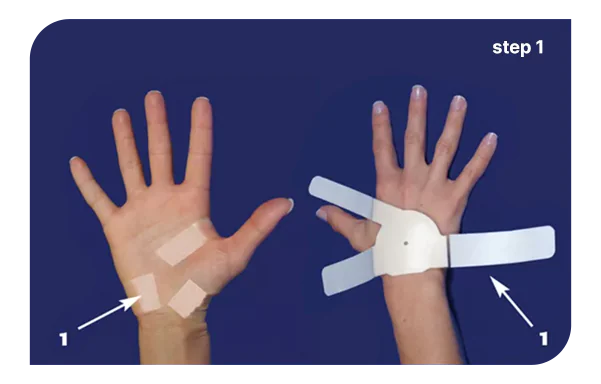
STEP 1: Place the Carpal Solution on the Back of the hand as shown with adhesive side down. Attach 1st strap below little finger securing it on the palm. Tear away excess tape to prevent overlap of straps on palm.
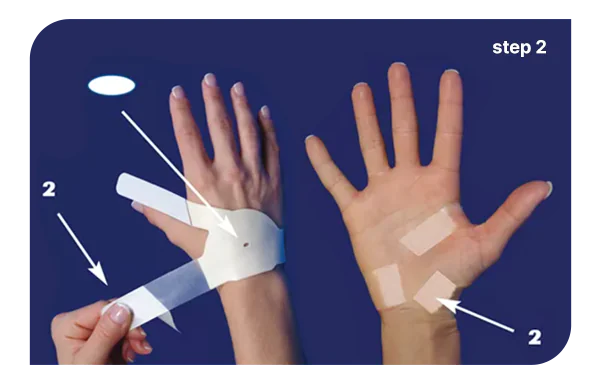
STEP 2: Self apply the appropriate tension to the Carpal Solution with 2nd strap below the thumb and attached on palm side of hand as shown. Adjust tension by stretching circular hole on back of hand in the elastic centerpiece to an oval shape. The diameter should be at least 1.5 times the original.
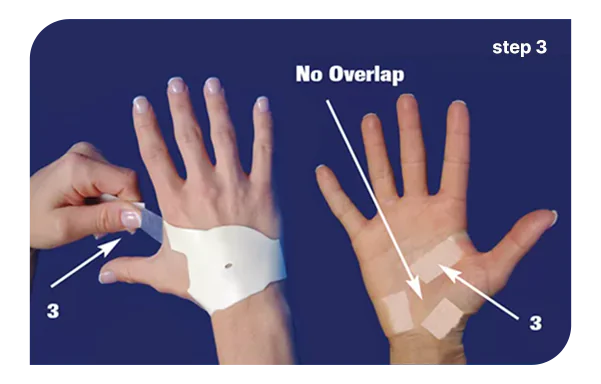
STEP 3: Self apply the appropriate tension to the Carpal Solution with 3rd strap above the thumb. Tear-away straps should be aligned so there is no overlap of straps on palm side of hand. The Carpal Solution begins to relieve symptoms usually within twenty minutes of placement.

Order Your Six Week Carpal Tunnel Treatment Now
The ONLY treatment for carpal tunnel that comes with a no questions asked 30-Day Patient Satisfaction Guarantee and in-house dedicated pain relief team.