Created by renowned Harvard health care professionals.


Worse Before It Gets Better: Why Carpal Tunnel Symptoms Can Flare as Natural Healing Begins
Stretching injured soft tissue to restore flexibility is a key part of natural healing of CTS. In about 8–10% of cases, that stretching can briefly create extra inflammation, so symptoms feel worse before it gets better. The good news is that this is temporary, usually lasting a few days up to a few weeks. Once the soft tissue regains its flexibility, your body disperses the excess inflammation and natural healing speeds up, without the risks, downtime, long rehab and scar tissue that come with carpal tunnel surgery.


Increased Discomfort for a Few Days for 8% of Patients – Before Natural Healing Begins
Written by Jeff Conley, President, First Hand Medical · Medically reviewed by Dr. Clyde E. Morgan, DC, musculoskeletal expert, co-founder of First Hand Medical and inventor of the Carpal Solution · Last reviewed: November 2026
Feeling worse before it gets better can be alarming when you have started a new treatment. This page explains why it happens, who it affects and how long it lasts.
Can carpal tunnel symptoms get worse before they get better? For a small group of people who use The Carpal Solution, the answer is yes, and this page explains why.
About 8-10% of people with Carpal Tunnel who use the Carpal Solution Treatment find that their discomfort increases for a few days up to a few weeks, before they start improving. If your symptoms worsen, ironically, it is actually a signal that the Carpal Solution Therapy is working. The Doctors call this phenomena: “Soft Tissue Transition”.
Don’t lose hope, even though it is frustrating to find your symptoms and discomfort increases for a short time. Within a few days or a maybe up to a couple of weeks you will be on your way to complete recovery without the risks of surgery and you will know it was worth the extra effort.
Below we offer free access to the Doctors’ Protocol for minimizing Soft Tissue Transition and accelerating your recovery. The Doctors recommendations provide some extra steps you can do at home to accelerate your recovery and minimize the discomfort while you go through this transition.
“Effective Carpal Tunnel Treatment requires gentle stretching consistently applied for 224 hours over Six Weeks.
The Carpal Solution is the only way to achieve this type of stretching therapy.”
Feeling a little worse before you feel better is different from a sharp increase in pain, new weakness or numbness that keeps spreading. If you notice any of those changes, stop and check with your doctor. The NINDS carpal tunnel syndrome fact sheet also explains which symptoms are typical of the condition.
It is up to you to decide if you want to keep going with the treatment with worsening symptoms. However there are some important issues to consider.
Most people start the Carpal Solution Treatment with the intent to use a doctor developed treatment that is clinically documented to avoid the downtime, risks and complications of Carpal Tunnel Surgery.
Some people lose hope and give up on the Carpal Solution treatment once their symptoms worsen. Unfortunately for them, they are giving up when the Carpal Solution Treatment is just starting to work. These people that give up face a gauntlet of risks, long rehabilitation and downtime with surgery – only to find that their symptoms come back even after a successful surgery.
Carpal tunnel surgery has a patient satisfaction rate lower than 69%. About 31% of patients report lingering or recurring symptoms after surgery, and no patient is satisfied with lingering symptoms. Most people feel surgery is not worth the risks and downtime if it comes back and repeat surgical procedures are required. Second surgeries for Carpal Tunnel have a patient satisfaction rate between 16% and 40% due to scar tissue formation.
You can learn more about Carpal Tunnel Surgery Here
- 1st Surgeries: Patient Satisfaction Lower Than 69%
- 2nd Surgeries Patient Satisfaction Rate Is Between 16% and 40%
- 3rd Surgeries are not recommended
- CTS comes back for up to 57% of people within about five and a half years. How often carpal tunnel symptoms come back after a “successful surgery” has rarely been studied beyond a few years. The highest published rate is 57% of patients with at least some symptoms returning within five and a half years (Nancollas et al., 1995, reviewed in Louie, Earp and Blazar, Hand, 2012). Based on two decades of clinical experience with patients, our doctors estimate that symptoms return for 80 to 90% of patients within 10 years of surgery. This is not a statistically researched figure. It is their best estimate until the work is done to follow carpal tunnel patients for 10 years or more, as other orthopedic fields do for hip and knee replacements. Why so little certainty? Published recurrence rates range from about 4% to 57%, a spread that shows how poorly this question has been studied. Studies define recurrence differently, follow patients for only a few years and lose many of them along the way. The lowest figures count only repeat operations, a biased approach that ignores patient satisfaction and the patient’s perspective, so they are not credible. Read more about carpal tunnel recurrence after surgery. Getting to surgery also means waiting: for appointments, a nerve test, insurance approval and an opening in a busy surgeon’s schedule. A safe, non-invasive treatment can relieve the sleep loss, numbness and pain while you wait.
Soft tissue Injuries Require Six Weeks to Heal Once Normal Blood Circulation Is Restored.
So, even though it is frustrating to get worse before you get better, all patients that get through this Soft Tissue Transition say it was worth it to get to the other side. Most people’s Carpal Tunnel Symptoms go into remission and they go on with a normal life with no pain, no numbness, and no sleep interruption. Routine sleep interruption is torturous enough with day time drowsiness, brain fog and irritability. However, it can also lead to serious medical conditions such as high blood pressure, stroke, heart disease, and depression if left untreated for more than 3 months.
Watch videos of People telling their experience with Soft Tissue Transition while using the Carpal Solution.
Randy Merrell, Founder of Merrell Foot Wear and leading Medical Pedorthist (Foot Orthotic Expert) and considered the best Custom Boot Maker in the world by Backpacker Magazine, tells his ordeal with Carpal Tunnel and how he experienced more intense discomfort/symptoms for a couple of weeks before he put Carpal Tunnel in complete remission using the Carpal Solution Treatment.
Anthony is a Network Engineer and uses the computer to manage and maintain complicated computing networks throughout the world. He also, is a home improvement enthusiast. He buys homes and fixes them up doing construction in his spare time after work. Here he tells his ordeal with Carpal Tunnel and how he experienced worse symptoms for a week before he put Carpal Tunnel in complete remission with the Carpal Solution Treatment.
As you go through this phase of treatment, it is important to understand what is happening with your hands and wrists.
So, what is Soft Tissue Transition? There are several different types of tissue in and around the Carpal Tunnel collectively known as Soft Tissue. These include, Fascia Tissue, Muscle, Tendons, Tendon Sheaths, Ligaments, etc. Injured soft tissue loses its flexibility and contracts in the tight carpal tunnel space and pinches the nerve. Also, swelling or inflammation is common with injured soft tissue. The inflammatory fluids build up, putting pressure on the nerve and the blood vessels in this narrow area.
Both of these mechanisms put pressure on the Median Nerve and also on the blood vessels restricting blood flow and blocking natural healing.
Stretching always involves some discomfort.
 In some cases (about 8-10%), when you start to gently stretch injured soft tissue, it can generate more inflammation as part of the process of restoring flexibility and your body’s healing process. The increased inflammation puts more pressure on the Median Nerve for a brief period known as the “Soft Tissue Transition”. This is part of the process of restoring flexibility to the soft tissue, restoring circulation and natural healing of the injured soft tissue that causes Carpal Tunnel Syndrome.
Athletes generally do stretching and warm up before an athletic event. The act of stretching healthy tissue can be somewhat uncomfortable, but necessary to prepare for intense athletic activity. Often people rely on athletic trainers to push them to the limit beyond their comfort zone. So, the discomfort associated with the act of stretching is an experience with which most people are somewhat familiar.
It is important to have gentle consistent stretching when dealing with injured tissue. Over stretching the tissue can result in further injury. That is why we have a built in mechanism in the Carpal Solution devices to assure that you cannot over stretch the tissue. The straps will break if you put too much tension.
Also, the elastic backing material is constructed with a circular hole in the middle so that when it is stretched at the optimum level you have an oval shape. By following this intuitive approach to applying tension as you put the Carpal Solution device on at night, you will not apply too much tension. In this way, you apply the ideal tension customized to your size and shape of hand.
The Carpal Solution Treatment stimulates blood circulation and restores normal circulation to the hand and wrist. This is a key to natural healing. In time, sometimes a couple of days, sometimes up to two weeks, the Carpal Solution Treatment will help your body overcome the initial reaction of the injured soft tissue, disperse the increased inflammation and accelerate natural healing and pain relief.
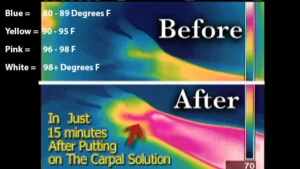
 Thermal Imaging Camera Technology demonstrates how in just 15 minutes after applying the Carpal Solution the patient’s hand and forearm see a pronounce increase in temperature due to an increase in blood circulation.
It is important to keep the end goal in mind of achieving complete relief and putting Carpal Tunnel Syndrome in complete remission without exposing yourself to the risk and potential complications of surgery.
There are some specific things you can do at home to mitigate the discomfort, shorten the Soft Tissue Transition Period and accelerate natural healing without complications.
Carpal Tunnel Worse Before Better: What Is Normal
Feeling your carpal tunnel worse before better is common in the first few nights of treatment. As stretching restores flexibility to tight soft tissue and the swelling starts to move, some people notice more aching or tingling for a short time. It usually settles within the first week or two.
If your carpal tunnel feels worse before better, keep the treatment gentle and consistent, use a cold water plunge to calm the inflammation, and call our customer service team at (800) 798-5210 if you have questions. Symptoms that keep getting worse, or constant numbness or weakness, are a reason to see your doctor.
Like most CTS sufferers, you can get better (97% of patients report satisfaction over two decades, and independent reviews on sites like Google Reviews average 4.9 out of 5 stars) if you are determined to do so.
over 100,000 people have successfully treated their Carpal Tunnel Syndrome with the Carpal Solution Treatment.
Click Here to learn about the Doctor’s Protocol to help you accelerate your recovery, minimize your discomfort and shorten the Soft Tissue Transition Period.
Is It Normal to Get Worse Before It Gets Better?
For a small group of people, yes. Our doctors see it in about 8–10% of patients. The phrase “worse before it gets better” describes something real in soft tissue healing: when tight, swollen tissue starts to loosen and circulation returns, the area can feel more irritated for a while before it settles. Some people call this a healing crisis; our doctors call it the Soft Tissue Transition.
The key is what happens next. In the transition, symptoms rise for a few days up to a few weeks and then begin to fall. That pattern is very different from carpal tunnel simply getting worse over months, which is a reason to see a doctor.
Why Carpal Tunnel Can Get Worse Before Better
Carpal tunnel starts with pressure. Swelling and entrapped inflammation in the soft tissue in and around the carpal tunnel squeeze the median nerve and restrict blood flow and lymphatic fluid transport. When the Carpal Solution’s gentle passive stretching begins to restore flexibility, trapped fluid starts to move and blood flow returns to tissue that has been starved of it. For a short time, that activity can make a sensitive nerve feel more irritated.
It is your body that does the healing; the Carpal Solution just jump-starts the natural healing that excess pressure had blocked. As the swelling clears, the pressure on the nerve drops and symptoms ease.
How Long Does Carpal Tunnel Stay Worse Before It Gets Better?
- Most people: no transition at all. Most people are better from their worst symptoms in two to three weeks; about 90% get complete remission in six weeks.
- About 8–10%: feel worse for a few days up to a few weeks before improving.
- About 10%: often those with more systemic inflammation, are 40 to 70% better at six weeks and reach full remission in 10 to 12 weeks.
Randy Merrell felt more intense symptoms for about two weeks, and Anthony for about a week, before both improved. Their video Patient Experiences are above.
Healing Crisis or Something Else? When Worse Before Better Needs a Doctor
A temporary flare during the first weeks is expected for some people. These signs are different and need a doctor’s attention:
When Healing Needs a Doctor’s Help and Professional Medical Evaluation
- Constant numbness that does not improve or loss of feeling in the fingertips that does not improve in 4 to 8 weeks.
- Extreme loss of the muscle at the base of the thumb, with loss of grip strength that does not improve over 6 to 8 weeks.
- Worsening symptoms over 6 to 8 weeks while using the best conservative treatments
- Symptoms that begin suddenly after hand or wrist trauma, a fracture or severe sprain from a fall or auto accident.
- Odd Symptoms that are not consistent with the Carpal Tunnel Symptoms listed on this website, that might be indicative of other nerve issues. A nerve conductivity study can clear up the confusion with minimal costs and not too much pain and no risk.
These signs may mean more advanced nerve involvement or a different condition and deserve professional medical evaluation and in person consultation. Home treatment can be used alongside professional in-person medical care while you wait for the healthcare delivery system to fit you into their schedule. There is no reason to wait doing nothing. You can start proven natural conservative treatment with good patient reviews while you wait for your appointments. If your symptoms start improving over 6 to 8 weeks, then you know you are on the right track and surgery is not necessary.
Why Getting Through the Soft Tissue Transition Is Worth It
The Carpal Solution has 97% patient satisfaction over 21 years and 4.9 out of 5 stars on independent review sites like Google Reviews, and over 100,000 people have used it over two decades. Neurologists, including Dr. James S. Zu, MD, PhD, of Edison, New Jersey, call it a better first line of defense. Remission typically lasts 5–7 years for most people. For the few who feel worse before it gets better, a few hard nights are a small price compared with the risks and downtime of surgery. For first-night discomfort, see managing discomfort.
Worse Before It Gets Better: FAQ
Does carpal tunnel get worse before it gets better with treatment?
For about 8–10% of people using the Carpal Solution, yes, for a few days up to a few weeks. Most people simply improve.
Is a healing crisis a sign the treatment is working?
A short-term flare as circulation returns is common in soft tissue healing, and our doctors see it as a sign the tissue is responding. Symptoms that keep rising for 6 to 8 weeks are not part of the transition.
Should I stop using the Carpal Solution if I feel worse?
Not usually. Follow the doctors’ protocol for minimizing the Soft Tissue Transition, lower the tension if needed, and contact us. Stop and see a doctor if you have any of the warning signs above.
Can I take something for the discomfort?
Ask your doctor or pharmacist which over-the-counter pain reliever is right for you. Gentle warmth and keeping the wrist straight at night also help.
Is a healing crisis common with carpal tunnel?
No. Most people never have a healing crisis. Only about 8–10% feel worse before it gets better, and for them the soft tissue transition usually passes within a few days to a few weeks.
Why does carpal tunnel feel worse before better for some people and not others?
People with more swelling, longer-standing symptoms or more systemic inflammation are more likely to notice a soft tissue transition, because there is more trapped fluid to clear.
How do I know the transition is over?
Night waking becomes less frequent, numbness fades and grip strength returns, usually within a few weeks.