Created by renowned Harvard health care professionals.


Tennis Players Relieved of Carpal Tunnel: A Player’s Guide
Tennis players need a strong grip and a sensitive touch. Learn how players get relief from carpal tunnel and keep their game on the court.


Written by Jeff Conley, President, First Hand Medical · Clinically reviewed by Alan Ward, MOT, OTR, Master Occupational Therapist and Vice President of Precision Rehabilitation · Last reviewed: November 2026
Tennis professionals and avid players need a strong grip to work their magic on the court. Nothing is more frustrating than building your game to a high level, only to wake up one day without the touch or grip strength to hold the racket firmly, serve with confidence and put away return shots. This guide explains why carpal tunnel in tennis players is so common, how tennis players are relieved of carpal tunnel without giving up the game, and what to avoid.
Table of Contents
Tennis Players Relieved of Carpal Tunnel: Quick Answer
Most tennis players relieved of carpal tunnel get there with conservative care, not surgery. Our doctors recommend nighttime passive stretching with the Carpal Solution, worn during sleep so daytime play and teaching are not interrupted. Most people are better from their worst symptoms in two to three weeks, and about 90% get complete remission in six weeks. Rigid splints are a poor fit for players because immobilization causes muscle atrophy, and surgery, the last resort, has a patient satisfaction rate lower than 69%.

Why Carpal Tunnel in Tennis Players Is So Common
Tennis loads the hand and forearm in ways few other sports do. Every forehand, backhand, serve and volley begins with a firm grip, and a coach or league player may hit hundreds of balls a day. The muscles that power that grip live in the forearm, and their nine tendons pass through the carpal tunnel at the wrist beside the median nerve.
Tennis wrist pain is not always carpal tunnel. Wrist pain from tennis can come from tendons, ligaments or the nerve; numbness and tingling in the thumb and first fingers point to carpal tunnel.
Several features of the game add to the strain:
- Grip pressure. Squeezing the handle tightly through contact, especially on volleys and returns, keeps the flexor tendons working hard.
- Wrist snap. Heavy topspin and wristy serves bend the wrist forcefully under load, many times per session.
- Impact and vibration. Off-center hits, stiff frames and tight strings send shock into the hand and forearm.
- Volume without recovery. Instructors and tournament players often play day after day with little rest for the tissue.
Over time, that repetitive stress inflames the tissue around the tendons. When the swelling becomes trapped inside the tunnel, it presses on the median nerve and restricts the circulation the body needs to clear it. That is the cycle behind carpal tunnel in tennis players, and it is why symptoms often show up first at night, after a long day on court.
The racket hand is usually affected first, but players with a two-handed backhand often notice symptoms in both hands. Work and daily life add to the load: a player who types all day or uses hand tools at work, then plays in the evening, gives the tissue little time to recover. Conditions that promote swelling, such as diabetes, thyroid disease and pregnancy, also make carpal tunnel in tennis players more likely, because the same hours on court produce more trapped swelling.
Signs of Carpal Tunnel in Tennis Players On and Off the Court
- Numbness or tingling in the thumb, index, middle and part of the ring finger
- Waking at night with numb hands and needing to shake them out
- A weaker grip, or the racket twisting or slipping on off-center hits
- Losing “feel” for touch shots, drop shots and volleys
- Aching that runs from the wrist up into the forearm
Carpal tunnel is not the same as tennis elbow, which causes pain on the outside of the elbow; some players have both. In our doctors’ two decades of clinical experience (not a published statistic), people with three or more of the common carpal tunnel symptoms can be about 95% confident they have carpal tunnel syndrome.
Get an in-person evaluation, and with that confidence you can start a natural, non-invasive treatment while you wait. The average wait for a new-patient physician appointment is 31 days (AMN Healthcare, 2025); read more about waiting for carpal tunnel treatment.
This all natural therapy allows people to get back to their active life styles quickly with No Downtime, No Risks and No Complications!
How Tennis Players Are Relieved of Carpal Tunnel Without Missing Court Time
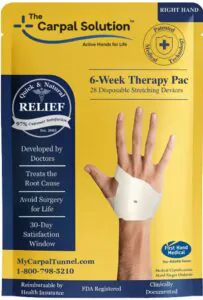
The Carpal Solution was developed by doctors for active people who are too passionate about their sport, hobby or work to give it up. It is not a rigid immobilizing wrist brace, nor is it a common splint. It is a soft, Hypoallergenic (No Latex) device worn during sleep that gently stretches the palm at three key points around the carpal tunnel.
That consistent stretch, applied for 6 to 8 hours while the hand is relaxed, decompresses and reshapes the soft tissue and relieves pressure on the median nerve. Over the six-week protocol it adds up to over 220 hours of targeted passive stretching. Dr. Clyde E. Morgan, its inventor, explains that better circulation of nutrient- and oxygen-rich blood helps disperse lymphatic fluid and supports recovery of injured tissue.
For a player, the rhythm is the point: nighttime stretching combined with normal, active use of the hand during the day. Nothing is immobilized, so there is no muscle atrophy, and the hand rehabilitates through normal use as pain eases. Many tennis players relieved of carpal tunnel, including instructors and pros, rely on it to keep symptoms away despite a heavy playing schedule. It has 97% patient satisfaction over 21 years and 4.9 out of 5 stars on independent review sites like Google Reviews.

Neurologists, including Dr. James S. Zu, MD, PhD, of Edison, New Jersey, call the Carpal Solution a better first line of defense for carpal tunnel syndrome. See how the Carpal Solution works.
Results Timeline for Tennis Players Relieved of Carpal Tunnel
The protocol is applied every night for two weeks, then every other night for four weeks. Most players keep hitting throughout, easing back to full intensity as symptoms settle.
| Stage | Schedule | What most people notice |
|---|---|---|
| Weeks 1–2 | Every night | Most people are better from their worst symptoms in two to three weeks. |
| Weeks 3–6 | Every other night | About 90% of people get complete remission in six weeks. |
| Higher inflammation | 10 to 12 weeks | About 10% of people, usually with excess systemic inflammation, are 40 to 70% better at six weeks and reach full remission in 10 to 12 weeks. |
| In season | Once a week to once every six months | Prevention nights while you keep playing. |
Remission usually lasts 5 to 7 years for most people, but everyone is different. How often you play, how hard you grip and your own systemic inflammation profile all matter; people have gone as long as 17 years and as little as 1 year between treatments. Because the repetitive stress of tennis usually continues, prevention nights are what keep most tennis players relieved of carpal tunnel season after season.
Want to hear it from a player? Read how a Bay Area tennis instructor relieved his carpal tunnel and was back to full days of teaching by the fourth week.
Splints, Injections and Surgery: What Players Should Know
Here is how the common options affect carpal tunnel in tennis players.
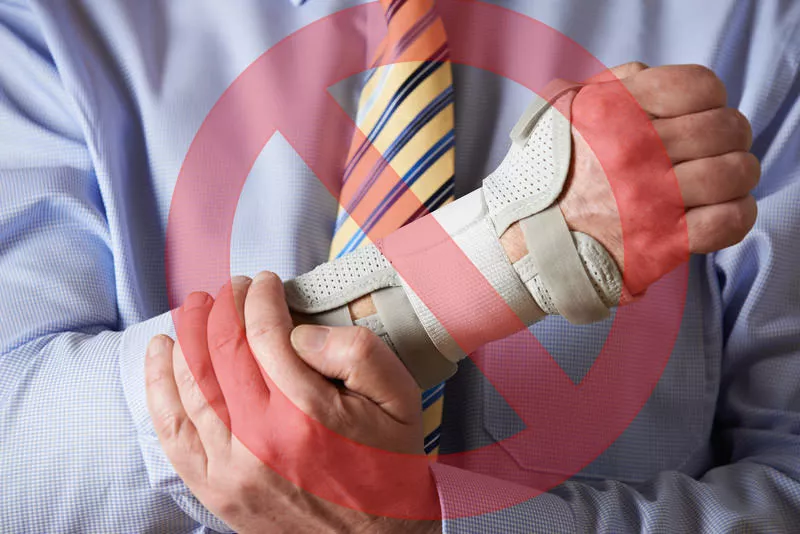
Splints. Splints are the right tool for fractures and sprains, where holding a joint still lets it heal. For carpal tunnel, a splint mostly shields the wrist from painful movement, at two separate costs: unused muscles weaken (muscle atrophy), and restricted blood circulation and lymph flow reduce the nutrients needed for healing and slow the clearing of inflammation, so soft tissue heals more slowly. Use one only for temporary relief, not long term. In one study, healthy adults lost about 8% of muscle size and 23% of strength after 14 days in a cast (Wall et al., Acta Physiologica, 2014). For an athlete who depends on grip strength, that is a steep price.
Our medical team has observed that splints give some relief at first but aggravate symptoms in the long run. Read more about cock-up splints.

Steroid injections. They can calm symptoms quickly, but relief is usually temporary. In a randomized trial, most patients had gone on to surgery within a year whether they received a steroid injection or a placebo (Atroshi and colleagues, 2013).
Surgery. Carpal tunnel surgery has a patient satisfaction rate lower than 69%: about 31% of patients report lingering or recurring symptoms, and no patient is satisfied with lingering symptoms. Some lose grip strength, and recovery takes players off the court. Even after a successful surgery, symptoms often return; 57% had at least some symptoms come back within 5.5 years in one study (Nancollas, 1995), and our doctors estimate 80 to 90% within 10 years from clinical experience (not a statistically researched figure). Read more about recurrence after surgery.
No Rigid Wrist Splints. No Immobilizing Wrist Braces. No Steroid Injections. No Surgery and No downtime. Just all natural relief with the Carpal Solution Therapy.
Equipment and Technique Tips to Ease Carpal Tunnel in Tennis Players
Treatment does the main work for tennis players relieved of carpal tunnel, but a few changes reduce the load on your hands while you heal and help keep symptoms away afterward:
- Relax your grip between shots and hold the handle only as firmly as contact requires.
- Check your grip size. A handle that is too small makes you squeeze harder; ask a pro to check yours.
- Soften the stringbed with a lower tension or softer string, and consider a vibration dampener.
- Keep the wrist quieter on serves and groundstrokes, generating power from the legs and trunk.
- Build volume back gradually after a flare-up, and take rest days between heavy sessions.
- Skip grip-strengthening and squeeze-ball drills while healing. Gentle daytime stretches (up to 6 sets of 10, holding each for 15 seconds with 30 seconds of rest) are a bonus.
An occupational therapist or teaching pro can watch your strokes and suggest changes specific to your game.
A simple warm-up and recovery routine
Before you play, spend a few minutes warming the hands and forearms: open and close the hands slowly, make gentle wrist circles, and stretch the fingers back one at a time without forcing them. Start the session with mini-tennis or easy rallies rather than full serves. After you play, let the hands rest, keep them warm, and avoid gripping heavy bags or tools right away. On heavy days, the Carpal Solution at night does the deeper work of stretching the soft tissue while you recover.
For coaches and teaching pros
Carpal tunnel in tennis players who teach is especially common, because teaching pros hit for hours with little rest, often feeding balls from a basket with the same wrist motion over and over. Spread feeding between hands when you can, mix in drills where students do more of the hitting, schedule short breaks between lessons, and watch for night numbness as an early warning. Many instructors treat early and use prevention nights through the busy season so they never have to cancel lessons.
Pickleball, Padel and Other Racket Sports
The same pattern behind carpal tunnel in tennis players shows up in pickleball, padel, squash, racquetball and badminton. Pickleball in particular has drawn many new and returning players, often adults who have not gripped a paddle for hours a day before. Firm grips, quick wrist flicks at the kitchen line and long sessions on hard courts can inflame the tissue around the flexor tendons just as tennis does.
The approach that gets tennis players relieved of carpal tunnel works here too: recognize the early signs, ease the grip, build volume gradually and treat the trapped swelling early with nighttime stretching rather than playing through numbness.
Getting Back on the Court
Carpal tunnel in tennis players is chronic and recurring, so the goal is control with the least interruption to your game, your work and your sleep. Tennis players relieved of carpal tunnel through conservative care keep a reliable, natural treatment ready for the next flare-up, without downtime, surgical risks or scar tissue.
The Carpal Solution comes with a 30-Day Satisfaction Window, is billed under HCPCS code L3924, and many health insurance plans reimburse 70 to 80%. For general background, see the NINDS carpal tunnel syndrome fact sheet, and talk with your doctor about any numbness or loss of grip.
When Healing Needs a Doctor’s Help and Professional Medical Evaluation
- Constant numbness that does not improve or loss of feeling in the fingertips that does not improve in 4 to 8 weeks.
- Extreme loss of the muscle at the base of the thumb, with loss of grip strength that does not improve over 6 to 8 weeks.
- Worsening symptoms over 6 to 8 weeks while using the best conservative treatments
- Symptoms that begin suddenly after hand or wrist trauma, a fracture or severe sprain from a fall or auto accident.
- Odd Symptoms that are not consistent with the Carpal Tunnel Symptoms listed on this website, that might be indicative of other nerve issues. A nerve conductivity study can clear up the confusion with minimal costs and not too much pain and no risk.
These signs may mean more advanced nerve involvement or a different condition and deserve professional medical evaluation and in person consultation. Home treatment can be used alongside professional in-person medical care while you wait for the healthcare delivery system to fit you into their schedule. There is no reason to wait doing nothing. You can start proven natural conservative treatment with good patient reviews while you wait for your appointments. If your symptoms start improving over 6 to 8 weeks, then you know you are on the right track and surgery is not necessary.
Carpal Tunnel in Tennis Players: FAQ
How are tennis players relieved of carpal tunnel?
Most do it with conservative care: nighttime passive stretching with the Carpal Solution, normal hand use during the day, a relaxed grip and gradual return to full volume. Most people are better from their worst symptoms in two to three weeks.
Can I keep playing tennis with carpal tunnel?
Many tennis players relieved of carpal tunnel kept playing while treating it, as long as symptoms allowed. Ease off if numbness worsens during play, and see a doctor for constant numbness or weakness.
Is carpal tunnel in tennis players the same as tennis elbow?
No. Tennis elbow causes pain on the outside of the elbow. Carpal tunnel causes numbness, tingling and weakness in the thumb and first fingers.
Should tennis players wear a wrist brace?
Our doctors do not recommend rigid splints long term. A splint can reduce pain from movement but does not promote healing, and immobilization causes muscle atrophy and weaker grip.
Does pickleball cause carpal tunnel?
It can contribute, the same way tennis does, through firm gripping, wrist motion and long sessions. The same treatment approach applies.
How long before I can play at full intensity?
Most players ease back as symptoms settle, often in two to three weeks, and build to full volume over the six-week protocol. Results vary; let symptoms guide you.
Is the Carpal Solution covered by insurance?
Many plans reimburse 70 to 80% under HCPCS code L3924, and it comes with a 30-Day Satisfaction Window.
Sources
- National Institute of Neurological Disorders and Stroke. Carpal Tunnel Syndrome fact sheet.
- Wall BT et al. Muscle disuse during immobilization. Acta Physiologica, 2014. doi:10.1111/apha.12190.
- Atroshi I et al. Methylprednisolone injections for the carpal tunnel syndrome: a randomized, placebo-controlled trial. Annals of Internal Medicine, 2013.
- Bland JDP. Patient-reported outcome of 1,268 carpal tunnel operations. Muscle & Nerve, 2001. PubMed 11410921.
- Louie D, Earp B, Blazar P. Long-term outcomes of carpal tunnel release: a critical review of the literature. Hand, 2012 (reviews Nancollas 1995). PMC3418353.
- AMN Healthcare. 2025 Survey of Physician Appointment Wait Times.

Order Your Six Week Carpal Tunnel Treatment Now
The ONLY treatment for carpal tunnel that comes with a no questions asked 30-Day Satisfaction Window and in-house dedicated pain relief team.