Created by renowned Harvard health care professionals.


Hand Cramps: Why Your Hands Cramp and Lock Up, and What Helps
Hand cramps are sudden, painful tightening of the muscles that curl the fingers and thumb, most often from overuse, dehydration or low minerals. Our doctors also see them with carpal tunnel, when trapped swelling slows circulation to the hand and forearm. Here are the causes, when to worry, and relief that restores circulation.


Hand Cramps: Our Doctors’ Short Answer
Written by Julie Sunberg, Director of Marketing and Customer Service at First Hand Medical · Clinically reviewed by Alan Ward, MOT, OTR, Master Occupational Therapist and VP of Precision Rehabilitation, Blanding, Utah · Last reviewed: November 2026
Hand cramps are sudden, painful tightening of the muscles that curl your fingers and thumb. Most are harmless and come from overuse, dehydration or low minerals. Our doctors also see hand cramps again and again in people with carpal tunnel, because trapped swelling at the wrist slows the circulation that hand and forearm muscles need to relax. Their approach is simple: give the muscles fluids, minerals and circulation, not more hard gripping.
On This Page
- Usually harmless. Overuse, dehydration and low magnesium, potassium or calcium top the list.
- The forearm is involved. The muscles that curl the fingers live in the forearm, so a hand cramp often starts above the wrist.
- Carpal tunnel can feed cramps by restricting blood flow and lymph transport in the hand and forearm.
- Know the warning signs. Cramps with weakness, muscle wasting, constant numbness or spasms all over the body need a doctor.
- Relief: open the fingers gently, rub the forearm, rehydrate, take breaks and restore circulation at night.
What Hand Cramps Are: Why Your Hand Curls and Tightens
A muscle cramp is a sudden, involuntary and usually painful contraction of a muscle or a group of muscles. In the hand, it pulls the fingers into a curl or a claw, or locks the thumb across the palm, and it can last from a few seconds to several minutes.
Two groups of muscles move your fingers. The small muscles inside the hand fine-tune pinch and grip, and the large finger and thumb flexors live in the forearm, sending nine tendons through the carpal tunnel. That is why finger cramps often come with tightness or a knot in the forearm, and why rubbing the forearm can release a cramp in the hand.
Hand Spasms, Finger Cramps and Thumb Cramps
Hand spasms is the everyday name for the same thing: muscles that tighten on their own. Finger cramps usually curl one or more fingers toward the palm. Thumb cramps pull the thumb across the palm and often start in the thumb pad, where the thenar muscles sit; see our guide to thenar eminence pain. Spasms that last much longer and spread through the body are different, and they are covered below.
Hand Cramps Causes: 8 Common Reasons Your Hands Cramp
Muscle cramps are often idiopathic, meaning no single cause is found. Dehydration, electrolyte imbalances, medications, overexertion and some medical conditions are common triggers. These are the hand cramps causes our doctors look at first:
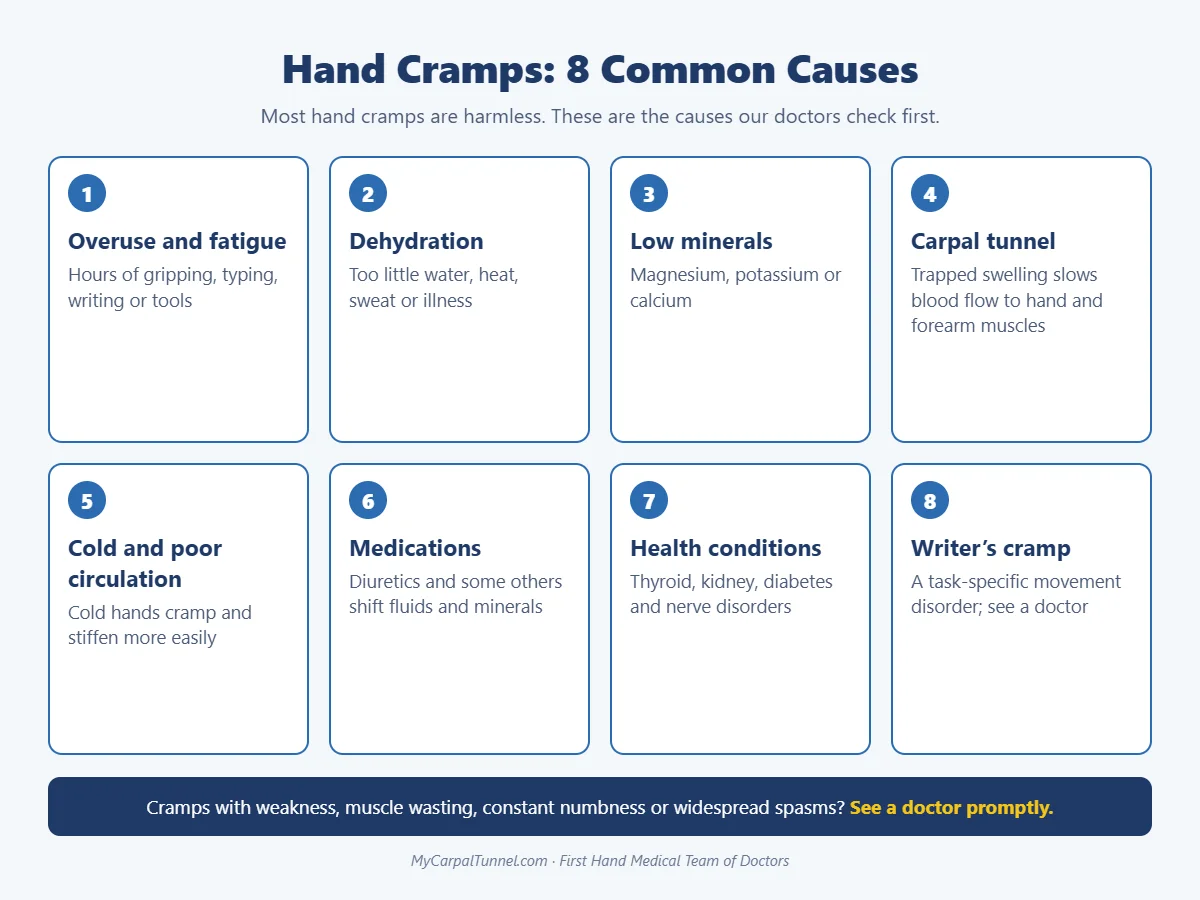
- Overuse and fatigue. Hours of gripping, typing, writing, gaming or using tools tire the hand and forearm muscles until they cramp.
- Dehydration. Heat, sweating, illness and simply not drinking enough leave muscles prone to cramping.
- Low minerals. Low potassium, magnesium or calcium in the blood can trigger cramps.
- Carpal tunnel syndrome. Trapped swelling at the wrist slows blood flow to the hand and forearm muscles.
- Cold and poor circulation. Cold hands stiffen and cramp more easily.
- Medications. Some diuretics and other drugs shift fluids and minerals.
- Health conditions. An underactive thyroid, kidney disease, diabetes and nerve disorders can all cause cramps.
- Writer’s cramp. A task-specific movement disorder, covered below.
Who Gets Hand Cramps Most Often?
- Computer workers and gamers. Hours of clicking, typing and gripping a controller tire the small hand muscles and the forearm flexors. See our gamer and esports guide.
- Musicians, hairstylists, dental hygienists and tradespeople. Repeated pinching and fine control with little rest set up cramps and carpal tunnel alike. Find your profession in who is at risk for carpal tunnel.
- Athletes. Climbers, cyclists, rowers and lifters cramp when they grip hard while sweating and low on fluids.
- Pregnant women. Fluid shifts and lower electrolyte levels late in pregnancy can bring on cramps, and the same swelling can squeeze the median nerve. See pregnancy and carpal tunnel syndrome.
- Middle-aged and older adults. Muscle cramps of all kinds become more common with age, and so do the medications and conditions that cause them.
Whatever your hands do all day, the fix starts the same way: more rest breaks, more fluids, gentler grip, and better circulation.
What Deficiency Causes Hand Cramps? Dehydration and Minerals
The usual answer to what deficiency causes hand cramps is low levels of potassium, magnesium or calcium in the blood. Low electrolyte levels can come from some diuretics, alcohol use disorder, certain hormonal disorders, vitamin D deficiency, or illnesses that cause loss of fluids. Electrolyte levels can also run low late in pregnancy.
Hand Cramps and Dehydration
Hand cramps dehydration is a common pairing after a hot day, hard exercise, a stomach bug, or a long day of work without enough water. Vomiting, diarrhea, heavy sweating and diuretics all drain fluids and minerals at the same time. Drink water through the day, and replace minerals after heavy sweating.
Food First
- Magnesium: leafy greens, nuts, seeds, beans and whole grains
- Potassium: bananas, potatoes, beans, avocados and yogurt
- Calcium: dairy, fortified plant milks, canned salmon and leafy greens
If cramps keep coming back, ask your doctor for a simple blood test before taking supplements, especially if you have kidney disease or take a diuretic. An anti-inflammatory way of eating helps the hands too; see the Carpal Solution Diet.
Hand Cramps and Carpal Tunnel: The Circulation Connection
Carpal tunnel starts with pressure. Swelling and entrapped inflammation in the soft tissue in and around the carpal tunnel squeeze the median nerve and restrict blood flow and lymphatic fluid transport. The hand and forearm muscles downstream get less oxygen and fewer nutrients, tire faster and cramp more easily, especially at night, when wrists curl and fluid pools. A squeezed median nerve also sends mixed signals to the thumb muscles, so thumb cramps, weakness and dropping things often travel together.
Elijah, a logistics expert and gamer in New Jersey, had cramping at night that got him out of bed to raise his hands, along with pinching in his hands, forearm and shoulder. Read Elijah’s Patient Experience.
If carpal tunnel is behind your hand cramps, surgery is the last resort. Carpal tunnel surgery has a patient satisfaction rate lower than 69%, because about 31% of patients report lingering or recurring symptoms after surgery, and no patient is satisfied with lingering symptoms. Our doctors recommend trying a well-reviewed conservative treatment for at least 12 weeks first, and you can start while you wait for carpal tunnel treatment.
Why Do My Hands Cramp and Lock Up?
During a true cramp, the finger muscles contract and stay contracted, so the hand locks into a curl or claw until the cramp releases. Gently opening the fingers and rubbing the forearm usually lets go within a minute or two.
Other kinds of locking are different and deserve a doctor’s look:
- A finger that catches, clicks or sticks bent and snaps straight is a tendon problem, not a cramp.
- Spasms throughout the body that last longer than a cramp, sometimes with twitching, are called tetany, and are often linked to low calcium. Get medical care promptly.
- Longer, repeated contractions that keep coming back are more typical of a dystonia than an ordinary cramp.
Hand Cramps When Writing: Fatigue or Writer’s Cramp?
Most hand cramps when writing are plain fatigue from gripping a thin pen too hard for too long. A wider pen, a looser grip, a slanted surface and a break every 20 to 30 minutes usually solve it. Writer’s cramp is different: it is a task-specific dystonia, where the hand twists or the fingers curl every time you start to write, even when you are rested. If that sounds like you, see a neurologist. Writer’s cramp does not respond to rest the way an ordinary cramp does, and a specialist can explain the treatment options.
Can Hand Cramps Be a Sign of Something Serious?
Usually not. Muscle cramps are common and often benign, but they can occasionally be a sign of a nerve problem. See a doctor as soon as possible if your hand cramps come with any of these:
- Sudden weakness or loss of feeling
- Weakness or wasting of the hand muscles, such as a flattening thumb pad
- Constant numbness or tingling in the fingers
- Spasms that spread through the body, or tingling around the mouth
- Severe or worsening cramps, or cramps after heavy fluid loss from vomiting or diarrhea
- Cramps that started with a new medication
Your doctor may check your electrolytes, thyroid and kidney function, and test the nerves if the cramped muscles are also weak. Tell the office about any weakness or constant numbness so they can see you sooner. While you wait, start gentle conservative care at home.
How to Relieve Hand Cramps
Conservative-first care follows medicine’s oldest rule: first, do no harm. To relieve hand cramps, let the muscle relax and lengthen now, then restore fluids, minerals and circulation so the next one never starts.
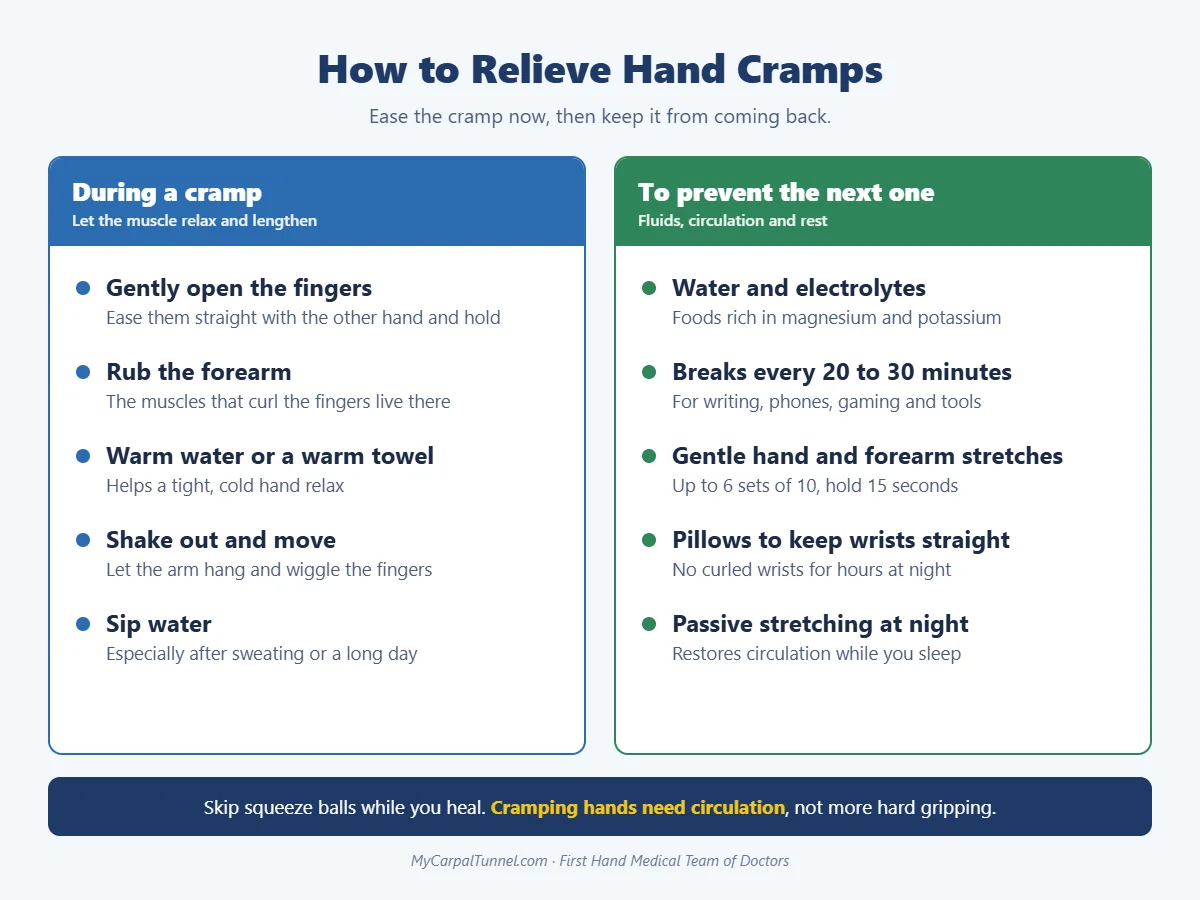
During a Cramp
- Gently open the fingers with the other hand and hold them straight for 15 to 30 seconds.
- Rub the forearm on the palm side, where the muscles that curl the fingers live.
- Warm the hand in warm water or with a warm towel.
- Shake out and move: let the arm hang and wiggle the fingers.
- Sip water, especially after sweating or a long day.
To Prevent the Next One
- Drink water and eat mineral-rich foods through the day.
- Take a break every 20 to 30 minutes from writing, phones, gaming and tools.
- Stretch gently: up to 6 sets of 10 hand, wrist and forearm stretches, holding each for 15 seconds with 30 seconds of rest. See our forearm stretches.
- Keep your wrists straight at night with pillows instead of a splint.
- Skip squeeze balls and putty while you heal. Cramping hands need circulation, not more hard gripping.
The Carpal Solution: Restoring Circulation While You Sleep
When carpal tunnel is part of the picture, our doctors developed the Carpal Solution to take the pressure off the median nerve. Its targeted passive stretching restores flexibility to the injured soft tissue, relieves pressure on the median nerve, relieves restrictions on blood circulation and lets lymph fluid flow freely to clear out the swelling. It is your body that does the healing; the Carpal Solution just jump-starts the natural healing preempted by excess pressure from inflammation and swelling.

- Over 220 hours of targeted stretching in the six-week protocol, while you sleep.
- Most people are better from their worst symptoms in two to three weeks.
- About 90% get complete remission in 6 weeks; the other 10%, usually people with excess systemic inflammation, are 40 to 70% better at six weeks and reach full remission in 10 to 12 weeks.
- 97% patient satisfaction over 21 years and 4.9 out of 5 stars on independent review sites like Google Reviews. Over 100,000 people have used it.

See how the Carpal Solution hand orthosis works, and if symptoms linger, follow our Persistent Symptoms Protocol.
When Healing Needs a Doctor’s Help and Professional Medical Evaluation
- Constant numbness that does not improve or loss of feeling in the fingertips that does not improve in 4 to 8 weeks.
- Extreme loss of the muscle at the base of the thumb, with loss of grip strength that does not improve over 6 to 8 weeks.
- Worsening symptoms over 6 to 8 weeks while using the best conservative treatments
- Symptoms that begin suddenly after hand or wrist trauma, a fracture or severe sprain from a fall or auto accident.
- Odd Symptoms that are not consistent with the Carpal Tunnel Symptoms listed on this website, that might be indicative of other nerve issues. A nerve conductivity study can clear up the confusion with minimal costs and not too much pain and no risk.
These signs may mean more advanced nerve involvement or a different condition and deserve professional medical evaluation and in person consultation. Home treatment can be used alongside professional in-person medical care while you wait for the healthcare delivery system to fit you into their schedule. There is no reason to wait doing nothing. You can start proven natural conservative treatment with good patient reviews while you wait for your appointments. If your symptoms start improving over 6 to 8 weeks, then you know you are on the right track and surgery is not necessary.
Frequently Asked Questions About Hand Cramps
What causes hand cramps?
The most common causes are overuse and fatigue, dehydration, low potassium, magnesium or calcium, cold hands, some medications, and conditions such as an underactive thyroid, kidney disease and diabetes. Carpal tunnel can add to cramping by slowing circulation to the hand and forearm.
What deficiency causes hand cramps?
Low levels of potassium, magnesium or calcium in the blood are the usual culprits. Vitamin D deficiency can lower calcium. Ask your doctor for a blood test before taking supplements, especially if you have kidney disease or take a diuretic.
Can hand cramps be a sign of something serious?
Usually not, but see a doctor promptly if cramps come with sudden weakness or loss of feeling, wasting of the hand muscles, constant numbness, spasms throughout the body, tingling around the mouth, or after starting a new medication.
Why do my hands cramp and lock up?
In a true cramp the finger muscles contract and stay contracted, so the hand locks into a curl until it releases. A finger that catches and snaps straight is a tendon problem, and spasms throughout the body need prompt medical care.
How do you relieve hand cramps fast?
Gently open the fingers with the other hand and hold them straight, rub the palm side of the forearm, warm the hand, shake it out and sip water. Most cramps release within a minute or two.
Can carpal tunnel cause hand cramps?
It can contribute. Trapped swelling at the wrist restricts blood flow and lymph transport, so hand and forearm muscles tire and cramp more easily, especially at night. Treating the root cause restores circulation.
Sources
- Muscle Cramps. StatPearls, NCBI Bookshelf, updated September 2025.
- Muscle Cramps. Merck Manual, Consumer Version.
- Muscle Cramps. MSD Manual, Professional Version.
- Carpal tunnel anatomy: the median nerve and nine flexor tendons. Journal of Ultrasound, 2012.
- Bland JD. Patient-reported outcomes of 1,268 carpal tunnel operations. Muscle & Nerve, 2001 (PubMed 11410921).
- AMN Healthcare. 2025 Survey of Physician Appointment Wait Times (average 31 days for a new-patient appointment).

Developed by First Hand Medical’s Team of Doctors
The Carpal Solution Treatment Kit was developed by our expert team of medical doctors who have worked at and led some of the top medical institutions in the World – Including Harvard Medical, Tufts Medical, UCSD, UF Health, and The Ohio State University. We treat root causes with clinically proven conservative treatments. The results: Quick Natural Relief of All Your Carpal Tunnel Symptoms without complications.

Order Your Six Week Carpal Tunnel Treatment Now
The ONLY treatment for carpal tunnel that comes with a no questions asked 30-Day Satisfaction Window and in-house dedicated pain relief team.