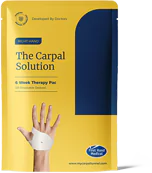
 Created by renowned Harvard health care professionals.


Dental Ergonomics: How Dentists and Assistants Protect Their Hands From Carpal Tunnel

Written by Jeff Conley, President of First Hand Medical · Clinically reviewed by Alan Ward, MOT, OTR, Master Occupational Therapist and VP of Precision Rehabilitation · Last reviewed: November 2026
Dental ergonomics is the science of fitting the dental workspace, instruments and posture to the person doing the work. For dentists, hygienists and dental assistants, good ergonomics in dentistry is not a comfort upgrade. It protects the hands, wrists and forearms that a dental career depends on, and it is one of the best ways to lower your risk of carpal tunnel syndrome.
Table of Contents
Why Dental Ergonomics Matters for Your Hands
Dental work combines nearly everything that strains the carpal tunnel: forceful pinching of small instruments, bent wrists held for long periods, repetitive scaling strokes and vibration from handpieces and ultrasonic scalers. Researchers who studied instrument design note that carpal tunnel syndrome is more common among dental practitioners than among people in most other occupations, and that right-arm symptoms affect 19 to 61% of dentists and hygienists (UCSF Dental Study, report to NIOSH).
Two 2023 meta-analyses put numbers on it. One pooled 37 studies of 17,152 dental health care workers and concluded that about one in seven may be affected by carpal tunnel syndrome (F1000Research, 2023). Another, limited to dentists, estimated a prevalence of about 9.9%, roughly twice the 4 to 5% seen in the middle-aged general population (Kostares et al., F1000Research, 2023).
The muscles that bend your fingers and thumb sit in the forearm, and their nine tendons pass through the carpal tunnel beside the median nerve. Every forceful pinch on a scaler loads those tendons inside the tunnel. Good dental ergonomics reduces that load hour after hour, year after year.
Ergonomic Dental Instruments: Size, Weight and Sharpness
Instrument choice is the part of dental ergonomics with the strongest research behind it. In a study published in the Journal of the American Dental Association, a scaler with a 10 mm handle weighing 15 grams required the least muscle load and pinch force of the designs tested; larger diameters added no further benefit, but lighter instruments may need even less force (Dong et al., JADA, 2006).
A four-month randomized trial among dentists and dental hygienists then found that using a lighter, larger-diameter instrument reduced arm pain, and the authors called it an easy, cost-effective intervention (UCSF Dental Study, report to NIOSH). Practical steps for ergonomic dental equipment:
- Choose wide, light handles with a textured grip, about 10 mm across, for scalers, mirrors and explorers.
- Keep instruments sharp. A dull curette needs more force on every stroke.
- Use cordless or lightweight handpieces where you can, since cord weight adds pinch force.
- Alternate instruments and grips so the same muscles are not loaded all day.
- Let powered scalers do the work with a light touch, and take breaks from vibration.
Posture and Positioning: Ergonomics for Dentists
Ergonomics for dentists starts before the first instrument is picked up. Bring the patient to you rather than reaching for the patient. A neutral wrist, straight and in line with the forearm, keeps the carpal tunnel as open as possible, while a wrist bent up or down narrows it and raises pressure on the median nerve.
- Sit with your thighs roughly level, feet flat and your back supported.
- Raise or lower the patient chair so your forearms stay close to horizontal.
- Keep your elbows near your sides instead of winging them out.
- Use a finger rest close to the working area, which shortens the lever on your wrist.
- Rotate the patient’s head and use indirect vision before you bend your own wrist or neck.
- Magnification can help you sit upright; choose a working distance that does not pull you forward.
Dental ergonomics is about the whole chain from neck to fingertips, but for carpal tunnel syndrome the wrist angle and pinch force matter most.
Dental Assistant Ergonomics
Dental assistant ergonomics follows the same principles, with a few differences. Assistants often sit higher than the operator to see the field, twist toward instrument trays and hold suction or retractors in static positions for long stretches.
- Sit 4 to 6 inches higher than the operator, with a stool that supports your torso, so you can see without leaning.
- Keep trays and suction within easy reach so you are not rotating or reaching across your body.
- Switch hands for suction when the procedure allows.
- Relax your grip on the high-volume evacuator; it does not need a tight hold.
What is the ideal working position for a dental assistant? Seated close to the patient, slightly higher than the operator, facing the patient’s mouth, with feet supported and forearms close to level.
Micro-Breaks and Stretches Between Patients
Even perfect ergonomics in dentistry cannot remove all strain. Short breaks between patients let blood flow return to the forearm and hand. Our doctors recommend gentle stretches during the day, up to 6 sets of 10, holding each stretch for 15 seconds with 30 seconds of rest. Skip grip, squeeze-ball and putty exercises while your hands are healing; they add the same pinch load that dental work already does.
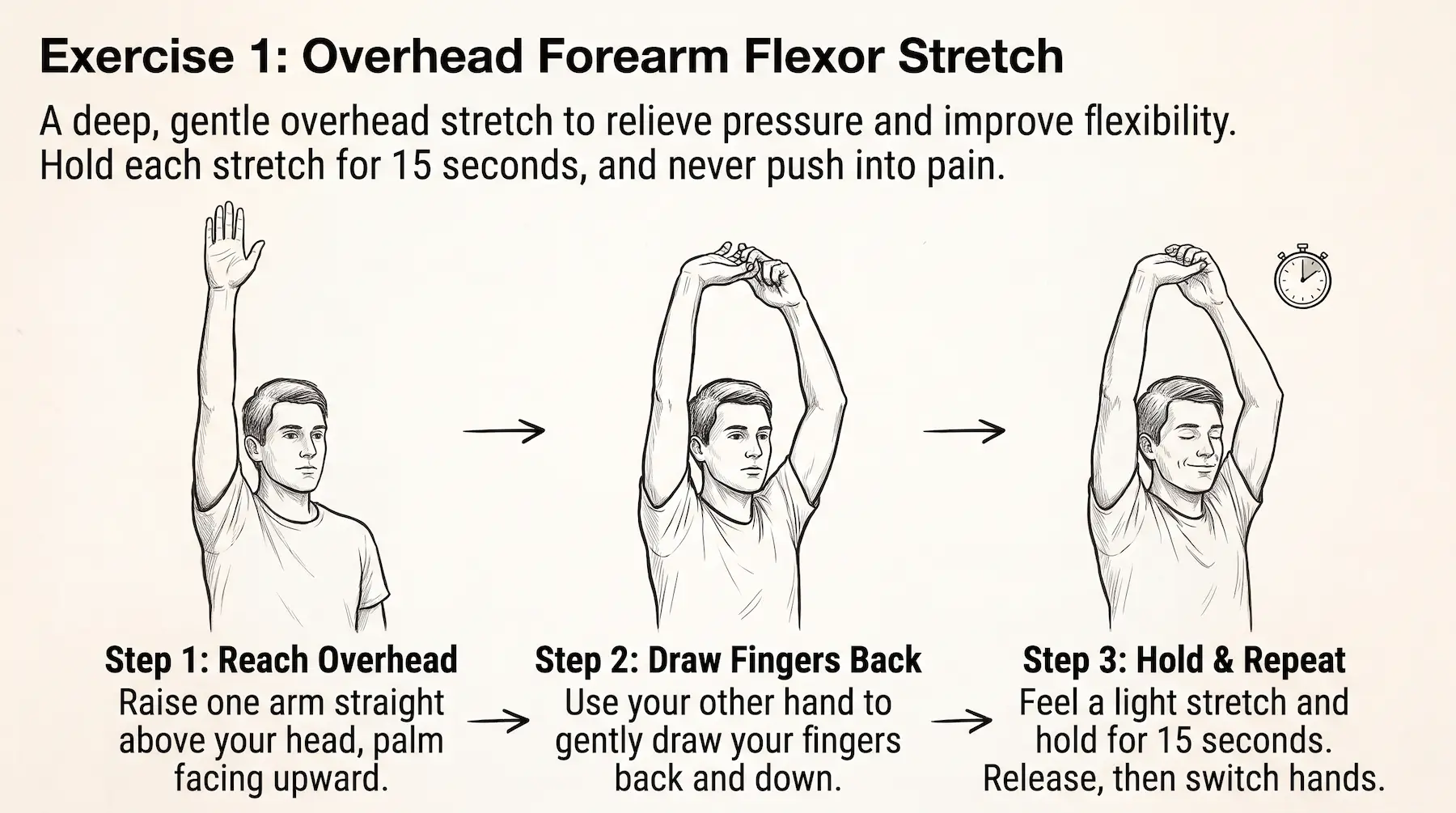
For a full set of desk-friendly stretches, see carpal tunnel stretches at your desk. Dental hygienists can find a hygienist-specific routine in our guide to dental hygienist ergonomics.
When Ergonomics Is Not Enough
Dental ergonomics lowers risk, but it does not clear swelling that is already squeezing the median nerve. If you wake with numb fingers, drop instruments or feel tingling in your thumb, index and middle fingers, the soft tissue in and around the carpal tunnel is likely already inflamed.
Swelling and entrapped inflammation in the soft tissue in and around the carpal tunnel squeeze the median nerve and restrict blood flow and lymphatic fluid transport. The Carpal Solution’s targeted passive stretching, worn at night, restores flexibility to the injured soft tissue, relieves pressure on the median nerve and lets lymph fluid flow freely to clear out the swelling. It is your body that does the healing; the Carpal Solution just jump-starts it, without time away from patients.
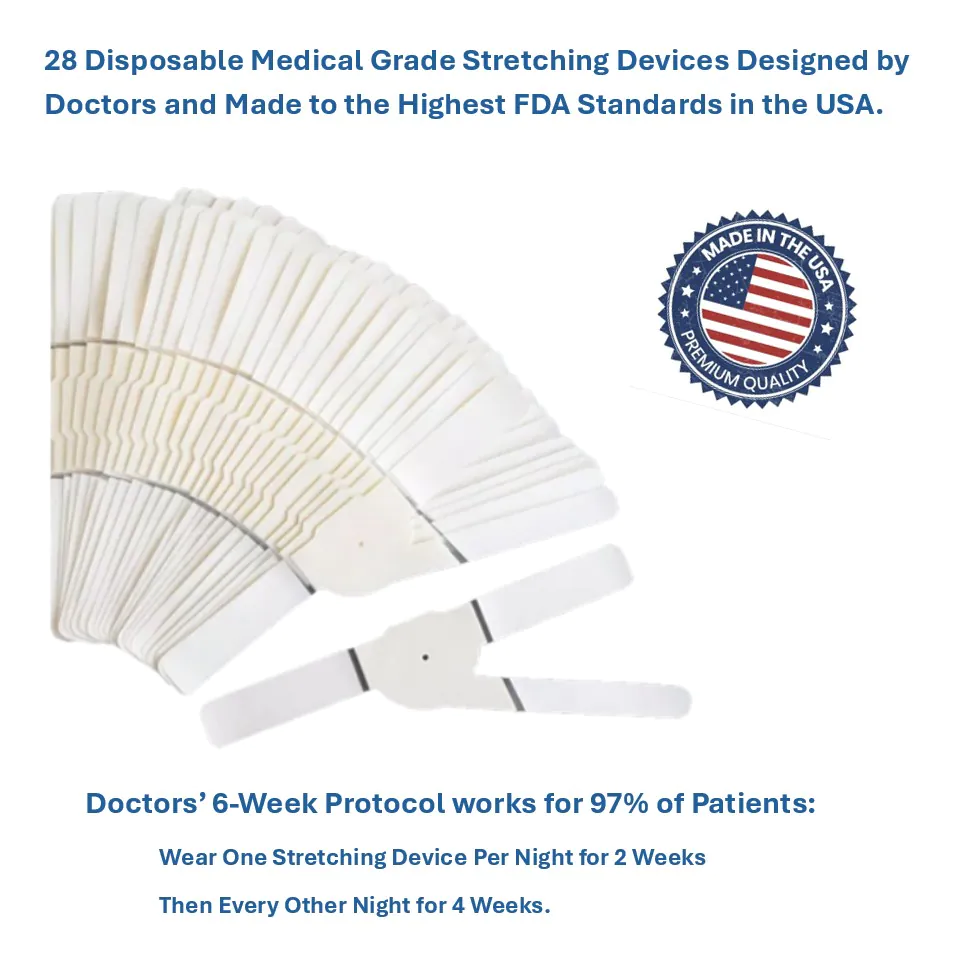
Most people are better from their worst symptoms in two to three weeks. Over 90% resolve in 6 weeks, after over 220 hours of targeted stretching. The Carpal Solution has 97% patient satisfaction over 21 years and 4.9 out of 5 stars on independent review sites, and neurologists, including Dr. James S. Zu, MD, PhD, of Edison, New Jersey, call it a better first line of defense.
A splint holds the wrist in a neutral position, which can reduce pain from movement, but it does not promote healing from carpal tunnel syndrome, and a rigid splint is hard to work in. Carpal tunnel surgery has a patient satisfaction rate lower than 69%, because about 31% of patients report lingering or recurring symptoms, and the downtime is hard on any dental practice. If you need an appointment, the average new-patient wait is 31 days (AMN Healthcare, 2025), so you can start at home while you wait for carpal tunnel treatment.
Dental Professionals Who Kept Working
Dr. Marielaina Perrone, a dentist in Henderson, Nevada, feared she would have to sell her practice. “I am not a surgery person anyway; as a trained medical professional, I know what can go wrong,” she says. Watch her story:
Read more stories from dental professionals:
- Dentist carpal tunnel: how 3 dentists treat it at home
- Dental hygienist carpal tunnel: Aishah stops dropping instruments
- How dental professionals heal carpal tunnel without downtime
- Dentist with carpal tunnel keeps working
- Dentist’s career saved: Dr. Perrone’s full story
- Who is at risk for carpal tunnel? All professions
Dental Ergonomics FAQs
What is dental ergonomics?
Dental ergonomics is fitting the operatory, instruments and working posture to the clinician, so the hands, wrists, neck and back are not strained by daily dental work.
How does ergonomics in dentistry help prevent carpal tunnel?
Neutral wrist angles, lighter and wider instruments, sharp tools and regular breaks reduce pinch force and pressure inside the carpal tunnel, which lowers the strain on the median nerve and the nine tendons beside it.
What are the best ergonomics for dentists?
Bring the patient to you, keep your forearms close to level and your wrists straight, use a nearby finger rest, choose 10 mm, lightweight instruments and keep them sharp.
What is the ideal working position for a dental assistant?
Seated close to the patient and 4 to 6 inches higher than the operator, with feet and torso supported, trays within easy reach and forearms close to level.
Can a dental professional keep working with carpal tunnel?
Many do. Combining dental ergonomics during the day with the Carpal Solution at night lets most people keep working while symptoms settle. See a doctor promptly for constant numbness, weakness or thinning of the thumb muscle.
References: Dong H, et al. The effects of periodontal instrument handle design on hand muscle load and pinch force. J Am Dent Assoc. 2006;137(8):1123–1130. · Rempel D, et al. UCSF Dental Study: Final Report to NIOSH (randomized trial of instrument handle design and arm pain). · Worldwide prevalence of carpal tunnel syndrome among dental health care personnel: a systematic review and meta-analysis. F1000Research. 2023;12:251. · Kostares M, et al. Prevalence of carpal tunnel syndrome among dentists: a systematic review and meta-analysis. F1000Research. 2023;12:196. · AMN Healthcare physician appointment wait time survey, 2025.
When Healing Needs a Doctor’s Help and Professional Medical Evaluation
- Constant numbness that does not improve or loss of feeling in the fingertips that does not improve in 4 to 8 weeks.
- Extreme loss of the muscle at the base of the thumb, with loss of grip strength that does not improve over 6 to 8 weeks.
- Worsening symptoms over 6 to 8 weeks while using the best conservative treatments
- Symptoms that begin suddenly after hand or wrist trauma, a fracture or severe sprain from a fall or auto accident.
- Odd Symptoms that are not consistent with the Carpal Tunnel Symptoms listed on this website, that might be indicative of other nerve issues. A nerve conductivity study can clear up the confusion with minimal costs and not too much pain and no risk.
These signs may mean more advanced nerve involvement or a different condition and deserve professional medical evaluation and in person consultation. Home treatment can be used alongside professional in-person medical care while you wait for the healthcare delivery system to fit you into their schedule. There is no reason to wait doing nothing. You can start proven natural conservative treatment with good patient reviews while you wait for your appointments. If your symptoms start improving over 6 to 8 weeks, then you know you are on the right track and surgery is not necessary.

Watch videos of people who “Cured” their Carpal Tunnel Naturally and Avoided the Risks of Carpal Tunnel Surgery!







Order Your Six Week Carpal Tunnel Treatment Now
The ONLY treatment for carpal tunnel that comes with a no questions asked 30-Day Patient Satisfaction Guarantee and in-house dedicated pain relief team.