 Created by renowned Harvard health care professionals.


Doctor's Recommendations For Persistent Carpal Tunnel Symptoms
Doctors recommendations for persistent carpal tunnel symptoms focus on finding out why symptoms linger and choosing the least invasive steps first.
Some Patients have Persistent Symptoms of CTS. They often wonder why. The answer is people have varying levels of systemic inflammation. People with high levels of systemic inflammation find it hard to get ahead of the inflammation curve and clear out trapped inflammation from the Carpal Tunnel Space. Here Expert Doctors provide a Master Course in managing inflammation naturally. Doctor's Recommendations for Persistent Carpal Tunnel Symptoms. Determined people can all beat CTS naturally with this program and avoid Surgery for life.

Written by Julie Sunberg, Director of Marketing and Customer Service at First Hand Medical · Medically reviewed by Dr. Joseph E. Scherger, MD, MPH, family physician and clinical professor, UC San Diego School of Medicine · Last reviewed: November 2026
Table of Contents
Doctors Recommendations for Persistent Carpal Tunnel Symptoms: Where to Start
When symptoms do not go away, doctors usually start by checking what is keeping the median nerve under pressure. Common reasons include ongoing repetitive hand use, high levels of systemic inflammation, other health conditions and an incomplete treatment routine. Doctors recommendations for persistent carpal tunnel symptoms are meant to be a starting point, so talk with your own doctor about what applies to you.
Steps Doctors Often Suggest
- Keep your wrists in a neutral position and take regular breaks from repetitive tasks.
- Use a gentle nighttime stretching therapy consistently, as directed.
- Ask your doctor about conditions that can add to inflammation, such as diabetes or thyroid problems.
- Avoid activities that clearly make numbness or pain worse.
- Add dry needling with electrical stimulation (interferential current or e-stim) from a physical therapist or chiropractor, 1 to 2 times a week for 2 to 3 weeks, to speed recovery. Learn how it works in Acupuncture and Dry Needling for Carpal Tunnel. Between visits, a home unit can help; see TENS Unit for Carpal Tunnel. Learn which therapy techniques speed healing, and which to skip, in Physical Therapy for Carpal Tunnel.
- Track your symptoms each week so you can see what helps.
- Once you reach remission, keep carpal tunnel away with daytime stretching and occasional preventive Carpal Solution nights, as described in Carpal Tunnel Prevention Exercises.
For a complete plan to lower systemic inflammation, see Carpal Tunnel Inflammation: The Key to Managing Carpal Tunnel for Life. For the foods to avoid and what to eat instead, read Foods to Avoid for Carpal Tunnel: 7 Proven Diet Rules From Our Doctors. For the full step-by-step home plan, see Carpal Tunnel Self-Care: The Doctors’ 7-Step Plan. For the evidence behind the supplements in this protocol, read Vitamin B6 and Supplements for Carpal Tunnel.
Carpal Tunnel Recovery: What Normal Looks Like
Carpal tunnel recovery with the Carpal Solution follows a fairly predictable path for most people. The six-week protocol delivers over 220 hours of targeted passive stretching while you sleep, and most people are better from their worst symptoms in two to three weeks. Over 90% resolve their symptoms within the six weeks.
About 10% of people take longer. In our doctors’ experience, these are usually people with excess systemic inflammation, and at six weeks they are often 50% to 70% better. Their carpal tunnel recovery simply needs 8 to 12 weeks instead of six. Slow progress is not failure; it is a sign that the inflammation load is higher and needs more help.
Why Carpal Tunnel Recovery Can Be Slow
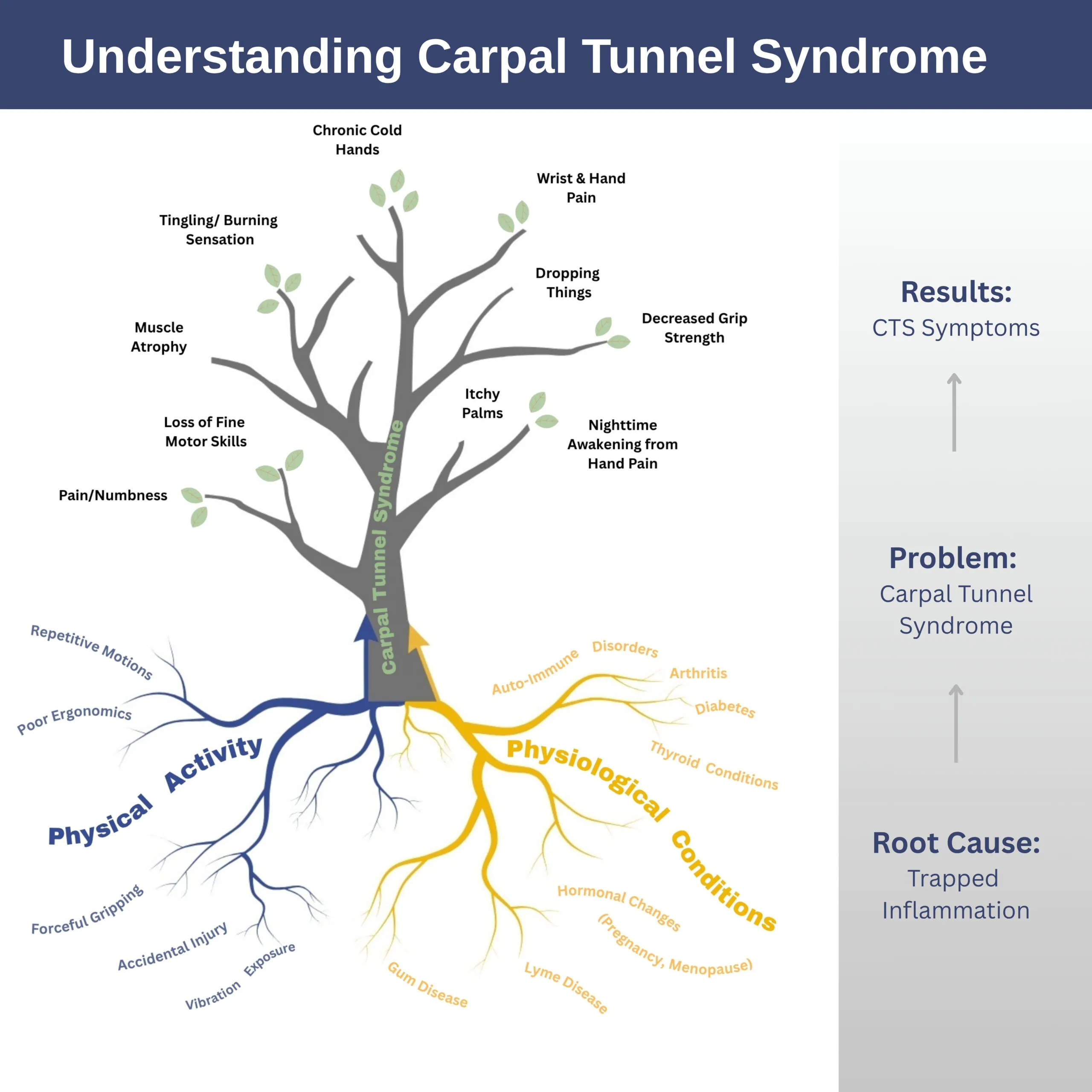
Carpal tunnel is caused by swelling and entrapped inflammation in the soft tissue in and around the carpal tunnel. They squeeze the median nerve and restrict blood flow and lymphatic fluid transport. Passive stretching relieves that pressure, but if your body keeps producing more inflammation than it can clear, recovery slows down.
Diet: excess sugar, refined carbohydrates and processed food raise systemic inflammation.
Blood sugar and weight: diabetes, prediabetes and extra weight add to the inflammation load.
Other conditions: thyroid problems, arthritis, lupus and pregnancy can all slow healing.
Ongoing strain: long hours of forceful, repetitive hand work keep re-irritating the tissue.
Skipped nights: the protocol works by adding up hours of stretching, so missed nights slow progress.
The Doctors’ Carpal Tunnel Recovery Plan for Persistent Symptoms
These are the steps our doctors recommend when carpal tunnel recovery is slower than expected. The Carpal Solution stays the anchor; the other steps accelerate it.
Keep going with nightly passive stretching for 8 to 12 weeks instead of stopping at six.
Lower your inflammation through diet. Cut sugar and refined carbohydrates and eat more vegetables, healthy fats and fish. Our doctors recommend Dr. Valter Longo’s The Longevity Diet, Dr. Nicole Avena’s Why Diets Fail and Max Lugavere’s Genius Foods. Start with our foods to avoid for carpal tunnel.
Add daytime stretches: up to 6 sets of 10 a day, holding each stretch for 15 seconds with 30 seconds of rest. See stretches to prevent carpal tunnel.
Add a therapy that speeds healing: dry needling with electrical stimulation, a TENS unit or physical therapy.
Drink enough water, sleep well and keep your hands warm, so fluid can move and the tissue can recover.
Skip grip, squeeze-ball and putty exercises while you heal. Add aerobic exercise once you reach remission.
Ask your doctor about underlying conditions such as diabetes or thyroid problems that add to inflammation.
A splint is not part of this plan. A splint holds the wrist in a neutral position, which can reduce pain from movement, but it does not promote healing from carpal tunnel syndrome. Our doctors observe that splints compress the wrist and restrict circulation and lymphatic flow, which slows the clearing of swelling.
How to Track Your Carpal Tunnel Recovery
Tracking makes a slow carpal tunnel recovery easier to judge, because small weekly gains are easy to miss.
Keep a simple weekly note: how many nights you woke up, how numb your fingers felt, whether you dropped things and how strong your grip feels. Progress that is slow but steady means the plan is working. If you are waiting for an appointment, keep treating while you wait; see waiting for carpal tunnel treatment.
Once you reach remission, it usually lasts 5 to 7 years for most people, though everyone is different. Use a Carpal Solution night or two whenever symptoms return, from once a week to once every six months. For the bigger picture on symptoms that linger, see our page on persistent carpal tunnel symptoms.
Frequently Asked Questions
How long does carpal tunnel recovery take without surgery?
Most people are better from their worst symptoms in two to three weeks, and over 90% resolve within the six-week protocol. People with excess systemic inflammation often need 8 to 12 weeks.
Why are my carpal tunnel symptoms not improving?
The most common reasons are high systemic inflammation, ongoing hand strain and missed treatment nights. Follow the recovery plan above, and see a doctor if numbness becomes constant or your thumb muscle weakens.
Can I speed up carpal tunnel recovery?
Yes. Lowering inflammation through diet, adding daytime stretches and adding a therapy such as dry needling with electrical stimulation can all speed up carpal tunnel recovery alongside nightly passive stretching.
Excess Inflammation Contributes to Persistent Carpal Tunnel Symptoms
Learn more about Causes of Excess Systemic Inflammation and how it contributes to Persistent Carpal Tunnel Symptoms clicking on the links below.
Treat The Root Cause of Carpal Tunnel: Trapped Inflammation
Excess Systemic Inflammation Can Slow Recovery of CTS
Who is At Risk for The Onset of Carpal Tunnel?
Causes of Carpal Tunnel Syndrome
Everyone can heal naturally from Carpal Tunnel Syndrome. Each person has a different inflammation profile. So, some people take longer to get ahead of the inflammation curve and clear out the trapped inflammation that is putting pressure on the Median Nerve in the Carpal Tunnel space.
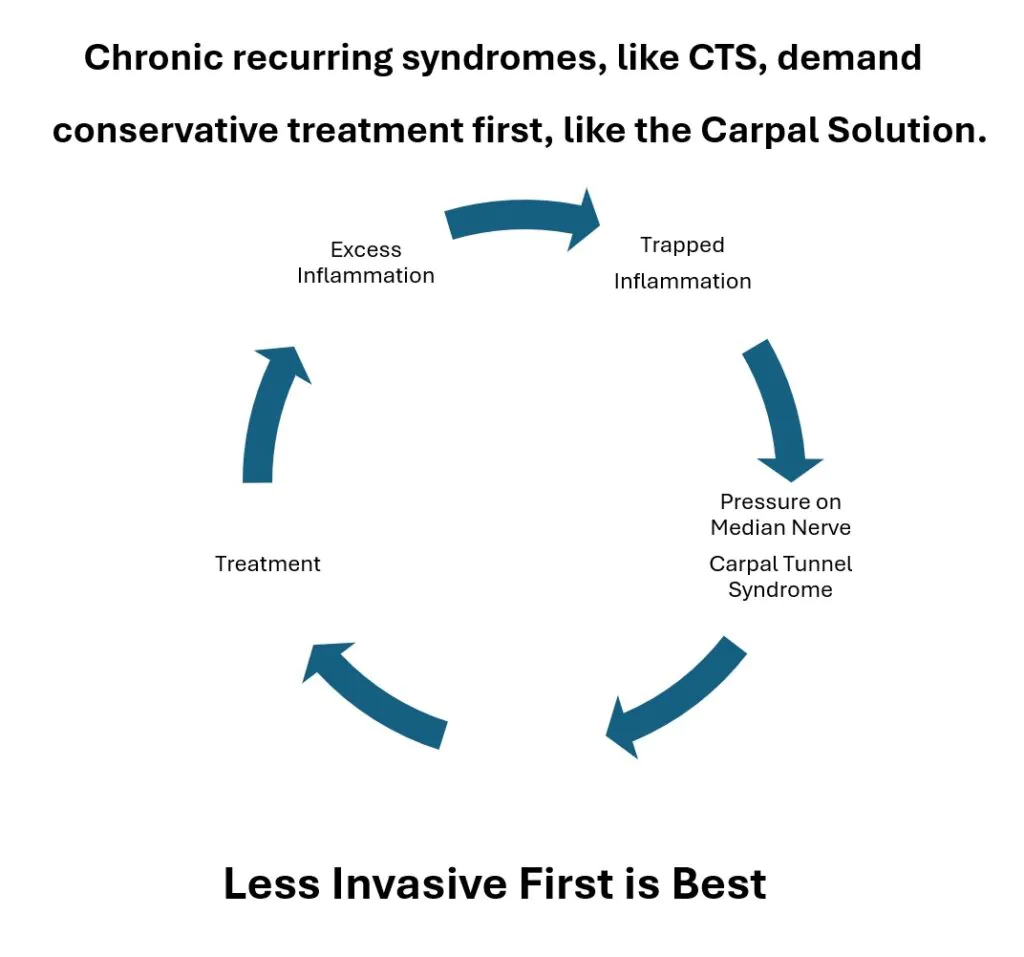
It is important to follow the “Conservative First” Principle in Medicine when dealing with any condition, but especially one that is chronic and recurring, like CTS. The Doctor’s Recommendations for Persistent Carpal Tunnel Symptoms focuses proven natural methods to address the root cause of CTS. Pairing proven natural physical therapy with The Carpal Solution Stretching Treatment will accelerate your recovery and assure complete remission of even the most persistent symptoms.
Treat The Root Cause with
Proven Natural Treatment:
The Carpal Solution Kit
When Healing Needs a Doctor’s Help and Professional Medical Evaluation
- Constant numbness that does not improve or loss of feeling in the fingertips that does not improve in 4 to 8 weeks.
- Extreme loss of the muscle at the base of the thumb, with loss of grip strength that does not improve over 6 to 8 weeks.
- Worsening symptoms over 6 to 8 weeks while using the best conservative treatments
- Symptoms that begin suddenly after hand or wrist trauma, a fracture or severe sprain from a fall or auto accident.
- Odd Symptoms that are not consistent with the Carpal Tunnel Symptoms listed on this website, that might be indicative of other nerve issues. A nerve conductivity study can clear up the confusion with minimal costs and not too much pain and no risk.
These signs may mean more advanced nerve involvement or a different condition and deserve professional medical evaluation and in person consultation. Home treatment can be used alongside professional in-person medical care while you wait for the healthcare delivery system to fit you into their schedule. There is no reason to wait doing nothing. You can start proven natural conservative treatment with good patient reviews while you wait for your appointments. If your symptoms start improving over 6 to 8 weeks, then you know you are on the right track and surgery is not necessary.
Learn more: NINDS fact sheet on carpal tunnel syndrome.
Follow the doctors recommendations for persistent carpal tunnel symptoms consistently, and review your progress with your doctor.
Waiting for an appointment? Most people wait weeks to see a doctor or a neurologist. Our doctors explain how to get safe relief in the meantime in the waiting in healthcare: relief while waiting for carpal tunnel treatment.