 Created by renowned Harvard health care professionals.


The Waiting in Healthcare: Relief While Waiting for Carpal Tunnel Treatment

Written by Joseph E. Scherger, MD, MPH, family physician, clinical professor at the UC San Diego School of Medicine and co-founder of First Hand Medical, and Jeff Conley, First Hand Medical · Medically reviewed by Joseph E. Scherger, MD, MPH · Last reviewed: November 2026
Waiting for carpal tunnel treatment is one of the hardest parts of having carpal tunnel syndrome, and one of the least talked about. You notice the numbness. You make the call. Then you wait: for your doctor, for a neurologist, for a nerve test, for a hand surgeon, for insurance, for a surgery date.
Medical research measures what happens after treatment. It rarely measures the weeks and months before it, when people are losing sleep, dropping things and struggling at work. We call this “the waiting,” and our doctors believe it deserves far more attention than it gets.
This article explains the waiting in healthcare, how long each step usually takes, what happens to your symptoms in the meantime, and our doctors’ position on how to get relief while you are waiting for carpal tunnel treatment.
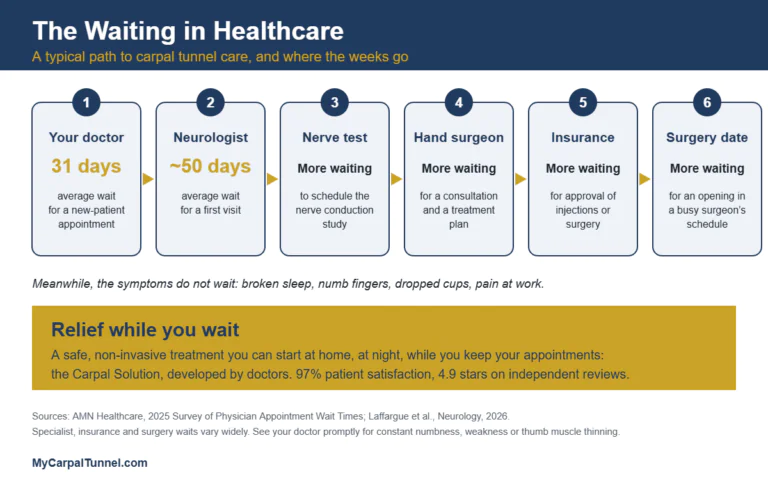
Table of Contents
What Is “The Waiting” in Healthcare?

The waiting is the time between noticing a health problem and actually getting it treated. Everyone who uses the healthcare delivery system experiences it: the waiting room, the hold music, the referral that takes weeks, the appointment three months out.
It is not anyone’s fault. Doctors are busy, specialists are booked, insurance needs paperwork, and operating rooms have schedules. But for someone with carpal tunnel syndrome, the waiting is not empty time. The symptoms keep going, every night and every day.
Studies of carpal tunnel treatment usually start the clock on the day of an injection or surgery. The suffering before that day is rarely counted. Our doctors think that is a serious blind spot, because for many people the waiting lasts longer than the recovery.
Why the Waiting Is So Often Overlooked
Most carpal tunnel research compares treatments from the day they start. A surgery study counts how patients feel after the operation. An injection study counts the weeks after the shot. The months spent waiting for carpal tunnel treatment usually fall outside the study, so the suffering in that time is rarely measured, reported or discussed.
Inside a busy clinic, the waiting is easy to miss for a different reason. Doctors see patients when they arrive, not during the weeks they spent getting there. By the time someone sits in the exam room, the sleepless nights and dropped coffee cups are already in the past.
Our doctors have listened to thousands of patients describe that time. Many say the waiting was the worst part: not knowing what was wrong, not sleeping, and not being able to do their work or care for their families. That experience is why First Hand Medical treats the waiting as part of carpal tunnel care, not something that happens before care begins.
Healthcare systems can and should work to shorten wait times. Until they do, patients deserve safe, effective ways to relieve their symptoms while waiting for carpal tunnel treatment, whether they are waiting for a carpal tunnel diagnosis, a neurologist, an injection or surgery.
Waiting for a Carpal Tunnel Diagnosis

“The doctor will see you shortly.” Shortly, in healthcare, can mean an average of 31 days.
The first wait is for your own doctor. Across major U.S. cities, it now takes an average of 31 days to get a new-patient appointment with a physician, 19% longer than in 2022 (AMN Healthcare, 2025). For family medicine, the average is about 23 days.
Waiting for a carpal tunnel diagnosis can feel like being stuck. The good news is that, for many people, the diagnosis does not have to wait for a specialist. Doctors can often diagnose carpal tunnel syndrome from your symptoms and an examination, which the 2024 AAOS guideline allows.
Our doctors’ experience: Over two decades, our doctors have found that people with three or more of the carpal tunnel symptoms listed on this website can be about 95% confident they have carpal tunnel syndrome. This is clinical experience, not a published statistic. You should still get an in-person evaluation and a formal diagnosis from a doctor. But with that level of confidence, you do not have to suffer while you wait.
Waiting for a Neurologist for Carpal Tunnel Evaluation

Waiting for a specialist can feel like this line. Your hands do not have to wait in it with you.
If your doctor wants a nerve conduction study, the next step is usually waiting for a neurologist for carpal tunnel evaluation. In a 2026 study of more than 114,000 commercially insured patients, the average wait for a first neurology visit was about 50 days, and half of patients waited 25 days or longer (Laffargue et al., Neurology, 2026).
For older adults, the picture is similar. Among Medicare patients referred to a neurologist, the median wait was 34 days, and 18% waited more than 90 days (Neurology, 2025).
Waiting for a neurologist for carpal tunnel evaluation is worth it when your symptoms are unusual or severe, or when you are considering surgery. Our page on whether you need a nerve conduction study explains when testing matters most and how to prepare for it.
Waiting for Carpal Tunnel Steroid Injection Appointments
Some doctors offer a steroid injection before surgery, and many people find themselves waiting for carpal tunnel steroid injection appointments after their first visit. Waiting for a carpal tunnel steroid injection can mean another referral, another appointment and sometimes insurance approval.
When an injection does help, the relief often fades. In a 2024 systematic review, 41.6% of patients who had a steroid injection for carpal tunnel eventually had surgery, and 29% needed another injection (Chan et al., Hand, 2024). That can mean more waiting for carpal tunnel treatment: for the next injection, or for the surgeon.
Waiting for Carpal Tunnel Surgery

Carpal tunnel surgery is considered elective, which often means a place on a wait list.
Waiting for carpal tunnel surgery is often the longest wait of all. It usually involves a surgeon’s consultation, a nerve conduction study, insurance approval and an opening in a busy surgeon’s schedule and a surgery suite. After surgery comes recovery, and it can take months to regain full grip strength.
Surgery is also not the guaranteed fix many people expect. Carpal tunnel surgery has a patient satisfaction rate lower than 69%: in a study of 1,268 operations, patient-reported success was 69% (Bland, Muscle & Nerve, 2001), and about 31% of patients report lingering or recurring symptoms. No patient is satisfied with lingering symptoms. About 8% of patients say their condition is worse after surgery (Bland, Muscle & Nerve, 2007). How often symptoms come back after a “successful surgery” has rarely been studied beyond a few years; read more about carpal tunnel recurrence after surgery.
The waiting can also be an opportunity. In a randomized trial in Australian public hospitals, people on the waiting list for carpal tunnel surgery who were given education, night splinting and home exercises were less likely to go on to surgery than those who simply waited (Lewis et al., Journal of Physiotherapy, 2020). Using the waiting well can change the outcome.
The Symptoms Do Not Wait
While the calendar moves slowly, carpal tunnel symptoms keep their own schedule. About 80% of people with carpal tunnel syndrome wake at night with numb hands (Patel et al., Hand, 2012). In a study of 100 patients having carpal tunnel surgery, 87% had night-time symptoms, and half said those symptoms were the reason they sought care (Turner and Fischer, American Association for Hand Surgery, 2016).

Whether you are waiting for a carpal tunnel diagnosis or waiting for carpal tunnel surgery, every week can mean:
- More nights of broken sleep, and more tired, irritable days.
- Numb, tingling fingers that make buttons, keys and phones harder to use.
- Dropping cups, tools and plates.
- Pain at work, and worry about falling behind.
- Giving up hobbies, from golf to knitting to playing an instrument.
This is the suffering of waiting for carpal tunnel treatment that the scientific community tends to overlook. It is real, it adds up, and in most cases it can be relieved.
Our Doctors’ Position on Waiting for Carpal Tunnel Treatment
Our doctors’ position on the waiting is simple: you should not have to suffer while waiting for carpal tunnel treatment. Here is what they recommend.
- Keep your appointment. A formal diagnosis matters, because other conditions can also make hands go numb. Relief while you wait is never a reason to skip the doctor.
- Start a safe, non-invasive treatment now. There is no reason to lose weeks of sleep while you wait for the system to catch up.
- Conservative care first, surgery last. Many people improve enough with conservative care that surgery is no longer needed.
- Tell your doctor what you have started. Bring your symptom notes to your appointment so your doctor can see your progress.
- Ask to be seen sooner for warning signs. Constant numbness, weakness, muscle thinning at the base of the thumb or symptoms after an injury are reasons to call your doctor’s office, so they can decide on the right next step.
Occupational therapist Alan Ward, MOT, OTR, put the cost of the alternative plainly:
“Even if we have to wear this for a month and a half, and even if we have to do that every so often, that still costs way, way less and is way, way less risky than one surgery.” — Alan Ward, MOT, OTR
Waiting for Carpal Tunnel Treatment? 6 Steps to Use the Waiting Well
These six steps turn the time you spend waiting for carpal tunnel treatment into time spent getting better.
- Book your appointment today, and ask to be put on the cancellation list so you can be seen sooner if a slot opens.
- Start the Carpal Solution at night. It works while you sleep, so it fits around work and appointments.
- Protect your wrists at night. Keep them straight, and avoid curling your hands under your chin or pillow.
- Calm the swelling during the day. Cold therapy after hand-intensive work, gentle stretches and short breaks every 30 to 45 minutes all help. Skip grip strengtheners and squeeze balls while you are healing.
- Keep simple notes. Write down how many times your hands wake you each night and what you drop or struggle with. Bring the notes to your appointment.
- Know when to call sooner. If numbness becomes constant, or you notice weakness or thinning at the base of the thumb, tell your doctor’s office.
What You Can Do About Carpal Tunnel While You Wait
Our doctors have written a great deal on this website about caring for carpal tunnel at home. Here is that advice gathered in one place, so you can put the waiting to work. Each item links to the full article.
1. Stretch while you sleep
Night is when symptoms are worst and when your hand is most relaxed. The Carpal Solution applies a gentle, steady stretch at three points around the carpal tunnel for six to eight hours while you sleep. Learn how the Carpal Solution works and why nighttime carpal tunnel therapy is so effective.
2. Keep your wrists straight at night
Avoid sleeping with your hands curled under your chin, chest or pillow, or dangling off the bed. If you sleep on your side, rest your top arm on a pillow. If you wake up numb, straighten your wrists and gently shake out your hands.
3. Use cold water to calm the swelling
Our doctors’ icing protocol: submerge the hand and lower forearm in water between 45 and 51°F (7 and 10°C) for about 20 minutes before bed, or alternate 2 minutes in warm water and 2 minutes in cold water for 25 to 30 minutes after work. Never put ice directly on the skin. See ice or heat for carpal tunnel for the full protocol and safety tips.
4. Do gentle stretches and nerve glides during the day
Slow, comfortable nerve and tendon glides help the median nerve slide more freely. Up to 6 sets of 10, holding each stretch about 15 seconds with 30 seconds of rest between, is a good bonus to the nighttime treatment. See our hand exercises for carpal tunnel.
5. Take microbreaks and lighten your grip
Every 30 to 45 minutes of hand-intensive work, take a short reset: straighten your wrists, relax your shoulders and loosen your grip on tools, keyboards and phones. Our carpal tunnel pain relief at home guide has a full 14-day plan.
6. Wear compression gloves during the day
Compression gloves can increase blood circulation and protect the hand from everyday bumps and bruises. Worn during the day with the Carpal Solution at night, they are one of the best combination therapies. Read do carpal tunnel gloves work.
7. Support healing from the inside
Stay well hydrated with electrolytes, and favor an anti-inflammatory diet, as described in Dr. Valter Longo’s The Longevity Diet, Dr. Nicole Avena’s Why Diets Fail and Max Lugavere’s Genius Foods. Our doctors’ 7-step self-care plan puts these habits together.
What to avoid while you wait
- Grip strengtheners, squeeze balls and putty while you are healing. Grip strength returns on its own as the nerve recovers.
- Relying on pain pills for weeks. They do not relieve the pressure on the nerve; see oral pain medication for carpal tunnel.
- Rigid bracing all day. In our doctors’ experience, long periods of immobilization can weaken the hand; see braces for carpal tunnel. A splint holds the wrist in a neutral position, which can reduce pain from movement, but it does not promote healing from carpal tunnel syndrome. It causes muscle atrophy and stiffness, and its tight compression restricts blood circulation and lymphatic fluid exchange, which slows the dispersion of entrapped swelling, the root cause of carpal tunnel syndrome. Our medical team has observed that splints give some relief at first but aggravate symptoms in the long run. Immobilization is great for fractures and sprains, but not for carpal tunnel syndrome.
If your symptoms are slow to improve, our doctors’ recommendations for persistent carpal tunnel symptoms add cold plunges, deep tissue massage and other steps that help the body clear trapped inflammation.
Humor Helps: A Little Laughter for the Waiting Room
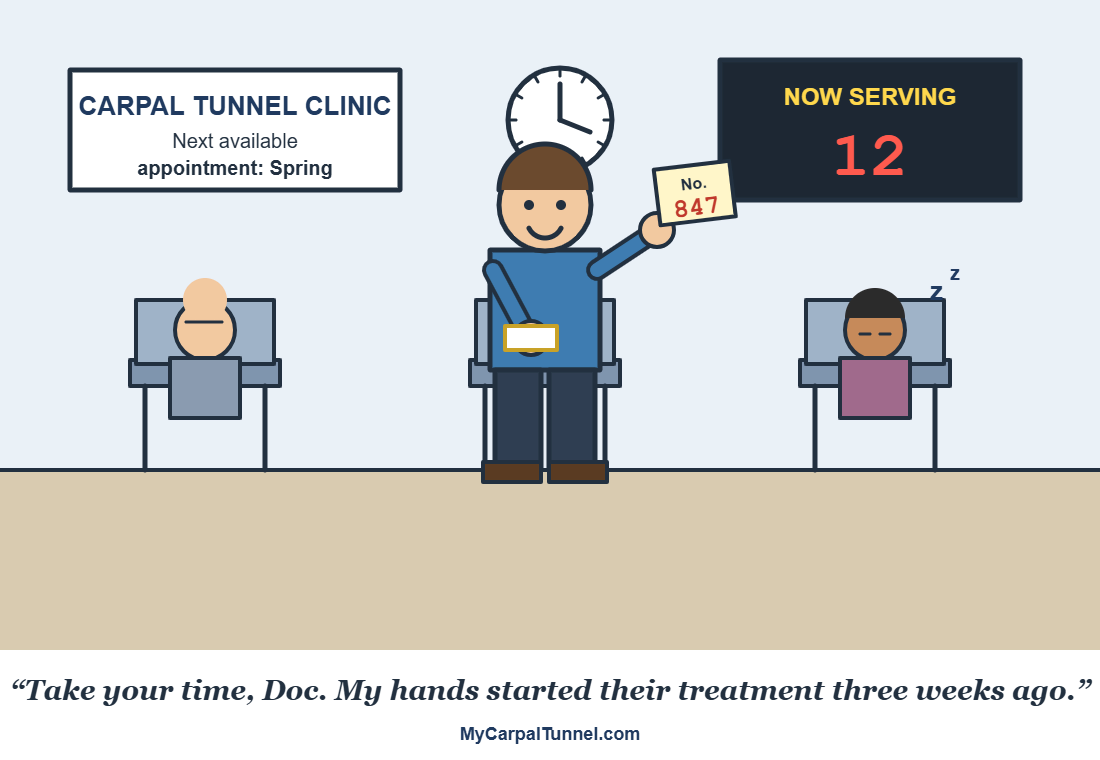
People have always used humor to get through hard times, and waiting while you are hurting is one of them. A good laugh will not fix a pinched nerve, but it can make the waiting easier to bear.
There is real science behind it. As Mayo Clinic explains, laughter eases the body’s stress response. Studies it cites found that laughter reduced the stress hormone cortisol during a stressful task, and that laughing together with other people triggered the release of the body’s own natural painkillers.
A few ways to bring some humor into the waiting for carpal tunnel treatment:
- Bring a funny book, podcast or comedy special to the waiting room, or to the cold-water icing sessions at home.
- Share the story of your wait with a friend who makes you laugh. Shared laughter helps the most.
- Keep a favorite cartoon on the refrigerator or by your desk.
- Laugh with people, never at them. The person at the front desk is waiting too, in a way.
Laughter is one way to cope, not a replacement for care. If stress, worry or low mood are weighing on you, talk with your doctor.
What to Expect From the Carpal Solution While Waiting for Carpal Tunnel Treatment
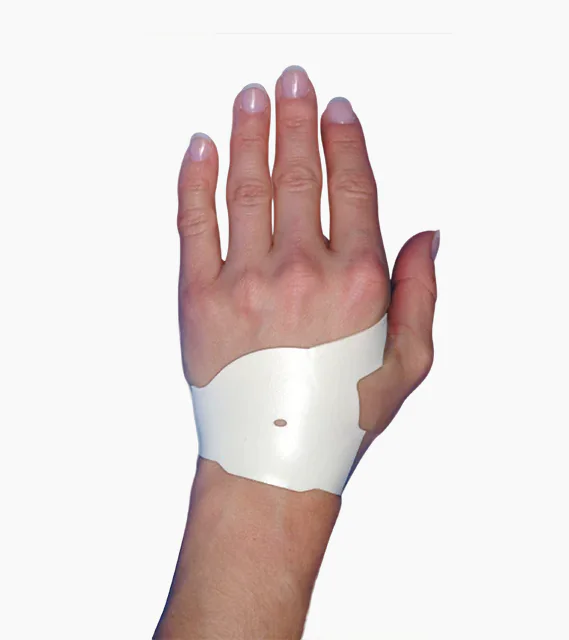
The Carpal Solution is a medically prescribed passive stretching device developed by doctors and worn at night. It gently stretches the soft tissue around the carpal tunnel to relieve the pressure on the median nerve. Over the six-week protocol, it delivers more than 220 hours of targeted stretching.
- Relief of the worst symptoms usually begins in two to three weeks, often well before you finish waiting for a neurologist for carpal tunnel evaluation or waiting for carpal tunnel surgery.
- Over 90% of people resolve their symptoms within the six-week protocol.
- About 10% of people, usually those with excess inflammation throughout the body, need 8 to 12 weeks and are typically 50 to 70% better at six weeks.
Over two decades, more than 100,000 people have used the Carpal Solution, with 97% patient satisfaction and 4.9 out of 5 stars on independent review sites like Google Reviews. If you have already had carpal tunnel surgery, wait three months before starting. For persistent symptoms, see our doctors’ recommendations for persistent carpal tunnel symptoms.
When Healing Needs a Doctor’s Help and Professional Medical Evaluation
- Constant numbness that does not improve or loss of feeling in the fingertips that does not improve in 4 to 8 weeks.
- Extreme loss of the muscle at the base of the thumb, with loss of grip strength that does not improve over 6 to 8 weeks.
- Worsening symptoms over 6 to 8 weeks while using the best conservative treatments
- Symptoms that begin suddenly after hand or wrist trauma, a fracture or severe sprain from a fall or auto accident.
- Odd Symptoms that are not consistent with the Carpal Tunnel Symptoms listed on this website, that might be indicative of other nerve issues. A nerve conductivity study can clear up the confusion with minimal costs and not too much pain and no risk.
These signs may mean more advanced nerve involvement or a different condition and deserve professional medical evaluation and in person consultation. Home treatment can be used alongside professional in-person medical care while you wait for the healthcare delivery system to fit you into their schedule. There is no reason to wait doing nothing. You can start proven natural conservative treatment with good patient reviews while you wait for your appointments. If your symptoms start improving over 6 to 8 weeks, then you know you are on the right track and surgery is not necessary.
Waiting for Carpal Tunnel Treatment: Frequently Asked Questions
How long is the wait for carpal tunnel treatment?
Waiting for carpal tunnel treatment varies. A new-patient doctor appointment averages 31 days in major U.S. cities, a first neurologist visit averages about 50 days, and injections or surgery can add weeks or months more.
What can I do while waiting for a carpal tunnel diagnosis?
While waiting for a carpal tunnel diagnosis, keep your appointment and start safe, non-invasive care at home: the Carpal Solution at night, straight wrists while you sleep, cold therapy and gentle stretches. Note your symptoms to share with your doctor.
Can symptoms get worse while waiting for carpal tunnel surgery?
While waiting for carpal tunnel surgery, symptoms can get worse for some people, and night-time symptoms often continue. That is why our doctors recommend starting conservative care during the wait, and calling your doctor if numbness becomes constant or you notice weakness.
Should I keep waiting for a neurologist for carpal tunnel evaluation before starting treatment?
Usually not, if your doctor agrees and you have no signs of severe nerve compression. Tell the neurologist about any treatment you have started.
Is there a carpal tunnel cure?
No. Carpal tunnel syndrome is chronic and recurring and cannot be cured, by surgery or anything else. The Carpal Solution is the next best thing, controlling symptoms at home without downtime, risks, scar tissue or complications.
Sources
- AMN Healthcare. 2025 Survey of Physician Appointment Wait Times.
- Laffargue EK, et al. Neurology wait times after primary care or emergency department visits among the commercially insured population in the United States, 2019–2023. Neurology, 2026 (AAN summary).
- Wait time to see a neurologist after referral among Medicare participants. Neurology, 2025.
- Patel JN, et al. Characteristics of sleep disturbance in patients with carpal tunnel syndrome. Hand, 2012.
- Turner CM, Fischer TJ. The effects of carpal tunnel syndrome and its release on sleep. American Association for Hand Surgery Annual Meeting, 2016.
- Lewis KJ, et al. Group education, night splinting and home exercises reduce conversion to surgery for carpal tunnel syndrome: a multicentre randomised trial. Journal of Physiotherapy, 2020.
- Chan PYW, et al. Long-term efficacy of corticosteroid injection for carpal tunnel syndrome: a systematic review. Hand, 2024.
- Bland JDP. Muscle & Nerve, 2001 and 2007.