 Created by renowned Harvard health care professionals.


Carpal Tunnel Prevention Exercises: 8 Simple Moves, Plus the Night Treatment That Keeps CTS Away
Eight simple daytime moves, five habits to avoid, and how nighttime passive stretching with the Carpal Solution prevents carpal tunnel and keeps it in remission

Written by Jeff Conley, First Hand Medical · Medically reviewed by Joseph E. Scherger, MD, MPH, family physician, clinical professor at the UC San Diego School of Medicine and co-founder of First Hand Medical · Last reviewed: November 2026
Carpal tunnel prevention exercises are simple stretches and gliding movements that keep the tissue around your wrist loose and help the median nerve slide freely through the carpal tunnel. If you type, grip tools, cut hair, clean teeth, play an instrument or use your hands hard all day, a few minutes of these moves can help keep carpal tunnel from building up.
But the most powerful prevention plan works around the clock. Pairing daytime carpal tunnel prevention exercises with the Carpal Solution nighttime stretching treatment, used anywhere from once a week to once every six months, helps prevent carpal tunnel from starting and keeps it in remission once you have beaten it. An ounce of prevention really is worth a pound of cure with carpal tunnel syndrome.
Table of Contents
Carpal Tunnel Prevention Exercises: The Short Answer
- Daytime moves help. Eight gentle carpal tunnel prevention exercises keep the wrist tissue loose and the nerve and tendons gliding.
- Nights matter most. Carpal tunnel builds while you sleep with curled wrists, so the strongest prevention also works at night.
- Use the Carpal Solution as preventive treatment. One night anywhere from once a week to once every six months, depending on your hand use and inflammation, helps keep carpal tunnel away.
- Day plus night is the winning combination. Daytime stretching and nighttime passive stretching together are the most powerful way to prevent onset and prevent recurrence.
- Compliance is easy. Passive stretching happens while you sleep, so you are not relying on raw discipline every day.
Can Carpal Tunnel Prevention Exercises Really Prevent CTS?
Carpal tunnel prevention exercises help, but they work best as part of a bigger plan. Carpal tunnel syndrome is an entrapment syndrome: inflammation and swelling get trapped in the narrow carpal tunnel at the base of the hand, squeezing the median nerve along with the blood vessels and lymph channels that should drain the area. Less drainage means more swelling, and more swelling means more pressure on the nerve.
Stretching keeps the soft tissue over the tunnel flexible and moves fluid, which supports healthy pressure inside the tunnel. The research on exercise is still growing. A 2022 Cochrane review found limited, very low quality evidence of benefit for exercise and mobilization in people who already have carpal tunnel syndrome, and a 2021 systematic review of workplace prevention looked at ergonomics, education and exercise programs together.
Our doctors’ experience over more than two decades is that carpal tunnel prevention exercises work best when they are combined with good wrist position, regular breaks, attention to whole-body inflammation and, most of all, gentle passive stretching at night.
Who Needs Carpal Tunnel Prevention Most?
Anyone can develop carpal tunnel, but prevention pays off most for people whose hands work hard every day or whose bodies run high on inflammation:
- Heavy hand users: dentists and hygienists, hairstylists, electricians, construction workers, mechanics, musicians, gamers, cooks, nurses and anyone who types or mouses for hours.
- People with inflammatory conditions: diabetes, thyroid disease, rheumatoid arthritis, fibromyalgia and other autoimmune conditions.
- Pregnancy and menopause: hormone shifts and fluid retention raise pressure in the tunnel.
- Anyone who has had carpal tunnel before: carpal tunnel is a chronic, recurring condition, and it can come back even after successful surgery.
If you see yourself on this list, carpal tunnel prevention exercises during the day and occasional nighttime passive stretching are a smart investment in your hands.
8 Carpal Tunnel Prevention Exercises
Do each of these carpal tunnel prevention exercises gently. You should feel a mild stretch, never pain, numbness or tingling. Hold each stretch about 15 seconds, then rest about 30 seconds. Warm your hands first if they are cold.
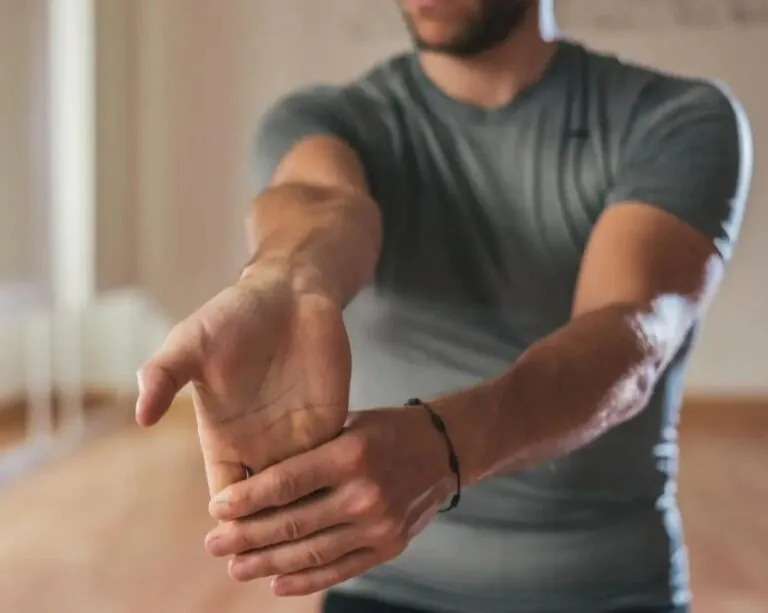
1. Wrist flexor stretch
Hold one arm straight in front of you, palm up. With the other hand, gently pull your fingers down and back toward the floor until you feel a stretch along the inside of your forearm. Hold 15 seconds.
2. Wrist extensor stretch
Hold your arm straight, palm down. Gently press the back of your hand down so your fingers point toward the floor, until you feel a stretch along the top of your forearm. Hold 15 seconds.
3. Prayer stretch
Press your palms together in front of your chest, fingers up. Slowly lower your hands toward your waist, keeping palms together, until you feel a gentle stretch. Hold 15 seconds. Stop sooner if your fingers tingle.
4. Median nerve glide
This moves the nerve, not just the muscles. Make a loose fist with the thumb outside. Open your fingers straight, then extend the thumb out to the side, then bend the wrist back, then turn the palm up, then gently pull the thumb back with your other hand. Move slowly through each position, holding a few seconds. See the full sequence in our nerve glide guide.
5. Tendon glides
Move your fingers through five positions, holding each for a few seconds: straight fingers, a hook fist (fingertips to the base of the fingers), a full fist, a “tabletop” (knuckles bent at 90 degrees, fingers straight) and a straight fist (fingertips to the palm). This keeps the nine finger tendons that share the tunnel with the median nerve gliding smoothly.
6. Finger fan
Spread your fingers as wide as comfortable, hold 5 seconds, then relax. Repeat 10 times. It is a great move between emails or phone calls.
7. Thumb stretch
With your palm facing you, gently pull your thumb back and away from your fingers with the other hand until you feel a stretch at the base of the thumb. Hold 15 seconds.
8. Shake out and shoulder rolls
Let your arms hang, shake your hands loosely for 10 seconds, then roll your shoulders back 10 times. Good posture at the shoulder and neck keeps the whole nerve pathway from neck to fingers relaxed.
For more carpal tunnel prevention exercises and stretches, see Carpal Tunnel Stretches and the best exercises for carpal tunnel.
How Often to Do Carpal Tunnel Prevention Exercises
Our doctors recommend up to 6 sets of 10 reps per day if they fit your day, holding each stretch 15 seconds with 30 seconds of rest. A practical way to fit carpal tunnel prevention exercises into a busy day is a short set at each natural break: first thing in the morning, mid-morning, lunch, mid-afternoon and the end of the workday.
Once your hands feel good, 2 to 3 sets of carpal tunnel prevention exercises a day is a reasonable maintenance level, especially if your work is hand-intensive. On extra-heavy days, such as a long shift, a big project or a weekend of yard work, add a set before and after.
Why Daytime Exercises Alone Often Fall Short
Here is the honest truth about carpal tunnel prevention exercises: they only work if you do them, and almost nobody does them every day for months. Busy schedules, long shifts and simply feeling fine all get in the way. Daytime prevention depends on raw discipline, and discipline fades.
There is a second problem. Carpal tunnel builds at night. Most people sleep with their wrists curled, which squeezes the carpal tunnel for hours and lets inflammation settle in the tight space. A few minutes of carpal tunnel prevention exercises during the day cannot undo six to eight hours of curled wrists every night.
That is why our doctors pair daytime carpal tunnel prevention exercises with passive stretching during sleep. The night treatment does the heavy lifting automatically, and the daytime moves add to it whenever your schedule allows.
Nighttime Prevention: The Carpal Solution Stretching Treatment
The Carpal Solution is a doctor-developed passive stretching treatment you wear while you sleep. Soft, flexible straps apply gentle, constant tension to three areas around the carpal tunnel for 6 to 8 hours, loosening the tight tissue over the tunnel so trapped inflammation can disperse and blood and lymph flow can return. It is drug-free, has no downtime and is rated 4.9 out of 5 stars on Google Reviews and Birdeye.

Why passive stretching during sleep is the easiest prevention
Compliance is the secret to any prevention plan, and the Carpal Solution makes compliance simple. You put it on at bedtime, go to sleep, and the stretching happens for hours without any effort from you. There is nothing to remember during a busy workday and no willpower required. That is why patients love the Carpal Solution for keeping carpal tunnel in remission: it fits into life instead of competing with it.
Day and night: the most powerful prevention combination
Daytime carpal tunnel prevention exercises and the nighttime Carpal Solution work on the same tissue from two directions:
- During the day, carpal tunnel prevention exercises such as active stretches and nerve and tendon glides keep things moving while you use your hands.
- At night, hours of gentle passive stretching loosen the tissue over the tunnel and clear trapped inflammation while you rest.
Together they are a powerful combination for preventing the onset of carpal tunnel in the first place and for preventing a recurrence once it is in remission. On days you miss your carpal tunnel prevention exercises, the night treatment still has you covered.
How often to use the Carpal Solution for prevention
Preventive use is occasional, not nightly. Most people need one night anywhere from once a week to once every six months. Because people have very different inflammation profiles and hand-use patterns, our doctors give this guide:
| Your situation | Preventive Carpal Solution nights |
|---|---|
| Minor systemic inflammation, light to moderate hand use | One night every 3 to 6 months |
| Heavy hand use at work (dentists, hygienists, electricians, hairstylists, construction trades) | One night every 1 to 3 months |
| Autoimmune or other inflammatory conditions | One night every 1 to 2 months |
| Severe autoimmune conditions such as rheumatoid arthritis or fibromyalgia | One night every 1 to 2 weeks |
| A very heavy week, or the first hint of tingling | A night or two right away |
If you are coming off treatment for carpal tunnel, step down gradually rather than stopping all at once. For stubborn cases, our doctors’ recommendations for persistent carpal tunnel symptoms taper from every other night for 2 weeks, to once a week for 2 months, to once every 2 weeks for 3 months, and then once a month as symptoms resolve. Following those recommendations for managing inflammation naturally also reduces how often you need preventive nights. Each device can be reused for 2 to 3 nights by saving the protective strips, so a single kit goes a long way as preventive treatment.
Preventing carpal tunnel if you have never had it
You do not have to wait for symptoms to start protecting your hands. If you are a heavy hand user, or you have a condition that raises inflammation, the same schedule works as primary prevention: daily carpal tunnel prevention exercises when you can, and a preventive Carpal Solution night anywhere from once a week during your heaviest work periods to once every few months when your hands are less busy. It is a gentle, low-cost way to keep the tissue over the carpal tunnel from tightening and keep inflammation from settling in.
An ounce of prevention is worth a pound of cure
Carpal tunnel is a chronic, recurring condition driven by inflammation that comes and goes with work, health, hormones and season. It can return even after successful surgery. Compare the two paths:
- Prevention: a few minutes of carpal tunnel prevention exercises during the day and an occasional night of passive stretching while you sleep, with no downtime, drugs or risks.
- Waiting until it is bad: lost sleep, numb and clumsy hands, missed work, appointments and nerve tests, and sometimes surgery with weeks of recovery.
First Hand Medical reports that most patients (about 90%) get relief of their worst symptoms in about 3 weeks, reach complete remission in about 6 weeks, and then stay in remission for 5 to 7 years, with occasional preventive treatment keeping carpal tunnel in remission for decades. More than 50,000 people have used the Carpal Solution, and tens of thousands of customers and patients rely on it to stay as active as they want to be without worrying about recurring carpal tunnel symptoms.
What Patients Say About Preventing Carpal Tunnel
Many of our patients now use the Carpal Solution on a simple preventive schedule after finishing treatment, often alongside carpal tunnel prevention exercises:
- A bricklayer who had worn wrist braces for years says he is now down to wearing the Carpal Solution once a week, or once every two weeks, as a preventive treatment, depending on his workload. Read his story in Construction Workers Cure Carpal Tunnel Without Surgery.
- Kathy, a surgical nurse in California, uses one or two devices about once every six weeks when symptoms try to creep back.
- Dr. Marielaina Perrone, a dentist in Henderson, Nevada, wears it for a night or two when symptoms start, or for about a week after a very hard stretch of work.
- Diane, a music director in Los Angeles, tapered to a few nights a week after her six-week program and was still relying on it years later after long playing days.
Read all of their stories in How I Cured My Carpal Tunnel Without Surgery.
5 Habits to Avoid If You Want to Prevent Carpal Tunnel
This section answers one of the most-searched questions: what exercises should I avoid with carpal tunnel syndrome?
- Heavy gripping with a bent wrist. Heavy wrist curls, stress balls, tight hand grippers and lifting with the wrist bent load the tunnel. Keep the wrist straight and use lighter weight.
- Long holds on bent wrists. Push-ups, planks and yoga poses like downward dog put full body weight through extended wrists. Use fists, push-up handles or forearm versions instead.
- Stretching into tingling or numbness. A stretch that brings on symptoms is too much, and carpal tunnel prevention exercises should never hurt. Back off.
- Hours without a break. Typing, mousing, phone scrolling or tool work without breaks keeps pressure up. Take a 1 to 2 minute break every 30 to 60 minutes.
- Sleeping with curled wrists. Tucking hands under the pillow or chin is one of the biggest triggers. Rest your forearm on a pillow instead. Rigid splints are not the answer either; see our night splint guide.
Other Ways to Prevent Carpal Tunnel
Carpal tunnel prevention exercises work best alongside these everyday habits:
- Workstation setup: keyboard at elbow height, wrists straight and a light touch. Use our ergonomic checklist.
- Whole-body health: a large analysis of 58 studies found overweight and obesity raise the odds of carpal tunnel syndrome by about 1.5 and 2 times. Blood sugar, thyroid health and sleep matter too. Learn more about carpal tunnel and inflammation.
- Warm hands: cold, stiff hands grip harder. See does cold weather make carpal tunnel worse?
- Everyday habits: read our full guide to carpal tunnel syndrome prevention.
If Symptoms Have Already Started
If you already notice tingling, numbness or night waking, it is time to treat as well as prevent. Use the Carpal Solution with one device every night for two weeks, then every other night for four weeks, along with your daytime carpal tunnel prevention exercises. Once you reach remission, step down to the preventive schedule above. If you have had carpal tunnel surgery, wait 3 months after the operation before starting passive stretching so the surgically disturbed tissue can heal first. To speed healing even more, add the at-home techniques in Physical Therapy for Carpal Tunnel.
When Healing Needs a Doctor’s Help and Professional Medical Evaluation
- Constant numbness that does not improve or loss of feeling in the fingertips that does not improve in 4 to 8 weeks.
- Extreme loss of the muscle at the base of the thumb, with loss of grip strength that does not improve over 6 to 8 weeks.
- Worsening symptoms over 6 to 8 weeks while using the best conservative treatments
- Symptoms that begin suddenly after hand or wrist trauma, a fracture or severe sprain from a fall or auto accident.
- Odd Symptoms that are not consistent with the Carpal Tunnel Symptoms listed on this website, that might be indicative of other nerve issues. A nerve conductivity study can clear up the confusion with minimal costs and not too much pain and no risk.
These signs may mean more advanced nerve involvement or a different condition and deserve professional medical evaluation and in person consultation. Home treatment can be used alongside professional in-person medical care while you wait for the healthcare delivery system to fit you into their schedule. There is no reason to wait doing nothing. You can start proven natural conservative treatment with good patient reviews while you wait for your appointments. If your symptoms start improving over 6 to 8 weeks, then you know you are on the right track and surgery is not necessary.
The Bottom Line
Carpal tunnel prevention exercises are a smart daily habit, but daytime discipline alone rarely lasts, and carpal tunnel builds at night. The most powerful plan pairs a few minutes of daytime stretching with the Carpal Solution nighttime stretching treatment, used anywhere from once a week to once every six months as preventive treatment. That combination helps prevent carpal tunnel from starting, keeps it in remission once you have beaten it, and lets you stay as active as you want to be. An ounce of prevention is worth a pound of cure. Learn more in Carpal Tunnel Home Remedies and Is Carpal Tunnel Surgery Necessary?
Carpal Tunnel Prevention Exercises: FAQ
What exercises prevent carpal tunnel?
Gentle wrist flexor and extensor stretches, the prayer stretch, median nerve glides, tendon glides, finger fans, thumb stretches and shoulder rolls. Combine these carpal tunnel prevention exercises with good wrist position, regular breaks and occasional nighttime passive stretching.
What exercises should I avoid with carpal tunnel syndrome?
Avoid heavy gripping with a bent wrist, stress balls and hand grippers, long weight-bearing holds on extended wrists such as push-ups, planks and downward dog, and any stretch that brings on tingling or numbness.
How many times a day should I do carpal tunnel prevention exercises?
Up to 6 sets of 10 reps per day if your schedule allows, with 15-second holds and 30 seconds of rest. A short set at each work break is a practical way to fit them in, and 2 to 3 sets a day works for maintenance.
How often should I use the Carpal Solution to prevent carpal tunnel?
Most people need one preventive night anywhere from once a week to once every six months. People with minor inflammation often need one night every 3 to 6 months, heavy hand users every 1 to 3 months, and people with severe autoimmune conditions every 1 to 2 weeks.
Can I use the Carpal Solution if I have never had carpal tunnel?
Yes. Heavy hand users and people with inflammatory conditions can use occasional Carpal Solution nights as preventive treatment, together with daytime carpal tunnel prevention exercises, to help keep carpal tunnel from starting.
Can wrist exercises cure carpal tunnel?
Exercises help keep tissue loose and nerves gliding, but once symptoms start, most people do best combining daytime stretching with nightly passive stretching for about six weeks, then switching to a preventive schedule.
Does typing cause carpal tunnel?
The AAOS guideline working group’s opinion is that keyboard use is not associated with carpal tunnel syndrome, but long hours with bent wrists and no breaks can aggravate symptoms once they begin.
Sources
- Exercise and mobilisation interventions for carpal tunnel syndrome. Cochrane Database of Systematic Reviews. 2022. Cochrane
- Tolosa Guzmán IA, et al. Strategies for the prevention of carpal tunnel syndrome in the workplace: a systematic review. Applied Ergonomics. 2021;93. doi.org/10.1016/j.apergo.2020.103353
- Shiri R, et al. The effect of excess body mass on the risk of carpal tunnel syndrome: a meta-analysis of 58 studies. Obesity Reviews. 2015. HealthDay report
- Sadler KP, et al. Management of carpal tunnel syndrome: guidelines from the AAOS. American Family Physician. 2025;112(3):337–339. AAFP
Disclosure: First Hand Medical makes the Carpal Solution, and Dr. Scherger is a co-founder of the company. This article is for education and is not a substitute for advice from your own doctor.