 Created by renowned Harvard health care professionals.


Is Carpal Tunnel a Disease? Syndrome vs Disease Explained
Is carpal tunnel a disease? Strictly speaking, no; it is a syndrome. Learn the difference and why it shapes how carpal tunnel is best treated.


Written by Jeff Conley, President, First Hand Medical · Medically reviewed by Dr. William Shucart, MD, neurosurgeon, clinical professor of neurosurgery, New England Medical Center, former chair of neurosurgery, Tufts · Last reviewed: November 2026
Is carpal tunnel a disease? Strictly speaking, no. It is a syndrome, and the difference between a syndrome and a disease shapes how carpal tunnel is best treated. Here is what that means for you.
 Carpal Tunnel Syndrome is not a disease, it is a “Syndrome”. That means it is a collection of symptoms caused by a pinching of the nerve within the Carpal Tunnel at the base of the hand. There is no permanent Fix or “Cure” for Carpal Tunnel Syndrome! Even after undergoing invasive Surgery, symptoms often return when active hand use resumes.
Carpal Tunnel Syndrome comes back for up to 57% of patients that have surgery.
Surgeons rarely follow patients long enough to know how often this happens; most studies stop at two years, and the longest published follow-up found that 57% of patients had at least some symptoms return within five and a half years, usually about two years after surgery (Nancollas et al., 1995).
Most people do not want to undergo surgery with all of the risks and potential complications for a syndrome that is reoccurring.
Why Carpal Tunnel Syndrome Is Not a Disease
In medicine, a disease usually has a specific cause and a recognizable process in the body. A syndrome is different: it is a group of signs and symptoms that tend to appear together. Carpal Tunnel Syndrome is not a disease in that sense, because it describes what happens when the median nerve is squeezed inside the narrow carpal tunnel at the base of the hand, and that pressure can come from many different sources.
How the Median Nerve Gets Pinched
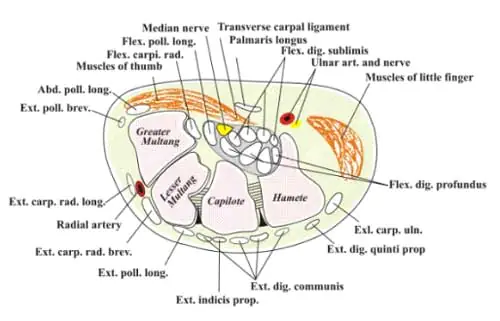
The carpal tunnel is a narrow passage formed by the small bones of the wrist and a strong ligament across the top. The median nerve shares this space with nine tendons that bend the fingers and thumb. When the tendons or the soft tissue around them swell, there is less room in the tunnel, and the nerve can be compressed. That compression is what produces the familiar symptoms.
Common Symptoms
Symptoms often start slowly and can include tingling or numbness in the thumb, index finger, middle finger and part of the ring finger, hands that “fall asleep” at night, pain that travels up the forearm, a weaker grip and dropping small objects. You can read more about carpal tunnel symptoms on our site.
Factors That Can Contribute
Because it is a syndrome and not a disease with one single cause, several factors may play a role: repetitive hand and wrist activity, a wrist injury, fluid retention during pregnancy, and health conditions such as diabetes, thyroid problems or arthritis. Learn more about what causes carpal tunnel syndrome.
Getting a Diagnosis
A doctor can usually confirm the diagnosis with a physical exam and, in some cases, a nerve conduction study that measures how well signals travel along the median nerve. The NINDS carpal tunnel syndrome fact sheet gives a clear overview of how the condition is diagnosed and treated.
What This Means for Treatment
Because the symptoms come from pressure on a nerve, most treatments aim to reduce that pressure. Common first steps can include resting the hand from repetitive tasks, changing how you hold tools or type, wearing a nighttime support, and gentle stretching of the hand and wrist.
Doctors may also suggest other options depending on how severe the symptoms are and how long they have lasted. Catching symptoms early often gives you more choices, so it is worth paying attention to night-time numbness or a weaker grip instead of waiting for them to pass. A short note of when symptoms appear can also help your doctor.
Knowing that this condition is not a disease can be reassuring. It means the symptoms are linked to pressure on a nerve, and reducing that pressure is the goal of most treatments.
After completing the initial Six Week Treatment Protocol using the Carpal Solution Therapy most people find their symptoms go away for 5 to 7 years (everyone is different, from as little as 1 year to as long as 17). If symptoms return more quickly, users find that applying the Carpal Solution between 1 night per week to once every six months allows them to enjoy active hands for life without the threat of recurring symptoms nor repeated surgeries. The Carpal Solution Gives You Peace of Mind. You can work and play as much as you might need to, or might want to without worrying about surgery.
We can help you!
Syndrome vs Disease: The Key Difference
- A disease usually has a specific, known cause and a predictable process in the body, such as an infection caused by a particular germ.
- A syndrome is a recognizable group of signs and symptoms that appear together. It can have several different causes, and the cause may not be the same for every person.
That is the main difference between syndrome and disease. A syndrome describes what is happening; a disease usually also explains why. Carpal tunnel syndrome describes the numbness, tingling, pain and weakness that occur when the median nerve is squeezed in the carpal tunnel, whatever is causing the squeeze.
What Is a Syndrome? A Few Familiar Examples
What is a syndrome in everyday medicine? Restless legs syndrome, irritable bowel syndrome and carpal tunnel syndrome are all named for the pattern of symptoms they produce rather than a single cause. In each case, doctors recognize the pattern, look for contributing factors, and treat what is driving the symptoms.
Why Carpal Tunnel Is a Syndrome, Not a Disease
Many different things can squeeze the median nerve: repetitive hand use, wrist position during sleep, pregnancy, fluid retention, diabetes, thyroid disease, arthritis and other inflammatory conditions. Some of those are diseases themselves, and they can cause carpal tunnel, but carpal tunnel itself is the result, not the cause. See underlying conditions that cause carpal tunnel and lupus and carpal tunnel.
Whatever the source, the result is the same: swelling and entrapped inflammation in the soft tissue in and around the carpal tunnel squeeze the median nerve and restrict blood flow and lymphatic fluid transport. The nerve becomes irritated, short of oxygen and compressed.
Disease vs Disorder vs Syndrome
You may also hear carpal tunnel called a disorder. The three words overlap, but they are not identical:
- Disease: a condition with a known cause and a recognizable process in the body.
- Disorder: a broad term for anything that disrupts normal function, whether or not the cause is known.
- Syndrome: a set of symptoms that occur together and point to a common problem, even when causes vary from person to person.
Carpal tunnel fits best as a syndrome, and many doctors also call it a nerve entrapment disorder. What it is not is a disease in the strict sense. Understanding syndrome vs disease helps explain why two people with carpal tunnel can have very different triggers and still respond to the same treatment.
How Doctors Recognize a Syndrome Like Carpal Tunnel

Because there is no single germ or lab marker, doctors recognize carpal tunnel by its pattern: numbness and tingling in the thumb, index and middle fingers, night symptoms, and weakness at the base of the thumb. Simple office tests and, when needed, a nerve conduction study confirm the pattern. In our doctors’ two decades of clinical experience, people with three or more of the symptoms on our symptoms page can be about 95% confident they have carpal tunnel, though everyone should still get an in-person evaluation. See how carpal tunnel syndrome is diagnosed.
Living With a Chronic Syndrome
Because carpal tunnel is a syndrome rather than an infection or injury that heals once and for all, it tends to come and go with how you use your hands, how you sleep and how much inflammation your body is carrying. That is not a reason for discouragement. It simply means the best plan is one you can repeat.
- Treat flare-ups early, before numbness becomes constant.
- Keep your wrists straight at night with pillows.
- Use the Carpal Solution from once a week to once every six months as maintenance, depending on how hard you use your hands.
- Address contributing conditions, such as diabetes or thyroid disease, with your doctor.
Thinking of carpal tunnel as a syndrome you manage, rather than a disease you must cut out, puts you back in control.
What This Means for Treatment
Because carpal tunnel is a syndrome, the goal is to relieve the pressure on the nerve and keep it from building up again. Carpal tunnel is also chronic and recurring, so a plan you can repeat at home matters more than a one-time fix.
The Carpal Solution’s targeted passive stretching restores flexibility to the injured soft tissue, relieves pressure on the median nerve and lets lymph fluid flow freely to clear out the swelling. It has 97% patient satisfaction over 21 years, 4.9 out of 5 stars on independent review sites like Google Reviews, and over 100,000 people have used it over two decades.
Neurologists, including Dr. James S. Zu, MD, PhD, of Edison, New Jersey, call it a better first line of defense. Most people are better from their worst symptoms in two to three weeks; about 90% get complete remission in six weeks; about 10% are 40 to 70% better at six weeks and reach full remission in 10 to 12 weeks. Remission typically lasts 5–7 years for most people.
Surgery does not change the syndrome’s chronic nature. Carpal tunnel surgery has a patient satisfaction rate lower than 69%, because about 31% of patients report lingering or recurring symptoms, and no patient is satisfied with lingering symptoms.
A note on the word “cure”: carpal tunnel syndrome is chronic and recurring and cannot be cured, but the Carpal Solution is the next best thing, controlling symptoms at home without downtime, risks, scar tissue or complications.
Carpal Tunnel Disease: Why the Name Causes Confusion
Many people search for “carpal tunnel disease” because that is how friends and family describe it. The confusion is understandable. Carpal tunnel can last for months, come back after treatment and affect daily life as much as many diseases do. But is carpal tunnel a disease in the medical sense? No. There is no single cause, no germ and no lab test that defines it.
The name tells the story. “Carpal” refers to the wrist bones, “tunnel” to the narrow passage they form with a ligament, and “syndrome” to the group of symptoms that appear when the median nerve inside that tunnel is squeezed. When people talk about carpal tunnel disease, they are really describing carpal tunnel syndrome.
Why does the syndrome vs disease distinction matter so much here? Because it points to a hopeful conclusion. A disease may need a cure aimed at its cause. A syndrome caused by pressure can improve when the pressure is relieved, which is exactly what conservative care is designed to do. For most people, that means real relief without surgery.
Common Questions About Syndrome vs Disease
People often search “syndrome vs disease” because a diagnosis can sound more serious, or less serious, than it is. A syndrome is not a lesser problem than a disease. It simply means the condition is defined by its symptoms. Carpal tunnel syndrome can be painful and disabling, and it deserves prompt, effective treatment.
The difference between syndrome and disease also explains why carpal tunnel treatment focuses on the mechanism, the pressure on the nerve, rather than a single cause. If you ask “is carpal tunnel a disease?”, the short answer is no; the more useful answer is that it is a pressure problem your body can recover from when the pressure is relieved.
Knowing what is a syndrome also helps you talk with your doctor. Ask what is contributing to your symptoms, whether any underlying condition needs treatment, and what conservative steps you can start right away.
When Healing Needs a Doctor’s Help and Professional Medical Evaluation
- Constant numbness that does not improve or loss of feeling in the fingertips that does not improve in 4 to 8 weeks.
- Extreme loss of the muscle at the base of the thumb, with loss of grip strength that does not improve over 6 to 8 weeks.
- Worsening symptoms over 6 to 8 weeks while using the best conservative treatments
- Symptoms that begin suddenly after hand or wrist trauma, a fracture or severe sprain from a fall or auto accident.
- Odd Symptoms that are not consistent with the Carpal Tunnel Symptoms listed on this website, that might be indicative of other nerve issues. A nerve conductivity study can clear up the confusion with minimal costs and not too much pain and no risk.
These signs may mean more advanced nerve involvement or a different condition and deserve professional medical evaluation and in person consultation. Home treatment can be used alongside professional in-person medical care while you wait for the healthcare delivery system to fit you into their schedule. There is no reason to wait doing nothing. You can start proven natural conservative treatment with good patient reviews while you wait for your appointments. If your symptoms start improving over 6 to 8 weeks, then you know you are on the right track and surgery is not necessary.
Is Carpal Tunnel a Disease? FAQ
Is carpal tunnel a disease?
No. It is a syndrome: a group of symptoms caused by pressure on the median nerve in the carpal tunnel, which can come from many different sources.
What is the difference between syndrome and disease?
A disease usually has a specific known cause and process. A syndrome is a set of symptoms that occur together and can have several causes.
Can a disease cause carpal tunnel syndrome?
Yes. Diabetes, thyroid disease, rheumatoid arthritis and other conditions can raise the risk by adding swelling or inflammation.
Is carpal tunnel a disease of the nerves?
Not exactly. It is a nerve entrapment syndrome: the median nerve itself is usually healthy but squeezed. Relieving the squeeze lets the nerve recover.
Why does syndrome vs disease matter for treatment?
Because a syndrome can have several causes, the most effective treatment targets the shared mechanism, the pressure on the nerve, while your doctor checks for contributing conditions.
Is carpal tunnel disease serious?
People often say carpal tunnel disease, but it is a syndrome. It can be serious if ignored, because long-term pressure can damage the nerve and weaken the thumb muscles, so treat symptoms early and see a doctor if you notice the warning signs above.
Is carpal tunnel syndrome contagious?
No. It is caused by pressure on a nerve, not by an infection, so you cannot catch it from anyone or pass it on to family members.
Can carpal tunnel syndrome go away?
Symptoms can go into remission with the right treatment, typically for 5–7 years with the Carpal Solution, but the syndrome can return.


