 Created by renowned Harvard health care professionals.


This pianist’s 5-star review comes from Cathy, a musician and mother who depends on her hands all day.
I give the Carpal Solution Therapy a “5 Star Rating” – I Love the Carpal Solution product! Ordering my maintenance pack right now….
As a musician I depend on my hands a lot. I love to play and entertain people around me. I am also a mother and always busy with my hands. The Carpal Solution lets me do anything I want with my hands without having to worry about the hand pain nor the tingling nor numbness.
I usually order the Carpal Solution once every three to four years when the symptoms come back. It keeps me going strong.
I don’t drop things unexpectedly any more. I also sleep through the night without any routine sleep interruption, like I used to have. The Carpal Solution Therapy is one of the best medical treatments I have ever purchased or received.
I am from Honolulu, Hawaii originally and now live in southern California. I had a friend from home in Honolulu tell me about the Carpal Solution. I read about it online and decided to give it a try because of the professional content written by doctors, real user videos and the 30-Day Patient Satisfaction Guarantee.
The same year that I started using the Carpal Solution Treatment for the first time, I also gave some to my sister-in-law in Hawaii. She was thinking of having surgery for Carpal Tunnel, but I told her to try The Carpal Solution first. No hand surgery for my sister after she started using the Carpal Solution.
My husband is a Chef and the Carpal Solution helps him to keep working hard with his hands.
 I also gave the website www.MyCarpalTunnel.com to one of my boss’s friends. Now, my boss’s son who’s a medical doctor also has CTS and is wearing one of those uncomfortable rigid braces that only make CTS worse. His Mom told him about what I have used, so I made a copy of the booklet that came with my order and gave him some of the disposable stretching devices. The Carpal Solution Treatment helped the doctor too.
I give The Carpal Solution a 5 Star Rating and recommend it to anyone who is suffering with Carpal Tunnel Syndrome. You do not need to go on suffering and worrying about surgery any more. When it works for your tell your friends and family. It keeps the good karma flowing.
Thank you First Hand Medical
Cathy
Los Angeles, California
Pianist Gives 5-Star Review: What Cathy Says About Her Hands
Cathy says the treatment lets her do what she wants with her hands without worrying about pain, tingling or numbness, and that she orders it again every three to four years when her symptoms come back. She also says she stopped dropping things unexpectedly and now sleeps through the night. Her account is personal, and results vary. For general background on the condition, see the NINDS carpal tunnel syndrome fact sheet.
 Professional Musicians and amateur musicians alike, depend on the Carpal Solution to keep their Carpal Tunnel Symptoms under control.
Pianists, violinists, guitarists and drummers all have great results with the Carpal Solution Treatment. They are able to work at their music as hard as they like. They prepare for concerts or entertainment events with no worry. They also can sleep through the night without routinely waking up with their hands numb and tingling and driving them crazy.
Reviews like Cathy’s reflect one person’s experience and are worth reading alongside medical advice. If you play an instrument and notice numbness, tingling or a weaker grip, ask a doctor about it early.
Whether you are a professional musician, a chef, a medical doctor, or home maker,
the Carpal Solution Treatment is our doctors’ first choice for carpal tunnel syndrome, because there is no downtime, no risks of complications and no long rehabilitation. The Carpal Solution has 97% patient satisfaction over 21 years and 4.9 out of 5 stars.
Neurologists, including Dr. James S. Zu, MD, PhD, of Edison, New Jersey, call the Carpal Solution a better first line of defense for carpal tunnel syndrome. Many patients call it their “Carpal Tunnel Cure.” Carpal tunnel syndrome is a chronic, recurring condition that cannot be cured, but the Carpal Solution is the next best thing: it controls symptoms at home without downtime, risks, scar tissue or complications. We can help you too!
Call today at 1-800-798-5210 or order online
Table of Contents
Pianist Carpal Tunnel: Why Pianists Are Prone to It
Playing the piano means thousands of quick, precise finger movements an hour, often with the wrists held up and the fingers driving the keys with force. Long practice sessions before a recital or performance multiply that load. The tendons that bend the fingers pass through the carpal tunnel with the median nerve, and when their linings swell from overuse, the swelling presses on the nerve.
Research backs up what pianists feel. A systematic review of 52 studies found playing-related musculoskeletal problems in 26% to 93% of pianists, depending on how they were measured (Bragge and colleagues, 2006). An ultrasound study found that musicians had a thicker median nerve at the carpal tunnel and more carpal tunnel symptoms than non-musicians (Pratt and colleagues, Medical Problems of Performing Artists, 2020).
Why This Pianist Gives 5-Star Review Marks
Cathy’s experience illustrates three things our doctors see again and again:
- Carpal tunnel is chronic and recurring. She reorders every three to four years when her symptoms return. Our doctors find remission usually lasts 5 to 7 years for most people, ranging from 1 to 17 years, depending on hand use and overall inflammation.
- Night symptoms improve. She sleeps through the night again and no longer drops things unexpectedly.
- It works for families with busy hands. Her husband is a chef, and her sister-in-law avoided surgery.
A pianist gives 5-star reviews like this because the treatment works while you sleep, so practice and performance time are untouched. Read more in our carpal tunnel treatment reviews.
5 Piano Habits That Strain the Carpal Tunnel
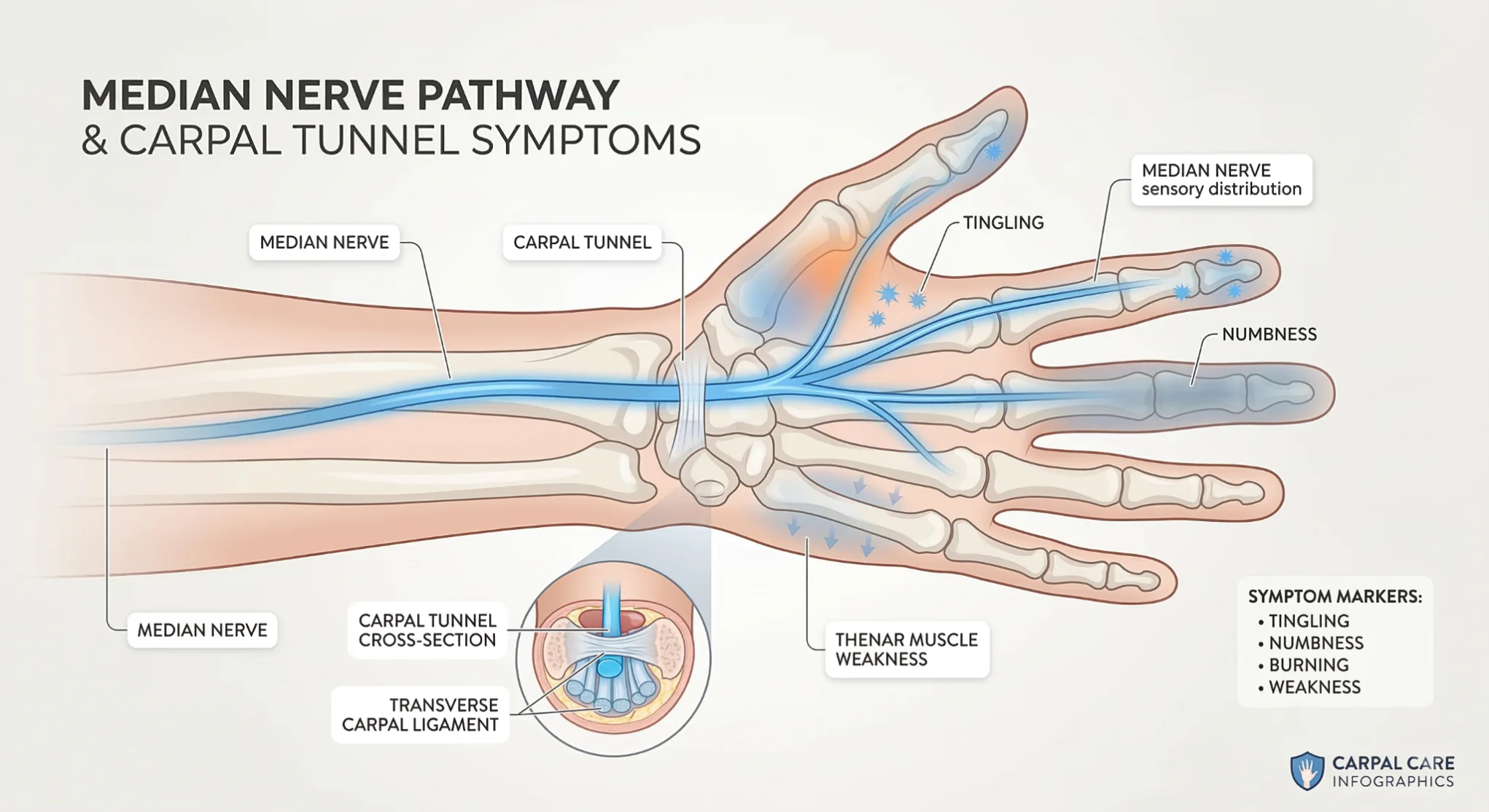
- Dropped or raised wrists. Playing with the wrists sagging below the keys or arched high bends the wrist for long periods, which raises pressure inside the carpal tunnel.
- Pressing too hard. Forcing loud passages from the fingers alone overloads the finger flexor tendons.
- Wide stretches without relief. Repeated octaves and large chords hold the hand open under tension, especially for smaller hands.
- Marathon practice. Hours without a break before a performance give the tendon linings no time to recover.
- Playing through numbness. Tingling during or after practice is an early warning. Pushing through it lets the swelling build.
None of these habits means pianist carpal tunnel has to stop you from playing. Small changes in technique and practice habits, plus nighttime treatment, are usually enough to keep a pianist at the keyboard.
7 Tips to Protect a Pianist’s Hands
- Warm up. A few minutes of gentle finger, wrist and forearm movement before you play.
- Keep the wrists level. Adjust the bench height so the forearms are roughly parallel to the floor and the wrists neither drop nor lift sharply.
- Use the arm, not just the fingers. Let the weight of the arm help with dynamics instead of forcing every note from the fingers.
- Break up long sessions. Short breaks every 25 to 30 minutes give the tendons time to recover.
- Increase practice time gradually. Sudden jumps before a recital are a common trigger.
- Stretch gently. Up to 6 sets of 10 a day, holding each stretch 15 seconds; skip grip balls and putty while symptoms are active.
- Treat pianist carpal tunnel early. Night tingling or numb fingers in the morning are the time to start the Carpal Solution, not after you lose control on the keys.
5 Gentle Stretches for Pianist Carpal Tunnel Relief
These gentle stretches fit easily into a practice break. Do up to 6 sets of 10 a day, hold each stretch about 15 seconds, and rest 30 seconds between. Stretch only to a light pull, never to pain or tingling.
- Wrist flexor stretch. Hold one arm out, palm up. With the other hand, gently draw the fingers down and back until you feel a mild stretch on the inside of the forearm.
- Wrist extensor stretch. Hold the arm out, palm down, and gently bend the wrist downward with the other hand to stretch the top of the forearm.
- Tendon glides. Move slowly through a sequence: straight fingers, hook fist, full fist, flat fist and straight again. This helps the nine finger tendons slide smoothly through the tunnel.
- Median nerve glide. With the elbow straight, gently extend the wrist and fingers while tilting the head away, then return. Keep it slow and easy.
- Finger spreads. Spread the fingers wide, hold, then relax. A good reset after long passages of tight chords.
Daytime stretches are a bonus, not a substitute for treatment. For pianist carpal tunnel symptoms that wake you at night or linger in the morning, the Carpal Solution provides the steady stretching during sleep that daytime routines cannot match. Avoid grip balls and putty until you are in remission.
Many professional pianists build these stretches into their warm-up and cool-down routines, the same way singers warm up their voices. A few minutes before and after each session costs little time and helps keep the forearm muscles, where the finger flexors are located, loose and well supplied with blood.
What to Expect From the Carpal Solution
- Six-week protocol: worn while you sleep, every night for two weeks and then every other night for four weeks, for over 220 hours of gentle stretching.
- 2 to 3 weeks: most people feel their worst symptoms ease.
- By 6 weeks: over 90% reach remission. About 10% need 8 to 12 weeks and are usually 50 to 70% better at 6 weeks.
- Prevention: once in remission, a short treatment from once a week to once every six months helps keep symptoms away.
A splint holds the wrist in a neutral position, which can reduce pain from movement, but it does not promote healing from carpal tunnel syndrome. It causes muscle atrophy and stiffness, which no pianist can afford, and our medical team has observed that splints give some relief at first but aggravate symptoms in the long run.
Why Musicians Think Twice About Surgery
For a pianist, surgery means weeks away from the keyboard and a risk to the fine control a musician depends on. Carpal tunnel surgery has a patient satisfaction rate lower than 69%: about 31% of patients report lingering or recurring symptoms, and no patient is satisfied with lingering symptoms (Bland, Muscle & Nerve, 2001). Second surgeries are needed in 16% to 40% of cases. If you have already had surgery, wait 3 months before starting the Carpal Solution.
Many musicians also face a long wait for care. The average new-patient doctor appointment takes 31 days (AMN Healthcare, 2025); read about relief while waiting for carpal tunnel treatment. See also how violinists manage carpal tunnel.
When Healing Needs a Doctor’s Help and Professional Medical Evaluation
- Constant numbness that does not improve or loss of feeling in the fingertips that does not improve in 4 to 8 weeks.
- Extreme loss of the muscle at the base of the thumb, with loss of grip strength that does not improve over 6 to 8 weeks.
- Worsening symptoms over 6 to 8 weeks while using the best conservative treatments
- Symptoms that begin suddenly after hand or wrist trauma, a fracture or severe sprain from a fall or auto accident.
- Odd Symptoms that are not consistent with the Carpal Tunnel Symptoms listed on this website, that might be indicative of other nerve issues. A nerve conductivity study can clear up the confusion with minimal costs and not too much pain and no risk.
These signs may mean more advanced nerve involvement or a different condition and deserve professional medical evaluation and in person consultation. Home treatment can be used alongside professional in-person medical care while you wait for the healthcare delivery system to fit you into their schedule. There is no reason to wait doing nothing. You can start proven natural conservative treatment with good patient reviews while you wait for your appointments.
If your symptoms start improving over 6 to 8 weeks, then you know you are on the right track and surgery is not necessary.
Frequently Asked Questions
Can you keep playing with pianist carpal tunnel?
Many do. The Carpal Solution is worn at night, so there is no time away from practice. Shorter sessions and good technique help while you heal.
Why does this pianist give 5-star review marks to the Carpal Solution?
Cathy says it lets her play and care for her family without pain, tingling or numbness, and that she sleeps through the night again.
How often do pianists need to repeat the treatment?
Cathy reorders every three to four years. Most people stay in remission 5 to 7 years, ranging from 1 to 17 years.
Should a pianist wear a wrist brace?
A brace only holds the wrist still and can cause stiffness and muscle atrophy. Our medical team has observed that braces and splints aggravate symptoms in the long run.
Does the Carpal Solution affect my playing the next day?
No. It is worn only while you sleep and removed in the morning, so nothing is on your hands when you practice or perform.
Can I use it before a big performance?
Yes. Many musicians use it for a few nights when a heavy rehearsal schedule brings symptoms back, the same way Cathy reorders when her symptoms return.
Is it covered by insurance?
With a prescription for a hand finger orthosis, it can be reimbursed under HCPCS code L3924, typically at 70% to 80%.
What are the first signs of pianist carpal tunnel?
Tingling or numbness in the thumb, index and middle fingers during or after practice, waking at night with numb hands, and a clumsy feeling on fast passages. Pianist carpal tunnel symptoms often start mild and come and go, which is the easiest time to treat them.
Do pianists need a diagnosis first?
You should see a doctor for a formal diagnosis. Our doctors’ two decades of clinical experience is that three or more typical symptoms make it about 95% likely to be carpal tunnel syndrome; that is clinical experience, not a published statistic.
Sources
- Bragge P, Bialocerkowski A, McMeeken J. A systematic review of prevalence and risk factors associated with playing-related musculoskeletal disorders in pianists. Occupational Medicine. 2006;56(1):28–38.
- Pratt E, McIlvain GE, Vauth H, Timmons MK. Musicians have thicker median nerve cross-sectional area and more symptoms of carpal tunnel than non-musicians. Medical Problems of Performing Artists. 2020;35(3):138–144.
- Bland JD. Do nerve conduction studies predict the outcome of carpal tunnel decompression? Muscle & Nerve. 2001;24(7):935–940.
- AMN Healthcare. Survey of physician appointment wait times, 2025.