Created by renowned Harvard health care professionals.



Written by Jeff Conley, President of First Hand Medical · Medically reviewed by Benjamin E. Bierbaum, MD, orthopedic surgeon and hand specialist, clinical professor of orthopedic surgery at Harvard Medical School · Last reviewed: November 2026
Table of Contents
 What does carpal mean? Like many medical terms and words in scientific english, Carpal Tunnel is derived from the Greek word Karpos, which means wrist. Tunnel comes from the shape of the narrow passage surrounded mostly by bone and a strong ligament at the base of the hand under which the Median Nerve and nine tendons pass.
The Median nerve and tendons combine to control precise feeling and movement in the fingers and hand. These bones and ligaments form a tight space, so whenever there is swelling of a tendon, the ligament or surrounding muscle or connective fascia tissue of the hand and wrist -painful Carpal Tunnel Syndrome is often the result.
The word Syndrome in CTS comes from the fact that the pain, sleep interruption and weakness does not necessarily derive from a disease or one specific factor, but usually from a set of conditions known as repetitive stress induced strain and a host of possible metabolic conditions.
In fact, there are over 15 different possible contributing factors to this frustrating condition. Hence the characterization as a “Syndrome” rather than a curable disease. It cannot be “cured” – but can be managed effectively with non-invasive consistent and disciplined soft tissue therapy.
Repetitive stress often combines with metabolic conditions, such as diabetes, water retention or arthritis, to aggravate and inflame the soft tissue in and around the Carpal Tunnel. The swelling of the soft tissue compresses the Median Nerve against the tendons and the Transverse Carpal Ligament at the top of the Carpal Tunnel and brings on Carpal Tunnel Discomfort.
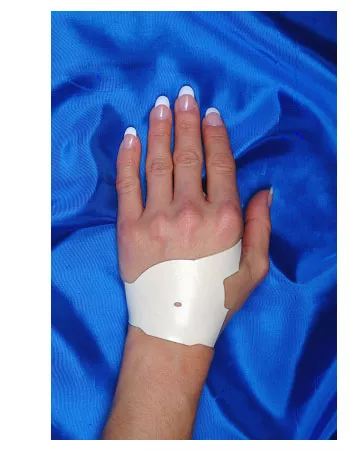
Carpal Solution Therapy gently decompresses and reshapes the soft tissue and relieves crowding of the Carpal Tunnel in weeks. Most people feel relief of their worst symptoms in two to three weeks, and over 90% resolve their symptoms within six weeks. Like good physical therapy, it provides the gentle consistent disciplined therapy needed over a six week protocol with minimum interruption to one’s busy life-style.
Carpal can refer to any of the bones of the carpus at the base of the hand and in the wrist.
Functional Anatomy: The wrist joint is composed of distal radial and ulnar surfaces, 8 carpal bones, and the proximal metacarpal bones. The distal carpal row consists of the following bones: hamate, capitate, trapezoid, and trapezium. The proximal row consists of the following bones: scaphoid, lunate, triquetrum, and pisiform. The carpal bones are held together by a complex set of soft tissue including the interosseous, volar, and dorsal ligaments and a triangular fibrocartilage complex (TFC). There are over 27 bones that make up the anatomy of the hand and wrist. These are held together by the Transverse Carpal Ligament, Fascia Tissue, Muscle and Tendons of the hand, wrist and forearm.
It is a complex web of soft and hard tissue that allows the miracle of hand dexterity to operate smoothly and without complication for most of our lives. We tend to take this miracle of precise movement for granted until something quits working the way it always has, then we wonder what is going on. The body also has a remarkable ability to heal itself naturally when the right kind of enabling therapy is applied. The Carpal Solution has earned 97% patient satisfaction over two decades in controlling Carpal Tunnel symptoms, without surgery, steroid injections or long-term pain pills.
Not only has Carpal Tunnel Syndrome often been confusing to understand and treat using the conventional health care methods, but it is commonly misspelled. Now the Carpal Solution offers a more reliable method to spell, understand and manage your symptoms without the complications, confusion and risks of restrictive splints, oral pain meds, steroid injections, and invasive surgery with long rehabs. A splint holds the wrist in a neutral position, which can reduce pain from movement, but it does not promote healing from carpal tunnel syndrome. It causes muscle atrophy and stiffness, and its tight compression restricts blood circulation and lymphatic fluid exchange, which slows the dispersion of entrapped swelling, the root cause of carpal tunnel syndrome. Our medical team has observed that splints give some relief at first but aggravate symptoms in the long run. Immobilization is great for fractures and sprains, but not for carpal tunnel syndrome.
On this website you will find authoritative information that will help guide your decision process with confidence and security and no risks. The Carpal Solution offers proven unique therapy that you can reliably depend on without fear of complications or downtime.
Some Common Misspellings of Carpal Tunnel Syndrome include:
- Carpal Tunnell Syndrome
- Carpal Tunnel Sydrome
- Carpal Tunnel Syndrone
- Carpal Syndrome
- Carpal Tunal
- Carpal Tunnel Syndrum
- Carpal Tunnel Symdrome
- Carpol Tunnel Syndrome
- Carpul Tunnel Syndrome
- Carpel Tunnel Syndrome
- Carpal Tunel Syndrome
- Carpal Tunnal Syndrome
The correct spelling is: Carpal Tunnel Syndrome.
For Relief Carpal Tunnel Syndrome Symptoms, Order the Carpal Solution Today.
What Does Carpal Mean in “Carpal Tunnel Syndrome”? Word by Word
- Carpal means “of the wrist.” It comes from the Latin carpalis, from the Greek karpos, meaning wrist.
- Tunnel describes the narrow passage at the base of the hand, with the carpal bones as the floor and walls and the transverse carpal ligament as the roof.
- Syndrome means a group of symptoms that tend to occur together, rather than a single disease with a single cause.
Put together, carpal tunnel syndrome means the group of symptoms, such as numbness, tingling, pain and weakness, that happen when the median nerve is squeezed inside the wrist’s tunnel.
The 8 Carpal Bones
So what does carpal mean when doctors talk about bones? The carpus, or wrist, is made of eight small carpal bones arranged in two rows of four.
- Proximal row (closest to the forearm), from the thumb side: scaphoid, lunate, triquetrum and pisiform.
- Distal row (closest to the fingers), from the thumb side: trapezium, trapezoid, capitate and hamate.
The carpal bones form a curved arch. The transverse carpal ligament stretches across the top of that arch, turning it into the carpal tunnel. The median nerve and nine flexor tendons pass through this tight space, which is why even a little swelling can press on the nerve.
Related Carpal Terms You May Hear
Knowing what carpal means makes these related medical terms much easier to follow:
- Carpus: the wrist as a whole, made of the eight carpal bones.
- Metacarpal: the five long bones of the hand between the wrist and the fingers. “Meta” means beyond, so metacarpal means beyond the wrist.
- Transverse carpal ligament: the strong band of tissue that forms the roof of the carpal tunnel.
- Carpal tunnel release: the surgery that cuts the transverse carpal ligament to make more room for the nerve.
- Carpometacarpal (CMC) joint: where the carpal bones meet the metacarpals, including the thumb’s base joint.
- Carpal boss: a small bony bump on the back of the wrist where the carpal bones meet the hand bones.
Other Conditions With “Carpal” in the Name
Once you know what carpal means, many wrist diagnoses become easier to understand. Not every wrist problem is carpal tunnel syndrome:
- Scaphoid fracture: a break in the carpal bone at the base of the thumb, usually from a fall on an outstretched hand. It can be easy to miss on a first X-ray.
- Kienböck’s disease: loss of blood supply to the lunate, one of the central carpal bones, causing wrist pain and stiffness.
- Carpal instability: damage to the ligaments that hold the carpal bones together, often after an injury.
- Wrist arthritis: wear or inflammation of the joints between the carpal bones.
- Ulnar tunnel syndrome: compression of a different nerve, the ulnar nerve, on the little-finger side of the wrist.
Because these conditions can feel similar, a doctor’s diagnosis is the right first step for any ongoing wrist pain or numbness.
Carpal Tunnel Syndrome Symptoms
Now that you know what carpal means, here is what carpal tunnel syndrome feels like. Symptoms usually affect the thumb, index finger, middle finger and half of the ring finger, the area supplied by the median nerve:
- Numbness or tingling, often worse at night or when you wake up.
- Pain or burning in the hand, wrist or forearm.
- A feeling that the fingers are swollen even when they are not.
- Weakness or clumsiness, such as dropping things.
- In more advanced cases, thinning of the muscle at the base of the thumb.
If your little finger is the main problem, the cause is probably a different nerve, so see a doctor for a proper diagnosis.
Treating Carpal Tunnel Syndrome Without Surgery
Knowing what carpal means helps explain how carpal tunnel syndrome is treated. Because the problem is crowding in a tight space, the goal is to relieve the pressure on the median nerve.
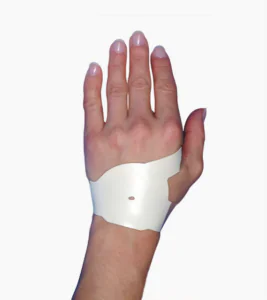
The Carpal Solution is a medically prescribed passive stretching device worn at night. It gently stretches the tissue around the carpal tunnel to make more room for the nerve, delivering more than 220 hours of targeted stretching over the six-week protocol. Most people feel their worst symptoms ease in two to three weeks, and over 90% resolve their symptoms within six weeks. Over two decades, more than 100,000 people have used it, with 97% patient satisfaction and 4.9 out of 5 stars on independent review sites like Google Reviews.
Surgery, by comparison, has a patient satisfaction rate lower than 69%: about 31% of patients report lingering or recurring symptoms, and no patient is satisfied with lingering symptoms (Bland, Muscle & Nerve, 2001).
Because carpal tunnel syndrome is chronic and recurring, prevention matters too. Keep your wrists straight while you sleep, take short breaks from hand-intensive work, use a lighter grip on tools and devices, and once you are better, many people wear the Carpal Solution from once a week to once every six months to keep symptoms from coming back. Gentle daytime stretches and cold therapy after a long day can help as well.
When Healing Needs a Doctor’s Help and Professional Medical Evaluation
- Constant numbness that does not improve or loss of feeling in the fingertips that does not improve in 4 to 8 weeks.
- Extreme loss of the muscle at the base of the thumb, with loss of grip strength that does not improve over 6 to 8 weeks.
- Worsening symptoms over 6 to 8 weeks while using the best conservative treatments
- Symptoms that begin suddenly after hand or wrist trauma, a fracture or severe sprain from a fall or auto accident.
- Odd Symptoms that are not consistent with the Carpal Tunnel Symptoms listed on this website, that might be indicative of other nerve issues. A nerve conductivity study can clear up the confusion with minimal costs and not too much pain and no risk.
These signs may mean more advanced nerve involvement or a different condition and deserve professional medical evaluation and in person consultation. Home treatment can be used alongside professional in-person medical care while you wait for the healthcare delivery system to fit you into their schedule. There is no reason to wait doing nothing. You can start proven natural conservative treatment with good patient reviews while you wait for your appointments. If your symptoms start improving over 6 to 8 weeks, then you know you are on the right track and surgery is not necessary.
What Does Carpal Mean: Frequently Asked Questions
What does carpal mean in medical terms?
Carpal means relating to the wrist, or carpus. It comes from the Greek karpos, meaning wrist.
What does carpal mean in carpal tunnel?
In carpal tunnel, carpal simply means wrist. The carpal tunnel is the narrow passage through the wrist, formed by the carpal bones and the transverse carpal ligament, that the median nerve and nine tendons pass through.
What does carpal mean for my symptoms?
It tells you where the problem is: at the wrist. Even though you feel numbness and tingling in your fingers, the nerve is being squeezed at the wrist, which is why treatment focuses on relieving pressure inside the carpal tunnel.
How many carpal bones are there?
Eight, arranged in two rows of four: scaphoid, lunate, triquetrum and pisiform, then trapezium, trapezoid, capitate and hamate.
Is it spelled carpal or carpel?
Carpal, with an a, means wrist. Carpel, with an e, is a part of a flower. The correct spelling is carpal tunnel syndrome.
Can carpal tunnel syndrome be cured?
No. Carpal tunnel syndrome is chronic and recurring and cannot be cured, by surgery or anything else. The Carpal Solution is the next best thing, controlling symptoms at home without downtime, risks, scar tissue or complications.
What Does Carpal Mean in Medicine?
What does carpal mean? In anatomy, carpal means “relating to the wrist.” The word comes from the Greek karpos, and the carpus is the group of small bones that connects your hand to your forearm. You can read the dictionary definition of carpal, but in everyday medical language the word most often shows up in carpal tunnel syndrome.
What Does Carpal Mean in the Term Carpal Tunnel?
In carpal tunnel syndrome, the carpal tunnel is the narrow passage at the base of the hand, formed by the carpal bones and a strong ligament. The median nerve and nine tendons pass through it. When the soft tissue inside swells, it can press on the median nerve and cause numbness, tingling and pain in the hand. So, what does carpal mean for your hands? It points to the wrist area where the nerve passes through the tunnel. Read more about where the carpal tunnel is located and the anatomy of the carpal tunnel and soft tissue.
How Do You Spell and Say Carpal?
Many people ask “what does carpal mean,” and just as many ask how to spell it. Carpal is spelled c-a-r-p-a-l and pronounced KAR-pul. It is often confused with “carpel,” which is a part of a flower, and the full term is carpal tunnel syndrome, usually shortened to CTS.
What Does Carpal Mean: Frequently Asked Questions
What does carpal mean in carpal tunnel syndrome?
It refers to the wrist. The carpal tunnel is the passage at the base of the hand that protects the median nerve and the tendons that move your fingers.
Is carpal tunnel the same as wrist pain?
Not always. Wrist pain has many possible causes, while carpal tunnel syndrome involves pressure on the median nerve and typically causes numbness or tingling in the thumb, index and middle fingers. Our guide to carpal tunnel symptoms explains the differences.
Where can I learn about carpal tunnel treatment?
A conservative approach starts with gentle, non-invasive therapies before anything more invasive. See how The Carpal Solution works for a doctor-developed nighttime stretching treatment.