 Created by renowned Harvard health care professionals.

Does Laser Help Carpal Tunnel? What the Evidence Says (LLLT)
Can light energy fix a pinched nerve? Low-Level Laser Therapy (LLLT), or "cold laser," offers a non-invasive way to target pain and inflammation. But because it cannot mechanically open the carpal tunnel, its ability to treat firm nerve compression is limited. We review the evidence to explain what LLLT actually does, what it misses, and where it fits in a comprehensive treatment plan.
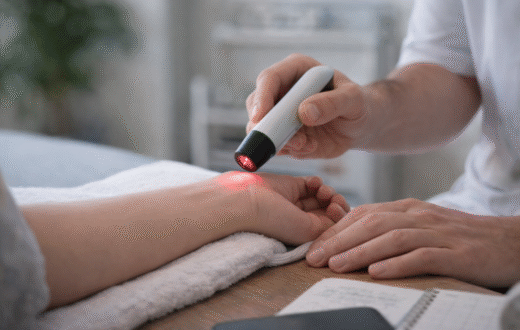

What LLLT Is, and What It Is Not
Low-Level Laser Therapy is a noninvasive treatment that applies light energy to tissues, usually at the wrist over the carpal tunnel region, sometimes extending into the forearm. Clinics may call it cold laser, photobiomodulation, or LLLT. The goal is typically to reduce pain, calm inflammation, and support tissue recovery.
LLLT is not surgery, it is not a steroid injection, and it does not mechanically “open” the carpal tunnel. If symptoms are driven by firm mechanical compression of the median nerve, light therapy can only do so much. That is why it helps to understand where lasers fit in the overall treatment ladder.
Why Results Look “Mixed” Across Studies
When people say “laser helped me”, and others say “laser did nothing,” both can be true, because laser research has several built-in variables.
Laser Settings Vary a Lot
Studies often use different wavelengths, doses, power outputs, application times, and numbers of sessions. A protocol that helps in one trial might be very different from what a clinic uses in real life. When protocols vary, outcomes vary.
People in Studies Are Not All the Same
Carpal tunnel syndrome is not one uniform condition. Some participants have mild, position-dependent symptoms. Others have longer-lasting symptoms, constant numbness, or nerve damage shown on testing. A laser is more likely to show short-term effects in mild-to-moderate cases than in severe or advanced compression. A placebo-controlled trial, for example, reported short-term improvements in mild-to-moderate cases compared with placebo.
What Laser Is Compared Against Matters
Laser may look better than placebo in the very short term, but not clearly better than other conservative treatments, or not better enough to matter clinically. In real life, the question is rarely “laser versus nothing,” it is “laser versus a splint, exercise program, injection, or surgery.”
Follow-Up Length Changes the Story
Several summaries note that any positive effects tend to fade quickly. A best-evidence synthesis published in Archives of Physical Medicine and Rehabilitation reported strong evidence for a very short-term benefit compared with placebo, with diminishing effects over time.
What do the Best Evidence Summaries Say?
Cochrane, Very Low Certainty Overall
Cochrane’s evidence summary concludes that the certainty is very low and that the available trials are small and at risk of bias, making it hard to confidently claim a clinically meaningful effect of LLLT in carpal tunnel syndrome.
Systematic Review and Network Meta-Analysis, Limited Added Value Over Splinting
A systematic review and network meta-analysis focused on LLLT as an add-on to splinting concluded that any additional benefits were limited and not clearly superior in symptom severity or functional status compared with splinting alone.
AAOS Guideline, Laser Sits in the “Mixed or No Difference” Bucket
The American Academy of Orthopaedic Surgeons guideline discusses a group of nonoperative modalities with high-quality overall evidence but limited option strength, and notes that studies on laser therapy show mixed results, with several showing no difference compared with orthosis or placebo.
Plain English translation: a laser might help some people in the short term, but the overall evidence does not support relying on it as a primary treatment, especially if symptoms are disruptive or worsening.
When Laser Might Be Reasonable
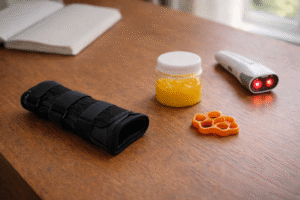
Laser makes the most sense when you treat it as an add-on, not a replacement for the basics.
Consider a laser if all of the following are true:
- Your symptoms are mild to moderate and still change with position.
- Night waking is a significant issue, but you can still function during the day.
- You are already doing the fundamentals, neutral wrist positioning at night when needed, pacing and microbreaks, and a safe mobility plan.
- Cost and time are acceptable for an option with uncertain durability.
- You are willing to stop quickly if you do not see real improvement.
Where laser may fit best is as a short trial while you build the foundation, so that you can separate “temporary symptom easing” from “actual functional recovery.”
When Laser Is Probably Not Worth It
A laser is less likely to be in focus if:
- You have constant numbness that does not change with wrist position.
- You have an apparent weakness, such as frequent dropping or loss of grip strength.
- You notice visible thinning at the base of the thumb.
- Your symptoms are getting worse month by month.
- You are using a laser to delay a needed medical evaluation.
In these scenarios, a clinician should assess severity and confirm the diagnosis. If surgery is on the table, you will want evidence-based guidance on timing, recovery, and what success looks like.
Better Supported Ways To Get Relief
If your goal is reliable improvement in sleep and function, prioritize the options that show the most consistent, meaningful benefit, and use add-ons like laser only if they fit.
Neutral Night Positioning, Short and Intentional
A neutral night splint can help some people with night-waking symptoms, especially early on, and it is typically low risk as a short-term trial. The key is to avoid wearing a splint all day and getting stiff. Use it as a bridge, not a forever device.
A Safe Mobility Plan That Improves Glide and Tolerance
Nerve glides, tendon glides, and gentle forearm stretching can support symptom control for some people when performed correctly and in accordance with safety guidelines. Your plan should be calm, consistent, and track outcomes such as sleep interruptions and task tolerance. Read more on how nighttime stretching provides relief and improves glide.
Injection for Persistent Mild to Moderate Symptoms
When symptoms are persistent and disruptive, a local corticosteroid injection can provide relief for a period of time. It can be an essential step for regaining sleep and function while you continue activity changes and mobility work.
Surgery for Severe or Refractory Cases
If there is advanced compression, progressive weakness, or failure of conservative care, surgical release is often the most reliable way to decompress the nerve.
Safety Notes and Red Flags
LLLT is generally considered low risk when delivered appropriately, but the most significant risk in carpal tunnel care is not the light itself; it is losing time while nerve compression progresses.
Get medical evaluation promptly if you notice:
- Constant numbness.
- Apparent weakness, frequent dropping, or reduced pinch strength.
- Visible muscle changes at the thumb base.
- Symptoms outside the usual thumb, index, and middle finger pattern.
If you want help deciding whether you are in the “safe to try conservative care” category or the “evaluate now” category, contact our team.
Key Takeaways
- LLLT has mixed evidence, with some short-term benefit signals in mild-to-moderate cases, but low certainty overall in high-level evidence summaries.
- A network meta-analysis suggests limited added value when a laser is added to splinting, especially for functional outcomes.
- Recent guideline discussion notes laser therapy studies show mixed results, and several show no difference versus orthosis or placebo, so it should not be treated as a core plan.
- If you try laser, treat it as a short, measured add-on while you do positioning, pacing, and mobility work.
- If you have constant numbness or weakness, prioritize medical evaluation and the whole decision pathway.

Laser Therapy (Low-Level Laser Therapy / LLLT) for Carpal Tunnel Syndrome