 Created by renowned Harvard health care professionals.

Carpal Tunnel Surgery & “Laser” Surgery: Options, Risks, Recovery & When to Consider It
Thinking about Carpal Tunnel surgery? If braces haven't helped, you might be at a crossroads. But before you book "laser surgery," know the facts—it’s often just marketing jargon. This guide compares real surgical options (open vs. endoscopic), explains the risks, and helps you decide when surgery is truly necessary versus when a structured conservative approach is still your safest bet.


If you are searching for carpal tunnel surgery, carpal tunnel syndrome surgery, or carpal tunnel laser surgery, you are probably at a crossroads.
Maybe you have tried a brace, glove, or wrist support and still wake up at night with numbness. Maybe you are dropping things, losing grip confidence, or feeling pressure to “just get surgery and be done.”
Here is the supporting evidence: Surgery can help many people, especially when the nerve is clearly compressed and symptoms are severe, but it is not a first-line option for most mild-to-moderate cases. It is a procedure with real trade-offs, including recovery time and a meaningful risk of lingering pain, scar sensitivity, or incomplete relief. NHS decision guidance also notes that surgery may not improve symptoms if you wait too long and already have severe nerve damage, constant numbness, or muscle loss.
This pillar post will help you:
- Understand what surgery actually does (and what it cannot do).
- Separate “laser surgery” marketing from real surgical techniques.
- Compare open vs endoscopic release.
- Know the risks, recovery timeline, and common disappointments.
- Decide when conservative care should be the first option and when surgery is reasonable.
What “Laser” Carpal Tunnel Surgery Really Means
“Carpal tunnel laser surgery” is a phrase that causes significant confusion. In practice, it usually means one of these three things:
1) Endoscopic release marketed as “laser”
Some clinics use “laser” language to signal “minimally invasive,” even when the procedure is a standard endoscopic carpal tunnel release that uses a camera and surgical instruments to cut the ligament. Mainstream clinical sources typically describe endoscopic and open methods, not a distinct “laser technique” as the standard of care.
2) Non-surgical low-level laser therapy (LLLT)
This is not surgery. It is a conservative modality sometimes used to relieve symptoms. Evidence reviews have found that the quality of evidence is very low and long-term benefits are uncertain.
3) A newer “incisionless” or percutaneous technique (not classic laser)
Some emerging techniques use ultrasound guidance and specialized cutting tools. These differ from open or endoscopic release and are not always available.
What to do if someone offers “laser surgery”: ask this directly
- Is this an open release, endoscopic release, or a percutaneous ultrasound-guided release?
- What instrument is used to cut the ligament?
- What are your complication and revision rates for this exact technique?
- What happens if symptoms persist, and what is the next step?
If the answers are vague, slow down and get a second opinion.
When Surgery Makes Sense, and When It Usually Does Not
Surgery Is Most Reasonable When:
- Symptoms are severe or worsening, especially weakness or muscle loss.
- Numbness is constant, not just at night.
- Conservative care has been implemented, and function continues to decline.
- Testing and clinical findings support significant median nerve compression.
AAOS patient education notes that severe cases may not fully regain normal sensation, but surgery can still be important to prevent worsening.
Surgery Is Usually Not the Best First Step When:
- Symptoms are mild to moderate and still fluctuate.
- Nighttime symptoms improve with conservative steps.
- You have not yet tried a structured, conservative plan.
- The diagnosis is uncertain (for example, neck issues, tendon problems, arthritis).
A 2024 Cochrane evidence summary found that surgery likely leads to a higher rate of clinical improvement than manual therapy; however, for other outcomes, benefits may be limited, and comparisons with other non-surgical interventions remain uncertain. The practical takeaway is not “never surgery,” it is “do not rush to surgery when conservative care still has room to work.”
Step-by-Step: How to Decide If Surgery Is Appropriate
Step 1: Confirm You Are Treating the Right Problem
Carpal tunnel syndrome has a recognizable pattern, but not every hand symptom is CTS. A diagnosis typically combines a symptom history, physical exam, and, in some cases, tests.
Outcome you want: High confidence diagnosis before irreversible decisions.
Pitfall: Treating “hand numbness” as CTS when the neck, elbow, or tendons are the real driver.
Step 2: Grade Severity: Mild, Moderate, or Severe
Your decision should match the severity.
- Mild to moderate cases usually deserve a conservative trial first.
- Severe cases, especially weakness or muscle loss, should be referred more quickly for specialist evaluation.
NHS decision guidance warns that waiting too long with severe nerve damage or muscle loss can limit how much surgery helps.
Outcome you want: A plan that matches risk.
Pitfall: Delaying too long, or rushing too early.
Step 3: Do a Time-Boxed Conservative Trial (Not “Random Things”)
A real conservative trial is structured and measured, not a drawer full of braces and gadgets.
Good conservative building blocks often include:
- Nighttime wrist positioning strategies
- Activity modification and microbreaks
- Guided therapy, glides, or stretching approaches
- In some cases, injection as a temporary symptom control tool
Outcome you want: Better sleep and function within a defined window.
Pitfall: “Trying everything at once,” then not knowing what worked.
Step 4: Decide With “Function and Sleep” Metrics, Not Fear
Surgery decisions should be driven by:
- Sleep interruption frequency
- Daytime function (typing, driving, tools, caregiving)
- Grip confidence (dropping things)
- Objective weakness or muscle changes
Outcome you want: A decision you can defend with data.
Pitfall: Surgery purely because you are tired of symptoms, without confirming the pattern.
Step 5: If Choosing Surgery, Choose the Technique and the Surgeon Deliberately
AAOS clinical guidance indicates there is no difference in long-term patient-reported outcomes between mini-open and endoscopic release. Choose based on the surgeon’s experience, your health factors, and your recovery needs.
Outcome you want: The safest technique in the most experienced hands.
Pitfall: Choosing a method based on marketing (including “laser”) instead of outcomes.
Surgery Options: Open vs Endoscopic

Open Carpal Tunnel Release
A small incision is made in the palm area, and the ligament is cut under direct visualization. NHS patient leaflets describe open release as the traditional approach.
Typical advantages:
- Direct visualization
- Widely available
- Strong track record
Common trade-offs:
- Scar tenderness, pillar pain, and slower early comfort for some people
Endoscopic (Keyhole) Carpal Tunnel Release
A small incision (or two) is used, a camera is inserted, and instruments cut the ligament from inside. Mayo Clinic notes that endoscopic surgery may result in less pain than open surgery in the first days or weeks after surgery. AAOS guideline review notes long-term outcomes are similar, and endoscopic release may allow shorter return to work for some, with costs and complication considerations varying by context.
Typical advantages:
- Smaller incisions.
- Often faster early recovery for some people.
Common trade-offs:
- Requires specific training and equipment.
- Complication and revision profiles can vary by setting, surgeon, and technique.
Bottom line: Open and endoscopic release are both accepted approaches, and long-term outcomes are similar overall.
Risks, Side Effects, and Why Some People Feel Worse After Surgery
Even when carpal tunnel syndrome surgery is done well, these issues can occur.
Incomplete or Slow Relief
NHS decision guidance notes that surgery may not improve symptoms if nerve damage is severe or longstanding. AAOS patient information also notes that numbness and tingling can take months to improve, especially in severe cases.
Pillar Pain and Scar Sensitivity
Pillar pain is a recognized post-release complaint, often felt at the base of the palm. The American Society for Surgery of the Hand notes that pillar pain is a common symptom after carpal tunnel release.
Nerve or Vessel Injury (Rare, but Serious)
NHS endoscopic release leaflets list risks such as infection, bleeding, nerve injury with permanent numbness or weakness, and complex regional pain syndrome.
Symptoms Returning (Recurrence) or Needing Revision
Recurrence and revision happen. Some NHS guidance estimates lifetime recurrence and revision risk in a range, and other local aftercare leaflets also acknowledge recurrence risk.
Why “Successful Surgery” Can Still Feel Disappointing
Common reasons include:
- The nerve was compressed long enough that recovery is slow or incomplete.
- Another condition was present (neck irritation, diabetes-related neuropathy, arthritis).
- The hand becomes sensitive during healing, and activity avoidance reduces tolerance.
- Postoperative expectations were not realistic (strength and endurance take time).
This is why we emphasize a conservative-first approach for many mild-to-moderate cases and careful triage for severe cases.
Recovery Timeline: What Most People Experience
Recovery varies, but these themes are consistent across major patient education resources.
Immediately After Surgery (First Days)
- Soreness and swelling are common
- You may be encouraged to move fingers early.
- Night numbness may improve quickly for some, but not all.
First 1 to 2 Weeks
NHS guidance notes that you may not be able to drive safely for 1 to 2 weeks due to pain and weakness. Many people can perform light daily tasks, but gripping and lifting may be limited.
Weeks 3 to 6
Some NHS clinical guidance notes that the hand can be weak and sore for several weeks, with recovery of normal function expected in most cases. Tenderness and pillar pain can still show up here.
Months 2 to 6 and Beyond
Nerve symptoms can continue improving over months, especially numbness. AAOS notes that severe cases may take 6 to 12 months to regain sensation, and some may never completely regain normal sensation.
Important: If symptoms are worse, not just sore, or if new neurological deficits appear, call your surgeon.
Strategies & Frameworks: “Conservative First” Without Losing Time
Here is a decision framework that helps you stay safe and avoid two common traps: delaying too long or rushing too soon.
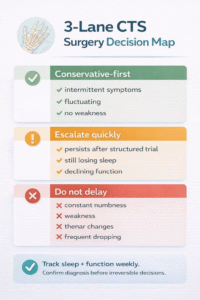
The “3-Lane” CTS Surgery Decision Map
Lane 1: Conservative-first (most mild to moderate cases)
You have intermittent numbness or tingling, symptoms fluctuate, sleep interruptions are present but not constant, and there is no clear weakness.
Plan: structured conservative care, track sleep and function weekly.
Lane 2: Escalate quickly (moderate cases that are not improving)
Symptoms persist after a defined conservative trial, you are still losing sleep, and your function is declining.
Plan: re-check diagnosis, consider injection or specialist evaluation, discuss surgery realistically.
Lane 3: Do not delay (severe cases)
Constant numbness, weakness, thenar muscle changes, frequent dropping, rapid decline.
Plan: Promptly schedule a specialist evaluation and discuss surgery timing, as waiting can reduce the chance of full recovery.
This is how you respect “surgery is not a great option” for many people, while still protecting those who truly need decompression.
Common Mistakes & How to Fix Them
- Mistake: Treating “laser” as a guarantee of easier recovery.
Fix: Ask what technique it actually is, open vs endoscopic, and what outcomes look like in that clinic. - Mistake: Going to surgery without a time-boxed conservative plan (when symptoms are mild to moderate).
Fix: Run a structured 2- to 6-week plan first, and track sleep and function weekly. - Mistake: Delaying too long with constant numbness or weakness.
Fix: Get evaluated promptly, because severe nerve damage can reduce recovery potential. - Mistake: Expecting immediate strength return.
Fix: Plan a staged return; strength and tolerance often take weeks to months to develop. - Mistake: Ignoring the possibility of overlapping conditions.
Fix: If symptoms are atypical, confirm diagnosis and consider systemic contributors.
Mini Case Example: Avoiding Surgery, Then Escalating the Right Way
Jordan has nighttime tingling and hand numbness that wakes them four nights per week. They read about carpal tunnel laser surgery and consider booking immediately.
Instead, Jordan runs a time-boxed conservative plan for four weeks:
- Nighttime strategy and structured stretching approach
- Work pacing and microbreaks
- Weekly tracking of sleep interruption and task tolerance
Sleep improves to one night per week, and grip confidence increases. Jordan avoids surgery.
Six months later, after a workload spike, symptoms become constant, and weakness appears. Jordan escalates quickly, gets evaluated, confirms severity, then discusses surgery realistically, including recovery and risk expectations. The decision is no longer driven by panic; a clear change in severity and function drives it.
Understanding Carpal Tunnel Surgery: Types, Risks, and Recovery
Know Your Options Before Surgery
Carpal tunnel syndrome surgery can be a meaningful option for severe or worsening cases, but it is not a great default for most mild to moderate symptoms. Before you commit, clarify what “laser surgery” actually means, compare open vs endoscopic realistically, and run a structured conservative plan when appropriate.