 Created by renowned Harvard health care professionals.

Steroid Injections vs. Splints vs. Surgery: What’s Typically Tried First?
Steroid injections vs splints vs surgery—most people with mild to moderate carpal tunnel symptoms begin with conservative care, typically including night splinting, activity modifications, and a targeted exercise program. If symptoms keep interrupting sleep or daily function, a steroid injection is often considered as a temporary “reset.” Surgery is typically reserved for severe cases or when conservative options fail, especially if there is constant numbness or weakness.


Steroid Injections vs Splints vs Surgery: Why Order Depends on Symptoms
Carpal tunnel syndrome is not one single experience. Two people can both say “my hand is numb,” but one has occasional night tingling that comes and goes, while the other has constant numbness with weakness and dropping objects.
That difference changes what’s reasonable to try first.
Most providers make the first choice based on three things:
- Severity, intermittent tingling vs constant numbness or weakness
- Time course, recent flare vs months of worsening symptoms
- Impact, sleep interruption, work limitations, loss of grip confidence
If you want the full overview of all options, including conservative care, injections, and when surgery enters the picture, see: Carpal Tunnel Treatment Options.
The Usual Stepwise Pathway Most Clinicians Follow
Here is the typical order in real life, with the big caveat that severe or progressive cases skip ahead.
Step 1: Conservative First
This usually includes:
- Nighttime wrist neutral strategies, often a night splint for a short trial
- Activity modification, less force, fewer long repetitive blocks, more microbreaks
- Hand and wrist exercises, especially gentle nerve and tendon glides, plus stretching with safety rules
- Ergonomic changes, keyboard, mouse, tool grip, phone habits
This is the default starting point for mild-to-moderate cases because it is low-risk, inexpensive, and often sufficient to control symptoms.
Step 2: Steroid Injection as a Bridge, Not a Forever Plan
If conservative care is not restoring sleep and function, a steroid injection is often used to reduce symptoms temporarily. For some people, it provides time to continue working while improving ergonomics and rebuilding tolerance.
It is usually not treated as a “cure,” but rather as a symptom-management tool with a defined time window.
Step 3: Surgery if Symptoms Are Severe or Not Improving
Surgery is commonly considered when:
- Symptoms remain significant after a structured conservative trial
- Numbness is constant, not just at night
- Weakness is present, grip is failing, or thumb muscle changes are seen
- Testing and exam findings suggest significant nerve compression
Many people still choose to avoid surgery if they can, because it involves downtime, recovery, and real risk trade-offs. That is why a conservative-first plan, done correctly, matters.
Know the full picture before you decide: Carpal Tunnel Surgery FAQ.
Splints First, What They Do Well, and Where They Fall Short
Why Splints Are Often First-Line
Night symptoms are frequently driven by wrist position during sleep. Many people unintentionally bend their wrists under a pillow or tuck them under their heads. A neutral wrist night splint can reduce wrist flexion, thereby reducing nighttime tingling in some people.
Splints are often tried first because they are:
- Low risk for most people
- Easy to access
- Simple to test for 1 to 2 weeks
- Helpful for the classic pattern of night waking
Where Splints Fall Short
Splints can help you sleep, but they do not automatically restore mobility, glide, or tolerance for daytime activity. Many people end up saying, “I slept better, but my daytime numbness and grip issues did not change.”
Common splint pitfalls:
- Wearing a rigid splint all day and getting stiff
- Tightening straps so much that tingling increases
- Using a splint as the only plan, without load management or exercises
- Staying in splint mode for months, rather than running a short trial and reassessing
Steroid Injections, When They Help, and What To Know Before Saying Yes
What Injections Are Typically Used For
Steroid injections are usually considered when:
- Night splinting and conservative changes are not enough
- Sleep interruption is ongoing
- Work function is dropping
- Symptoms are moderate, not just occasional tingling
Many clinicians treat injections as a way to calm a flare so you can resume a conservative plan with better results.
What Injections Do Not Do
Injections do not change:
- Your daily mechanical load, grip force, and workstation setup
- Your tissue mobility or glide by itself
- Underlying contributors that may keep symptoms recurring
That is why injections work best when paired with a plan, not used as a standalone fix.
Questions To Ask Before an Injection
- What is the goal: short-term relief, avoiding surgery, buying time, or confirming diagnosis?
- What should I do during the relief window to make gains stick?
- What are the risks in my situation, especially if I have diabetes or other conditions?
- What is the next step if symptoms return?
If you are unsure whether an injection makes sense for your symptom pattern, contact us so we can help you triage and choose a conservative-first plan that matches your severity.
Surgery, When It Makes Sense, and Why Many People Want To Avoid It
Surgery can be effective for the right person at the right time. But many people still want to avoid it unless clearly necessary.
Why Surgery Is Often a Last Step
Surgery is typically reserved for:
- Severe or progressive symptoms
- Constant numbness
- Weakness or frequent dropping
- Failure of conservative care when done consistently and correctly
Why Some People Regret Rushing Into Surgery
People can feel disappointed when:
- The diagnosis was not purely carpal tunnel, for example, neck or elbow nerve irritation was also present
- Nerve compression was present for too long, so numbness improves slowly or incompletely
- Postoperative sensitivity or stiffness limits early function
- The underlying drivers, like repetitive load, inflammation, or systemic contributors, were never addressed
A Simple Triage Checklist, Mild, Moderate, Severe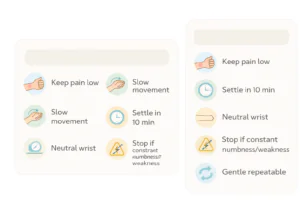

Use this to understand what is typically tried first for your level.
Mild Pattern
- Tingling comes and goes
- Symptoms mainly at night or after long hand use
- No weakness, no constant numbness
Typical first steps:
- Night splint trial for 1 to 2 weeks
- Ergonomic changes and microbreaks
- Gentle glides and stretching plan
Moderate Pattern
- Night waking is frequent
- Symptoms interfere with work or daily tasks
- Occasional dropping or clumsiness, but not clear weakness
Typical pathway:
- Conservative-first plan with tighter structure and tracking
- Consider injection if sleep and function do not improve
- Reassess quickly, do not drift for months without progress
Severe or Urgent Pattern
- Constant numbness
- Clear weakness, loss of grip strength, and frequent dropping
- Visible thumb muscle changes, or fast-worsening symptoms
Typical pathway:
- Prompt medical evaluation
- Conservative care may still play a role, but surgery discussion often happens sooner
- Do not delay if the function is declining
If you are not sure which category you are in, contact our team.
A Two-Week Decision Test You Can Run at Home

If you are in the mild-to-moderate range, this is a practical way to avoid estimation.
Week 1
- At night, use a neutral wrist strategy, usually a night splint, if symptoms wake you.
- During the day, reduce force and repetition, and add microbreaks every 30 to 45 minutes.
- Exercises: do gentle tendon and nerve glides once or twice daily.
- Track two markers, nights waking from symptoms, and minutes of comfortable work before tingling begins.
Week 2
- Keep the same plan.
- Make one ergonomic upgrade: mouse position, keyboard height, tool grip, and phone scrolling habits.
- If night waking is clearly improving, taper splint use and keep the exercise plan.
- If there is little change, it is time to compare next steps, including therapy support or injection discussions.
Common Mistakes That Lead to Unnecessary Escalation
- Trying three devices at once, then not knowing what helped
- Wearing rigid support all day, then getting stiff and weaker
- Doing aggressive stretches that spike tingling, then giving up on movement entirely
- Waiting too long with constant numbness or weakness
- Treating the injection as a cure, then returning to the same overload pattern
The goal is not “never escalate,” the goal is “escalate only when the conservative-first plan has been done well, and outcomes are clear.”
When To Contact Our Team
Reach out if you want help choosing what to try first based on your symptoms and lifestyle, especially if:
- Sleep interruption is ongoing
- You are dropping objects or losing grip confidence
- You are unsure whether you are mild, moderate, or severe
- You want to avoid unnecessary invasive steps and follow a conservative-first plan