 Created by renowned Harvard health care professionals.

How Long Does Carpal Tunnel Take to Heal? Timelines by Treatment
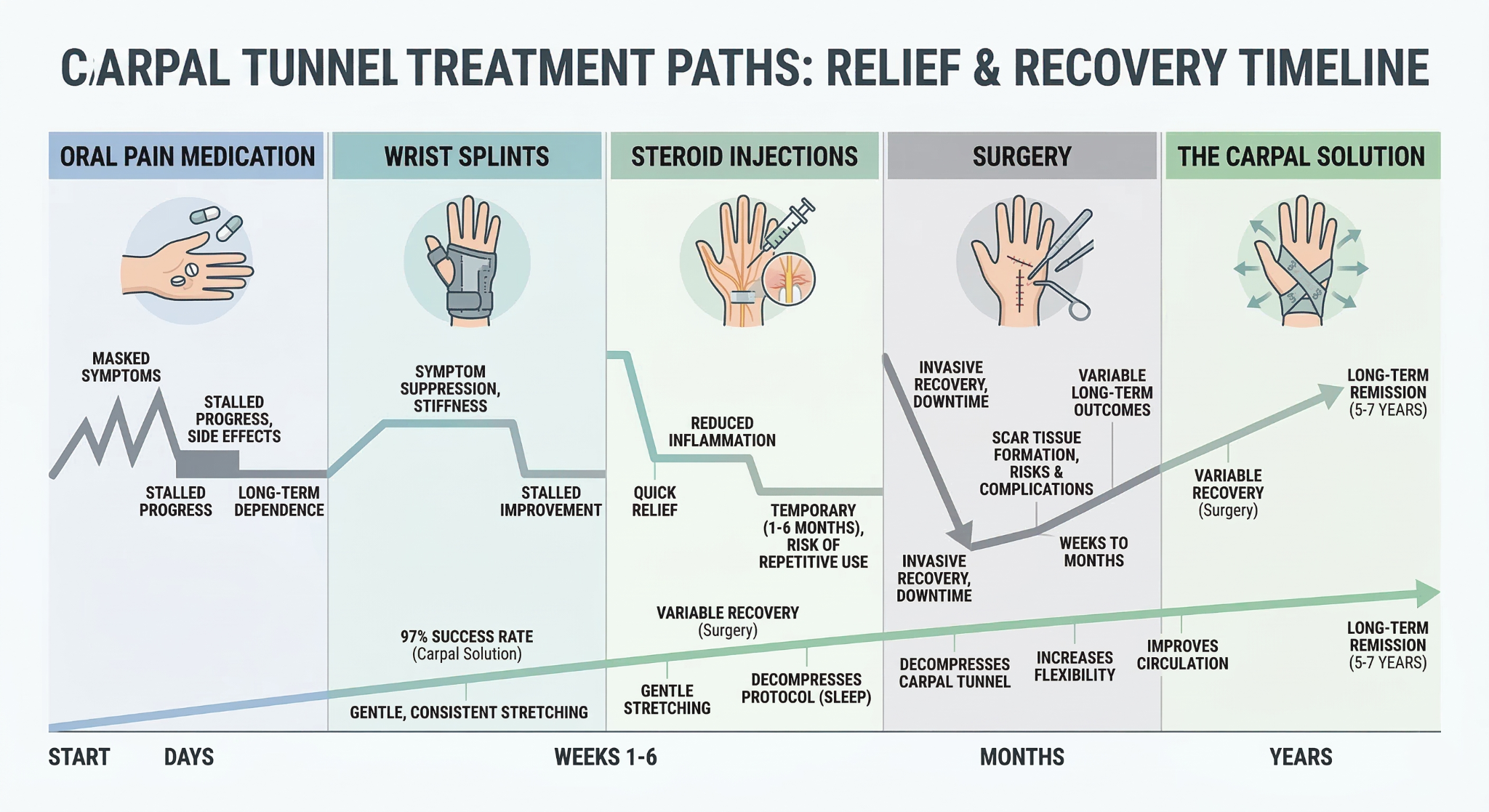
Wondering how long Carpal Tunnel takes to heal? The answer depends entirely on your treatment. While pain meds, wrist splints, and steroid injections might offer quick relief, they often just mask the underlying trapped inflammation. Even surgery isn't a guaranteed permanent fix. Discover realistic recovery timelines for each option and learn why true healing takes more than a quick patch.


If you are dealing with carpal tunnel symptoms, one of the first questions you probably have is, “How long is this going to take to heal?”
That is a fair question, but the answer depends a lot on the treatment path you choose.
Some options may take the edge off for a short time. Some seem helpful at first, but lose value over time. Some are invasive and still do not guarantee lasting relief. That is exactly why your brand guide emphasizes positioning The Carpal Solution as the superior option over conservative treatments, while explaining carpal tunnel as a trapped-inflammation problem, not just a simple nerve issue.
This article breaks down healing timelines by treatment, what people can realistically expect, and why “feeling better for a little while” is not the same as truly solving the problem.
First, What Does “Healing” Actually Mean With Carpal Tunnel?
A lot of people use the word healing when they really mean one of three different things:
- Symptoms feel a little better
- Nighttime flare-ups become less frequent
- The underlying problem is actually being addressed
Those are not the same thing.
Your brand guide makes that distinction important. It explains carpal tunnel as trapped inflammation that creates symptoms and also blocks the body’s ability to relieve that inflammation on its own, by pinching the nerve, blood flow, and lymphatic channels.
So when people ask how long it takes to heal, the better question is, “Which treatment is helping the body move out of that cycle, and which one is just covering symptoms for now?”
Timeline With Oral Pain Medication
Expected Timeline
Pain medication may reduce discomfort quickly, sometimes the same day or even the same night.
What That Really Means
That does not mean the carpal tunnel is healing.
Your brand guide says prescribed medications for carpal tunnel are risky, can be dangerous or addictive, and should not be used for a chronic recurring condition like CTS. It also says they mainly just take the edge off.
Realistic Takeaway
Medication may provide short-term symptom relief, but it does not offer a meaningful timeline for healing because it does not address the underlying issue. For most people, symptoms return when the effect wears off.
Timeline With Wrist Splints
Expected Timeline
A splint may help a little in the first few nights or first week.
What That Really Means
Early relief can make splints seem promising, especially when nighttime numbness and tingling are the biggest problems. But your brand guide is very clear that splints help a bit at first, can make carpal tunnel worse in the long run, should mainly be used for heavy lifting, and may lead to muscle atrophy.
Realistic Takeaway
If a splint helps, it is usually a short-term management tool rather than a true healing plan. So the timeline is often:
- First few nights, some relief
- After that, progress may stall
- Long-term, symptoms may continue or worsen
That is not the kind of timeline most people want when they are looking for real recovery.
Timeline With Steroid Injections
Expected Timeline
Steroid injections may help relatively quickly, often within days.
What That Really Means
According to your brand guide, steroid injections work about 50 percent of the time and usually only last 2 to 3 months. It also notes that people should not have more than two steroid injections in one joint in a lifetime.
Realistic Takeaway
Injections may provide temporary relief, but they do not establish a reliable long-term healing timeline. A more accurate timeline looks like this:
- Short-term improvement, if it works
- Relief may last 2 to 3 months
- Symptoms can return, sometimes leading people toward more invasive next steps
So while injections may look like a faster answer, they are often a temporary detour.
Timeline with Surgery
Expected Timeline
Surgery usually comes with the longest recovery window upfront, because it is invasive.
What That Really Means
Many patients assume surgery is the permanent fix. Your brand guide explicitly warns against that assumption, noting that symptoms can return and that surgery only works 50 percent of the time. It also notes that some physicians move toward surgery because they know the more conservative options often do not work well.
Realistic Takeaway
Surgery often has the most serious recovery period, but it still does not guarantee lasting success. So the timeline may be:
- Initial surgical recovery
- Hope for long-term relief
- For many patients, symptoms eventually return
That is a difficult tradeoff for anyone hoping to avoid invasive treatment.
Timeline With the Carpal Solution
Expected Timeline
The Carpal Solution is better framed as a consistent, non-invasive process rather than a one-time event.
What That Really Means
Your brand guide says every piece should position The Carpal Solution as the superior option compared to conservative treatments. It should reinforce: no risky oral pain medication, no restrictive splints, no steroid injections, no painful nerve studies, and no carpal tunnel surgery.
Because the brand explains carpal tunnel as a trapped inflammation problem, the logic behind The Carpal Solution differs from simply masking pain or forcing immobilization. It is meant for people who want a more sensible path for a chronic, recurring condition.
Realistic Takeaway
The best way to describe the timeline is:
- early use, building a consistent routine
- over time, working toward symptom improvement in a non-invasive way
- long-term goal, helping the body break out of the cycle instead of chasing temporary relief
That is a stronger “healing” story because it is built around the underlying problem described in your guide, not just symptom suppression.
Side-by-Side Healing Timeline Summary
Oral pain medication
Fast symptom reduction, but no real healing timeline
Splints
It may help at first, but long-term use is not positioned as helpful
Steroid Injections
May work temporarily, often only 2 to 3 months
Surgery
Longest upfront recovery, but only about 50 percent success, and symptoms may return.
The Carpal Solution
Non-invasive, consistency-based approach designed for a chronic recurring condition and positioned as the better long-term path.
Who Each Timeline May Appeal To
Medication May Appeal to People Who
Want immediate symptom dulling, even though it does not solve the problem
Splints May Appeal to People Who
Want short-term support at night or during heavy lifting
Injections May Appeal to People Who
Want temporary relief and are comfortable with a short-lived solution
Surgery May Appeal to People Who
Are you ready for an invasive option despite the uncertainty
The Carpal Solution May Appeal to People Who
Want a non-invasive approach that makes more logical sense for an ongoing condition.
What Customers Usually Want: Relief or Healing?
Most people say they want healing, but many treatments only offer symptom control.
That difference matters.
A pill that dulls pain is not the same as recovery. A splint that helps for a few nights is not the same as lasting progress. An injection that fades after 2 to 3 months is not the same as a real long-term solution. Even surgery is not automatically permanent, according to your brand guide.
If your goal is not just “getting through tonight” but actually moving toward meaningful improvement, then the treatment timeline needs to be judged by more than speed alone.

Treatment Timelines and Long-Term Effectiveness
Final Thoughts
How long carpal tunnel takes to heal depends on whether your treatment is actually helping the problem or just managing symptoms for a little while.
Your brand guide gives a clear framework:
- Medications take the edge off
- Splints may help briefly, but they are not a smart long-term solution
- Steroid injections are temporary
- Surgery is invasive and only 50 percent successful
The Carpal Solution is the stronger, more logical option for people seeking non-invasive relief from a chronic, recurring condition. If you have questions about your specific symptoms or healing timeline, don’t hesitate to Contact us.