 Created by renowned Harvard health care professionals.

Carpal Tunnel Wrist Braces and Splints: What Works, When, and How to Wear
Carpal tunnel flare-ups often mean your nerves and tendons have lost their smooth "glide." The fix isn't forceful stretching, but gentle, controlled motion. This guide teaches safe nerve glides and stretches to restore movement without irritation. Learn how to reduce wrist pressure and make daily tasks like typing comfortable again—ensuring your hands finish every session feeling calmer, not worse.

Introduction: Why Splints Are So Popular
If you feel numbness, tingling, or pain in your thumb, index, and middle fingers that gets worse at night, you are not alone. Many people reach for a wrist brace or splint because it is easy, low-cost, and available at the nearest pharmacy. A neutral wrist position often calms symptoms triggered by sleeping with the wrist bent, by long stretches of gripping, or by an awkward device posture.
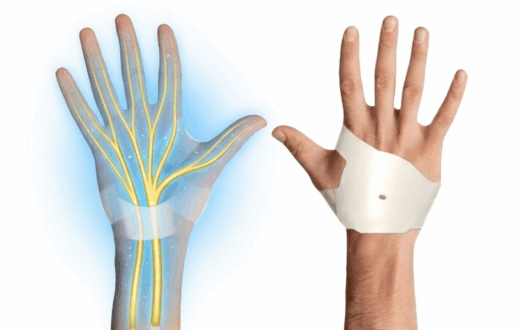
Here is the catch. A splint is a support, not a fix. It can buy you some sleep while you change the things that irritate your median nerve. This is where therapy and targeted stretching come in. Our product is not a splint. It is a structured stretching treatment that helps the soft tissues glide, reduces pressure on the median nerve, and teaches your wrist to tolerate daily tasks again. You will see how the two approaches differ and how to use each on purpose.
For the complete treatment landscape, see the pillar guide.
What a Wrist Splint Actually Does?
A carpal tunnel splint keeps your wrist near neutral, not flexed, not extended. Neutral positioning reduces pressure inside the carpal tunnel compared with bent positions, which can calm tingling enough to let you rest. Most night symptoms are positional. You fall asleep with your wrist straight, then it curls without you noticing. The splint simply blocks that curl.
A splint does not stretch the transverse carpal ligament. It does not break down adhesions. It does not restore tendon glide. It does not strengthen the muscles that control your thumb. It is posture control, nothing more. That is useful for a short window, especially at night, but it is not the whole plan.
When a Splint Helps, and When It Does Not?
Good use cases
- Nighttime numbness and tingling that wakes you from sleep.
- Very recent symptom onset after a spike in hand-intensive work.
- A transition tool while you start therapy or stretching.
- Pregnancy-related symptoms where conservative steps are preferred.
Poor use cases
- Constant numbness that does not change with position.
- Visible thenar muscle thinning.
- Severe daytime symptoms that stop you from gripping or pinching.
- Long-standing symptoms that have not responded to prior splinting.
In these poor use cases, jump straight to a more comprehensive plan, which may include targeted stretching therapy, a medical evaluation, and, in some cases, a surgical opinion.
How To Choose and Fit a Neutral Wrist Splint?

Use this checklist while you try one on.
- Neutral is the goal. Your wrist should line up straight with your forearm, not bent up or down.
- Palm support, not a mitten. You should still be able to move your fingers.
- Adjustable straps. You want snug, not tight. If your fingers tingle more with the splint on, loosen it or try a different model.
- Breathable fabric. Night use gets warm. Comfort matters if you want to stick with it for a short trial.
- Right size matters. Too long and it pries your wrist into extension. Too short and it will not control posture.
Check this page to see how it works.
How To Wear a Splint, Simple Schedule
Here is a conservative, time-limited way to test benefit without creating stiffness.
- Week 1, nights only. Wear the splint for sleep. During the day, keep the wrist moving through gentle ranges of motion. Do not lock it in place for work.
- Week 2, nights only plus heavy tasks. If you notice that a specific task makes symptoms spike, for example, long driving or a rare heavy project, wear the splint just for that task. Still avoid full-time daytime use.
- End of week 2, reassess. Did night awakenings drop by at least half, and can you work 30 minutes with fewer symptoms? If yes, taper off night use over the next week while you continue therapy or stretching. If no, change course. This is the point to shift to a stretching-first plan.
Common Mistakes To Avoid
- Wearing a splint all day. This can stiffen your wrist, weaken fine control, and does not fix the underlying mechanics.
- Overtightening. If tingling increases with the splint on, it is too tight or the wrong shape.
- Thinking a splint is a cure. It is a positioner, not a tissue remodeler.
- Ignoring red flags. Constant numbness, apparent weakness, or thenar atrophy needs timely medical input.
Splints Versus Stretching Therapy, a New Way To Think
Most people see splints and think of them as a way to immobilize the problem. Our approach flips that script. The median nerve and the flexor tendons need space and glide. Guided stretching can reduce local pressure, improve the slide between tissues, and build tolerance for the movements you do every day. Instead of immobilizing the wrist around the clock, we teach the system to move better and to calm down. To see precisely how this 6-week protocol works, view the Carpal Solution Treatment details.
How the stretching treatment differs from a splint
- Active, not passive. You are doing gentle, targeted movements that restore glide, not holding a position.
- Builds capacity. You progressively increase what your wrist can handle.
- Fits real life. Short sessions you can do at home, plus microbreaks during your day.
- Aims at remission. By addressing mechanics and tissue mobility, you are working toward long-term control rather than nightly patching.

How the stretching treatment complements a splint
- You can use a splint at night for one to two weeks while you learn the stretches.
- As symptoms settle and the splint improves, you taper the splint.
- If symptoms flare after a heavy day, you can use the splint for one night as a temporary guardrail.
Who Benefits Most From a Stretching First Plan
- You have intermittent symptoms that get worse with use, especially after long sessions of typing, grooming, dental work, assembly, or gaming.
- You want to stay active and avoid round-the-clock bracing.
- You have tried a splint before, and it helped with sleep, but not daytime function.
- You are in a life stage where medication or injections are not your first choice.
- You prefer a natural, skill-based plan that targets the root mechanics.
If you have persistent numbness or noticeable weakness, start with a medical review, then add stretching as directed.
Practical Guide to Splinting and Active Recovery