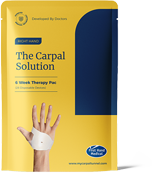
 Created by renowned Harvard health care professionals.

Carpal Tunnel Treatment Options: Splints, Therapy, Injections, and Surgery
Is wrist pain or numbness interrupting your sleep and slowing you down? Finding the path to quick, low risk relief shouldn't be complicated. This guide breaks down every primary treatment for Carpal Tunnel Syndrome—from splints and therapy to injections and surgery. We offer a clear decision path to help you understand what works, what doesn't work and which option is best for your recovery.


Introduction: Who Is This For?
If hand numbness, tingling, or wrist pain is interrupting sleep, slowing your work, or causing you to drop things, you are in the right place. This guide explains every primary treatment for carpal tunnel syndrome, from wrist splints and therapy to injections and surgery. You will see what each option does, who it helps most, how long relief typically lasts, and how to track progress.
This post is for people who want a clear decision path, free of medical jargon. It is also for clinicians and coaches who need an at-a-glance summary to share with patients and teams.
Definitions and Core Concepts
Carpal tunnel syndrome, the core idea
Carpal tunnel syndrome, CTS, is median nerve compression at the wrist. That nerve supplies sensation to the thumb, index, and middle fingers, and controls thumb muscles that drive pinch and grip. Increased pressure inside the tunnel reduces the quality of nerve signals, leading to numbness, tingling, pain, and sometimes weakness.
Why treatment works
Any option that lowers pressure in the tunnel, calms tenosynovial swelling, or increases space around the nerve can help. Splints keep the wrist neutral during sleep when many people bend the wrist; therapy improves mechanics and load tolerance; injections reduce local inflammation; and surgery removes the roof of the tunnel to free the nerve.
Step by Step, How To Choose Your Treatment Path
- Confirm the pattern
Symptoms in the thumb, index, and middle fingers, worse at night or during sustained gripping or driving, are classic. If you feel constant numbness or notice thumb muscle wasting, escalate sooner to specialist care. - Start with low-risk changes, one to three weeks
Adopt a neutral wrist at night, break up long hand-intensive sessions, adjust your workstation, and test a well-fitted neutral wrist night splint. The splint trial should be short and intentional, not indefinite. Evidence shows small short-term benefits for symptoms, with unclear changes in hand function, so measure your own response rather than assume it will work. - Add targeted therapy when mechanics are a factor
Education on positions that compress the tunnel, pacing, and gentle nerve and tendon gliding can help some people, especially when load spikes and sustained wrist flexion or extension cause symptoms. For a safe, step-by-step routine, see our guide to Carpal Tunnel Exercises and Nerve Glides. - Consider a local corticosteroid injection if symptoms persist
For mild to moderate CTS that is still waking you at night or disrupting work, a local corticosteroid injection provides relief for up to 3 months on average, sometimes longer, and can reduce the risk of surgery at 1 year. Serious complications are uncommon in trials that reported them. - Escalate to surgery when indicated
If weakness, thenar atrophy, constant numbness, or severe electrodiagnostic abnormalities are present, or if conservative measures fail, surgical release is the option with the most substantial likelihood of durable relief. Long-term comparisons show similar pain outcomes across open, mini open, and endoscopic techniques, with differences mainly in short-term recovery profiles. - Track results and iterate
Use a short checklist and a symptom scale to see what is changing if you are not improving on a two-to-four-week cadence, upgrade or change the plan.
Strategies and Frameworks: Pick the Right Tool at the Right Time
The RELIEF Ladder for Carpal Tunnel Treatment
- R: Recognize the pattern
Nighttime tingling in the thumb, index, and middle fingers, shaking the hand for relief, and difficulty with jars or fine pinching. - E: Evaluate severity
Ask simple questions: constant numbness? Dropping objects often? Visible thenar thinning? If yes, consider direct referral for testing and surgical opinion. - L: Limit aggravation
Keep wrists neutral at night, adjust devices, schedule microbreaks, and rotate tasks to reduce force and repetition. - I: Initiate a short splint trial
Use a neutral wrist night splint for one to three weeks. Continue only if you see a clear benefit. Combine with education and load management. Evidence suggests modest short-term symptom relief for some, not all. - E: Employ an injection when needed
If sleep and function remain limited, a local corticosteroid injection can provide meaningful relief and may delay surgery for some patients. Use it to gain control while you address contributors and decide on next steps. - F: Free the nerve with surgery when appropriate
If deficits are present or conservative care has failed, surgical release is effective across techniques with broadly favorable outcomes when performed for the proper indications.
Decision Checkpoints That Make Choices Easier
- Sleep score checkpoint
Are you waking up fewer than two nights per week after the splint and load changes? If not, consider injection. - Function checkpoint
Can you type or grip for 30 minutes without tingling? If not, progress to the next step. - Safety checkpoint
Any new weakness or constant numbness? If yes, stop the step-ups and seek a surgical opinion.
Tools and Options, Side-by-Side Comparison
| Option | Best for | What it does | Expected time to feel change | Durability of benefit | Notable limitations |
| Education and ergonomics | Everyone, early-stage symptoms | Lowers provocative positions and loads | Days to 2 weeks | Ongoing if habits persist | Requires behavior change |
| Neutral wrist night splint | Night waking, mild and recent symptoms | Keep wrist in neutral to lower tunnel pressure during sleep | 1 to 2 weeks | Short-term, unless paired with load changes. Consider our stretching treatment. | Evidence shows small short-term symptom gains, uncertain function change |
| Targeted hand therapy | Load-related symptoms, posture issues | Tests and teaches mechanics, pacing, gentle nerve and tendon glides | 2 to 4 weeks | Builds with practice | Quality of evidence varies, tailored to irritability |
| Oral analgesics, short-term | Temporary pain relief when dialing in other steps | Dulls pain | Hours to days | Short-term only | Does not decompress the nerve |
| Local corticosteroid injection | Mild to moderate CTS with persistent symptoms | Reduces local inflammation and edema | Days to 1 week | Up to 3 months on average, sometimes longer, can reduce the need for surgery at 12 months | Relief is temporary for many, rare adverse events; repeat dosing requires judgment |
| Work modifications | Forceful repetitive jobs or vibration | Reduces exposure, adds task rotation | 1 to 3 weeks | Lasting if maintained | May require employer coordination |
| Surgery, open or endoscopic release | Severe, progressive, or refractory CTS | Cuts the transverse carpal ligament to free the nerve | Days to weeks for pain, months for strength | Durable relief for most, across techniques | Recovery time, procedure risks, and short-term differences by technique |
Common Mistakes and How To Fix Them

- Wearing a splint all day
Night splints make sense in a short trial, but full-time immobilization can stiffen joints without added benefit. Keep the wrist free for gentle daytime motion. - Waiting on weakness
Thenar weakness or constant numbness calls for expedited testing and a surgical opinion. Do not stall on conservative care in that situation. - Treating only the symptoms
If diabetes, thyroid disease, inflammatory arthritis, or pregnancy-related fluid shifts are present, coordinate care for them as well. Treatment is more durable when contributors are addressed. - Relying on pain pills
Analgesics alone do not decompress the nerve. Use them, if at all, only while you implement steps that change mechanics or reduce inflammation. - Expecting a splint to cure long-standing CTS
Evidence shows modest short-term symptom improvement with splints for some people. If you are not better within two to three weeks, change course.
Measurement and KPIs: Know if Treatment Works
Measurement turns guesswork into decisions. Use a simple scoreboard that you update weekly.
- Night awakenings from hand symptoms
Goal: Cut awakenings by at least 50 percent within two to four weeks of starting a splint and load changes. - Boston Carpal Tunnel Questionnaire (BCTQ)
Track the Symptom Severity and Functional Status scales. A drop of 0.5 to 1.0 points is meaningful in many studies. - Grip and pinch anchors
Open a jar, hold a mug, or type for 30 minutes without numbness. Record yes or no each week. - Return to activity
Are you back to the tools or tasks that matter to you, and for how long, before symptoms start? - Post injection check
You should notice improvement within one to two weeks. Reassess at 6 to 12 weeks and plan your next interval.
Mini Case Study, a Practical Treatment Sequence
Profile
Jordan, a 38-year-old dental hygienist, reports 3 months of night-time tingling in the thumb and index finger, worse on double-booked days. She shakes her hands at night and sometimes drops instruments.
Plan
Week 1 to 2, Jordan adjusts posture, lowers wrist flexion on the tray, and begins a neutral wrist night splint. She tracks night awakenings and 30-minute work blocks without tingling.
Results
Sleep improves a little, but numbness returns during lengthy procedures. After shared decision-making, Jordan receives a local corticosteroid injection to calm the cycle while maintaining ergonomic changes.
Outcome
At 6 weeks, she sleeps through most nights and can complete lengthy procedures without stopping. Since she has no weakness or constant numbness, surgery is kept in reserve with clear thresholds for reconsideration. If symptoms return and escalate, she will move to a surgical opinion.
Treatment Options and Clinical Decision-Making for Carpal Tunnel Syndrome
Moving From Pain To Plan

Carpal tunnel treatment is a sequence, not a single bet. Begin with education and load management, conduct a short, neutral-night splint trial, and use therapy to improve mechanics. If symptoms still interfere with sleep or work, consider a corticosteroid injection to regain function while you decide on next steps. When weakness, constant numbness, or refractory symptoms are present, surgery reliably frees the nerve and restores quality of life for most people. Use the decision checkpoints and simple measurements in this guide to evaluate progress on a two- to four-week cadence and make confident adjustments.