 Created by renowned Harvard health care professionals.

Carpal Tunnel Exercises You Can Do at Your Desk
Do you feel the urge to "shake out" your hands after typing or gaming? The solution isn't forceful stretching—in fact, aggressive exercises can actually worsen Carpal Tunnel symptoms. The key is gentle, consistent movement. Discover the right way to calm nerve irritation and protect your grip with specific safety tips, ensuring you don't do more harm than good.
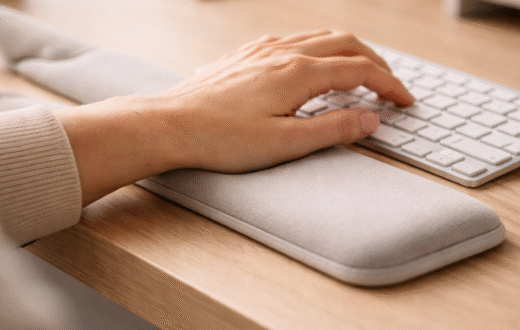

If you are feeling tingling, hand numbness, wrist pain, or that annoying “shake your hands out” feeling after typing, mousing, gaming, or tool work, the best next step is often smaller than you think.
A few minutes of the right movements, done consistently and gently, can help many people calm symptoms and protect their grip and sleep. The key is dose and safety. Carpal tunnel exercises can help, but they can also irritate symptoms if you push too hard or stretch the nerve aggressively.
For the full home program, including progressions and safety tips, see Carpal Tunnel Exercises, Nerve Glides and Stretching, and Safety Tips.
If you want help choosing the right routine for your symptoms and workload, contact our team.
Safety First: How To Know You Are Doing It Right
Use these rules every time.
- Keep pain low. Mild pulling is fine; sharp pain, burning, or electric zaps are not.
- Keep movements slow. Nerves dislike fast, jerky motion.
- Symptoms should settle within about 10 minutes after you finish. If not, do less next time.
- Never force wrist flexion or extension. Neutral wrist usually wins.
- If numbness is constant, you feel weakness, you are dropping things more often, or you see thumb muscle changes, stop self-treating and get evaluated.
Think “gentle and repeatable,” not “harder is better.”
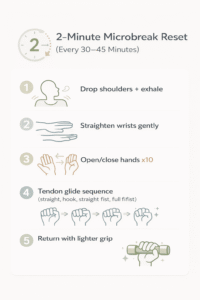
The 60-Second Desk Reset, Do This Every 30 to 45 Minutes
This is your most important preventive tool on heavy-hand days.
- Drop your shoulders, breathe out slowly.
- Let your arms hang at your sides for a few breaths, or rest forearms on your thighs.
- Open and close your hands slowly 10 times.
- Roll your shoulders back 5 times, then relax.
- Return to work with a lighter grip and straighter wrists.
If you only do one thing, do this often.
The 3-Minute Desk Routine, Morning, Midday, Late Afternoon
This routine fits between meetings, clients, or work blocks.
Wrist Circles, Calm Range
- Make loose fists.
- Circle wrists 10 times each direction, small circles, slow speed.
Tendon Glides, One Gentle Cycle
Move through these hand shapes slowly, keep the wrist mostly straight:
- Straight hand
- Hook fist
- Straight fist
- Full fist
- Back to the straight hand
Do one cycle, then pause. If symptoms are calm, repeat once.
Forearm Flexor Stretch, Short and Mild
- Arm straight in front of you, palm up.
- Use the other hand to gently extend the wrist until you feel a mild stretch in the forearm.
- Hold 10 to 15 seconds, then release slowly.
- Repeat once.
Stop sooner if tingling increases sharply.
Median Nerve Glide, the Safest Way To Start at Your Desk
Nerve glides can help some people, but they can also worsen symptoms if the nerve is very irritated. Start with the mildest version.
The “Small Glide” Version
- Sit tall, shoulders relaxed.
- Bend your elbow at your side, palm facing up.
- Open your hand, then gently extend the wrist a small amount, just until you feel a mild forearm stretch.
- Hold one second, return to neutral.
- Do 3 to 5 slow reps.
If tingling increases and does not settle quickly, skip nerve glides for now and focus on tendon glides, posture, and load reduction.
A good rule: nerve glides should feel like flossing, not tugging.
The 8-Minute Desk Routine, Use During Flare Days
Do this once or twice on higher symptom days, and keep it calm.
Step One: Posture Reset
- Gently chin-tuck, as if making a double chin; hold for 3 seconds, then repeat 5 times.
- Shoulder blade squeeze, gentle, hold 3 seconds, repeat 5 times.
Posture matters because nerve irritation can stem from the neck, shoulder, elbow, and wrist. You are calming the whole chain.
Step Two: Tendon Glides
- Do 2 slow cycles of tendon glides.
- Pause after each cycle, shake hands loosely.
Step Three: Forearm Stretch Pair
Flexor stretch, palm up, 10 to 15 seconds, twice.
Extensor stretch, palm down, gently flex the wrist, 10 to 15 seconds, twice.
Keep both stretches mild. If you feel a tingling spike, shorten the stretch and reduce the range.
Step Four: Grip Pressure Reset
- Place your hands flat on your thighs.
- Breathe out and let fingers soften, 3 breaths.
- Return to your task using the lightest grip possible.
Grip force is a major symptom amplifier.
Desk Setup Tweaks That Make Exercises Work Better
Exercises help most when you remove the triggers that keep re-irritating the nerve.
Keyboard and Mouse
- Keep the keyboard at about elbow height.
- Keep wrists straight, not bent upward to reach keys.
- Keep the mouse close so you do not reach forward.
- Use a lighter touch on keys and mouse clicks.
- Consider a different mouse shape if your wrist bends outward while mousing.
Phone and Scrolling
- Switch hands often.
- Use voice to text.
- Avoid long thumb scrolling sessions without breaks.
Chair and Arm Support
- Sit back so your shoulders can relax.
- If your forearms float all day, your wrist flexors work overtime. Light forearm support can help, but avoid pressing the wrist crease into hard edges.
A Simple “If This, Then That” Guide
Use this to match the routine to your symptom pattern.
- If symptoms occur primarily after long typing blocks, increase the 60-second resets and tendon glides.
- If symptoms wake you at night, do the 3-minute routine in the evening and reduce force and repetition the next day.
- If nerve glides increase tingling, stop them for now and focus on tendon glides and posture resets.
If symptoms are getting more constant, do not push harder; shift to evaluation and a conservative plan that matches your severity.
Common Mistakes That Slow Progress
- Doing one long session per day instead of short sessions spread out
- Stretching aggressively because you want faster results
- Holding the wrist in deep flexion or extension while stretching
- Wearing rigid support all day, then becoming stiff and weaker
- Ignoring sleep disruption and pushing through the next day with a high load
When in doubt, reduce intensity, increase consistency.
When To Contact Our Team
Reach out if you want a plan tailored to your pattern, your work, and your goals, especially if you are dealing with any of these:
- Sleep interruption from tingling or numbness
- Dropping things or loss of grip confidence
- Symptoms that keep returning after short relief
- Confusion about whether it is carpal tunnel or something else
- You want to avoid unnecessary invasive steps and start with a conservative-first plan