 Created by renowned Harvard health care professionals.


Carpal Tunnel Stretches: Passive Stretching at Night Is Best
Why the amount of time you stretch matters more than which stretch you do, and how to get hundreds of hours of it while you sleep.
Search for carpal tunnel stretches and you will find dozens of routines: prayer stretches, wrist circles, nerve glides. Most of them are perfectly reasonable. But they share one weakness that almost nobody talks about: you cannot do them for long enough to make a lasting difference. This guide explains why the dose of stretching matters most, why passive stretching at night is the most effective way to get it, and which daytime stretches are worth pairing with it.
Quick Answer: The Most Effective Carpal Tunnel Stretches
The most effective carpal tunnel stretches are gentle, sustained and done for many hours, not a few minutes. Soft tissue responds to time under gentle stretch, and research on stiff joints shows that gains grow in proportion to the total time a tissue is held at its stretched position. Daytime routines rarely add up to more than a few minutes a day. That’s why time matters so much when healing carpal tunnel without surgery. For a complete daily plan that pairs night stretching with daytime sets, see our best exercises for carpal tunnel.
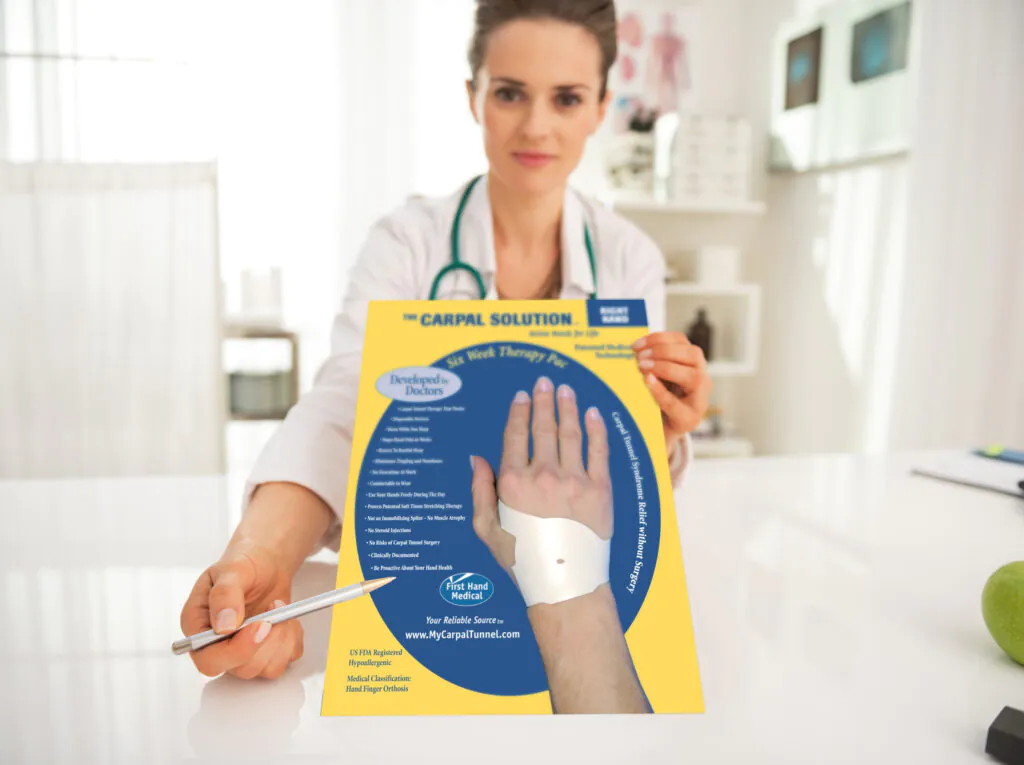
Passive stretching at night, with a device like The Carpal Solution, delivers six to eight hours of targeted stretch per night, more than 220 hours over six weeks, during the hours when carpal tunnel symptoms are usually worst. Patients rate it 4.9 out of 5 stars on Google Reviews.
Table of Contents
Why Carpal Tunnel Stretches Help
The carpal tunnel is a narrow channel at the base of the hand, roofed by the transverse carpal ligament. The median nerve and nine flexor tendons pass through it. Carpal tunnel syndrome (CTS) develops when pressure inside that space compresses the nerve.
Pressure sets off a self-reinforcing cycle. Compression restricts blood flow and lymph drainage, fluid and inflammation become trapped, the soft tissue stiffens, and the swelling raises pressure further. Carpal tunnel stretches target that cycle in several ways:
- Restoring flexibility to the ligament, fascia and soft tissue around the tunnel
- Encouraging drainage of trapped fluid and inflammation as tissue loosens
- Improving circulation to the nerve and surrounding tissue
- Helping the nerve and tendons glide freely instead of being tethered
For more background, see the root cause of carpal tunnel: trapped inflammation and anatomy of the carpal tunnel and soft tissue.
Active vs. Passive Carpal Tunnel Stretches
| Active (daytime) stretches | Passive (overnight) stretching | |
|---|---|---|
| How it works | You move your hand into a stretch and hold it with your own effort | A device holds a gentle, steady stretch while you rest |
| Typical duration | Seconds per hold, a few minutes per session | Six to eight hours per night |
| Consistency | Depends on memory and motivation; often fades within weeks | Built in: apply at bedtime and sleep |
| Timing | During the day, when symptoms are often milder | At night, when symptoms usually peak |
| Effort | Requires time out of your day | Under a minute to apply |
Both have a role. But if you want stretching to change the course of CTS, the passive approach has a decisive advantage: time.
The Missing Ingredient: Enough Stretching Time
What Research Shows About How Long Carpal Tunnel Stretches Should Last
Hand therapists have long known that stiff soft tissue responds to low-load, prolonged stretch: a gentle force held for a long time, rather than a strong stretch held briefly. A classic randomized study in the Journal of Hand Therapy (Flowers and LaStayo, 1994) tested this in stiff finger joints.
When joints were held in a stretched position for six days instead of three, the gain in range of motion was nearly double (a ratio of about 1.8 to 1). The authors called this the total end range time principle: the improvement depends on how much total time the tissue spends gently stretched.
That study involved finger joints rather than the carpal tunnel, but the principle applies to soft tissue generally, and it explains why short daytime carpal tunnel stretches so often disappoint.
Why Daytime Carpal Tunnel Stretches Fall Short
A Cochrane review of exercise and mobilisation for CTS (Page et al., 2012; 16 trials, 741 participants) found only limited and very low quality evidence of benefit across the many routines studied. That does not mean stretching doesn’t work; it fits with the problem of dose. Most daytime programs deliver a few minutes a day, and real-world consistency drops quickly once the novelty wears off.
Here is what that looks like over a typical six-week treatment period:
| Approach | Stretch time per day | Total over 6 weeks |
|---|---|---|
| Daytime routine: 3 sessions × 5 minutes (if done every single day) | 15 minutes | About 10.5 hours |
| The Carpal Solution, passive night stretching (nightly for 2 weeks, then every other night) | 6–8 hours per treatment night | More than 220 hours |
Even with perfect discipline, daytime carpal tunnel stretches deliver a small fraction of the stretching time that overnight wear provides, roughly twenty times less in this example.
Why Night Is the Best Time for Carpal Tunnel Stretches
- Symptoms peak at night. Pressure in the carpal tunnel rises sharply when the wrist bends, and many people sleep with their wrists curled. That is why numbness and tingling so often wake people up. A passive stretch worn overnight works during the exact hours the problem is worst. See why symptoms are worse at night.
- Your hands are resting. During the day, gripping, typing and lifting constantly load the tissues you are trying to relax. At night, the stretch is not competing with activity.
- It costs you no time. Six to eight hours of stretching happen while you sleep, so you never have to find time in a busy day.
- Consistency is automatic. Bedtime is a built-in habit. Applying a device takes under a minute, so treatment nights are far less likely to be skipped than daytime sessions.
- You stay mobile. Unlike a rigid night splint, which holds the wrist still, a passive stretching device keeps gentle tension on the tissue while allowing natural movement. A Cochrane review found only limited short-term evidence for night splints, and First Hand Medical’s doctors caution that prolonged rigid bracing can contribute to stiffness. See why to avoid wrist splints and braces.
How The Carpal Solution Delivers Passive Carpal Tunnel Stretches at Night
The Carpal Solution Treatment Kit was developed by First Hand Medical’s physician team, including co-founders Dr. Jerome H. Grossman, MD (former Harvard professor and president of New England Medical Center) and Dr. Joseph E. Scherger, MD, MPH, musculoskeletal clinician and inventor Dr. Clyde E. Morgan, DC, and orthopedic hand surgeon Dr. Michael E. Ruff, MD. It was designed to turn the low-load, prolonged stretch principle into something anyone can do at home.
- Targeted: two types of medical-grade elastic tape in a patented design apply gentle tension to three key areas around the carpal tunnel.
- Sustained: worn six to eight hours a night, for more than 220 hours of stretching over six weeks.
- Simple protocol: one device every night for two weeks, then every other night for four weeks. See the 6-week treatment protocol, The Carpal Solution Quick-Start Guide and how to apply The Carpal Solution.
- Comfortable: hypoallergenic materials, adjustable tension, and guidance on applying the right tension.
- Safe and repeatable: no needles, drugs or downtime. FDA registered and made in an ISO 13485-certified facility. Repeat the protocol whenever symptoms return.
What the evidence and patients say: independent meta-analyses of elastic therapeutic taping, the closest studied relative of this approach, found improvements in pain and function in mild to moderate CTS (13 trials in 2023; 14 trials in 2025). First Hand Medical reports more than 500,000 people helped since 2005 and a 97% success rate in its clinical experience, with relief of the worst symptoms in about three weeks and complete remission in about six weeks for most patients.
| Review platform | Average rating | Number of reviews |
|---|---|---|
| Google Reviews | 4.9 / 5 | 69 |
| 4.8 / 5 | 314 | |
| Birdeye | 4.8 / 5 | 271 |
| Trustpilot | 4.6 / 5 | 41 |
Learn more in how The Carpal Solution works, the clinical documentation and patient reviews.
6 Gentle Daytime Carpal Tunnel Stretches to Pair With Night Stretching
Daytime carpal tunnel stretches are a useful complement to overnight treatment: they keep tissue moving and help break up long periods of typing or gripping. Do each one gently, 5 to 10 repetitions, two or three times a day. Stop if tingling or numbness increases; a good stretch should feel mild, never painful.
1. Median Nerve Glide
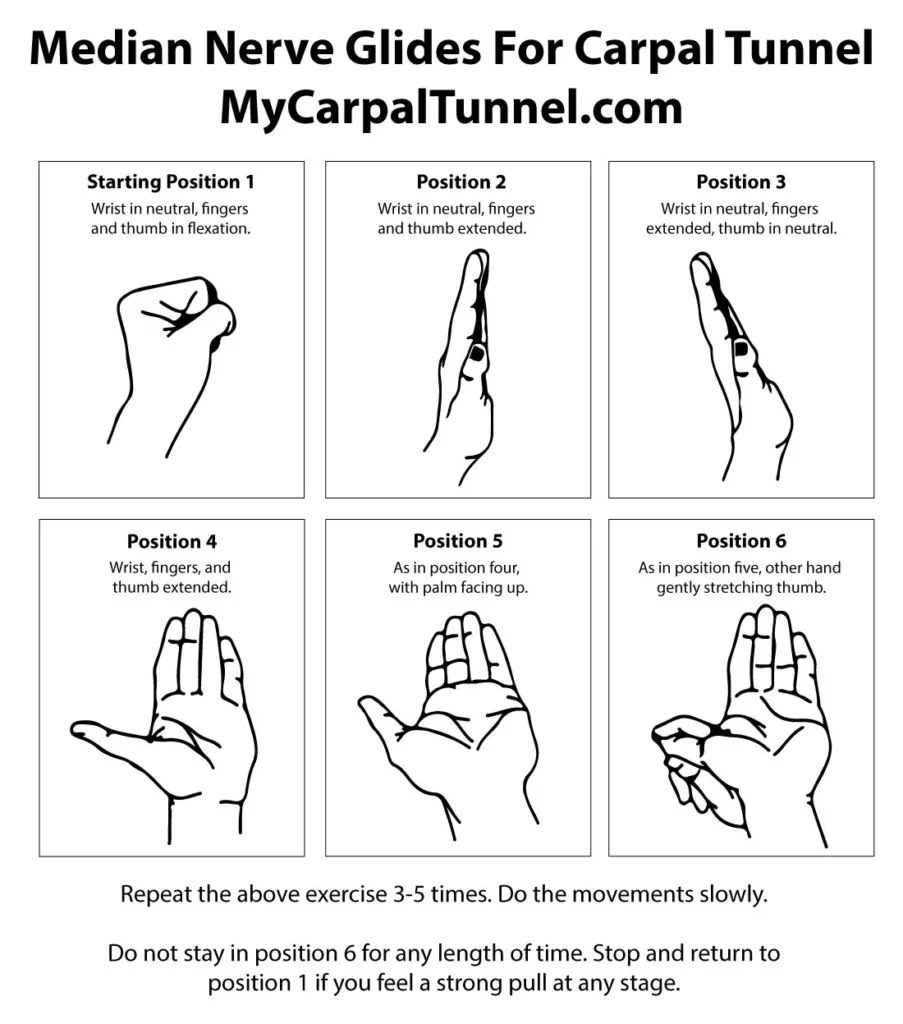
- Start with your arm at your side, elbow bent, hand in a loose fist at shoulder height.
- Open your fingers and straighten them, keeping your thumb relaxed.
- Gently bend your wrist back, then slowly extend your thumb out to the side.
- Return to the start. Move smoothly; this is a glide, not a hold.
2. Tendon Glides
- Begin with fingers straight.
- Move through five positions, holding each for 3 seconds: straight fingers, hook fist (fingertips to the base of the fingers), flat fist, full fist, and straight fist (fingertips to the palm, knuckles straight).
- Return to straight fingers and repeat.
3. Gentle Prayer Stretch
- Place your palms together in front of your chest, fingers pointing up.
- Slowly lower your hands toward your waist, keeping palms together, until you feel a mild stretch in the palms and forearms.
- Hold for 10 to 15 seconds. Do not push into tingling.
4. Forearm Flexor Stretch
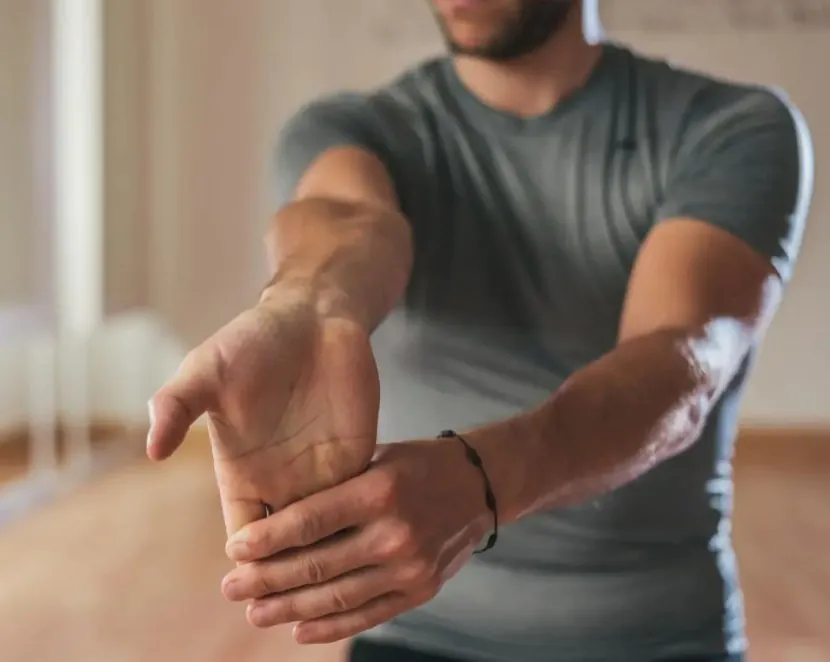
- Hold one arm straight in front of you, palm up.
- With the other hand, gently draw the fingers back toward you until you feel a light stretch along the inner forearm.
- Hold for 10 to 15 seconds, then switch hands.
5. Thumb Stretch
- With your palm facing up, gently pull your thumb away from your fingers and slightly back with the other hand.
- Hold for 10 seconds. You should feel a mild stretch at the base of the thumb.
6. Shake-Out and Open-Hand Reset
- Let your arms hang at your sides and gently shake your hands for 10 seconds.
- Spread your fingers wide, hold 3 seconds, then relax. Repeat 5 times.
- Use this as a micro-break every 30 to 60 minutes at the keyboard or while working.
A randomized trial of patients waiting for carpal tunnel surgery (Journal of Physiotherapy, 2020) found that a home program including nerve and tendon gliding exercises and night-time care cut the share who went on to surgery from 80% to 59%. Daytime carpal tunnel stretches are worth doing; they work best as a supplement to a strong night-time foundation.
For more routines, see carpal tunnel stretching exercises, hand exercises for carpal tunnel, carpal tunnel stretches you can do at your desk and yoga for carpal tunnel. For which exercises to avoid and how to adjust workouts at the desk or gym, see our carpal tunnel exercise guide.
Carpal Tunnel Stretching Mistakes to Avoid
- Forcing the stretch. Aggressive stretching can irritate the nerve. Gentle and long beats hard and short.
- Holding the wrist fully bent. Prolonged deep wrist flexion raises pressure in the tunnel and can bring on symptoms.
- Adding grip strengthening too early. Squeezing balls and grippers increase tunnel pressure. Grip strength usually returns once the nerve is decompressed.
- Relying on a rigid brace all day. Long periods of immobilization can contribute to stiffness and weakness.
- Giving up too soon. Soft tissue changes take weeks. Give a consistent program at least six weeks, and First Hand Medical recommends at least three months of The Carpal Solution before considering invasive options.
- Overusing your hands while healing. Normal use is fine, but avoid intense, repetitive strain during treatment. See the Persistent Symptoms Protocol for supporting measures.
A Simple Carpal Tunnel Stretches Plan
| When | What to do |
|---|---|
| Bedtime (core) | Apply The Carpal Solution: every night for weeks 1–2, every other night for weeks 3–6. |
| Morning | Median nerve glides and tendon glides, 5–10 reps each. |
| Every 30–60 min at work | Shake-out and open-hand reset; check that wrists are straight. |
| Evening | Gentle prayer, forearm and thumb stretches. |
| If symptoms return later | Repeat the 6-week night protocol or use occasional preventive nights. |
After carpal tunnel surgery? Passive stretching can help with lingering post-surgical symptoms, but First Hand Medical recommends waiting at least three months after surgery so the surgically disturbed tissue can heal before starting stretching therapy with The Carpal Solution. See symptoms after carpal tunnel surgery.
When Stretching Is Not Enough
See a doctor promptly if you have:
- Constant numbness that never goes away, or loss of feeling in the fingertips
- Wasting of the muscle at the base of the thumb
- Weakness when pinching or gripping
- Symptoms that began suddenly after a wrist injury
- Symptoms in the little finger, the whole arm, or with neck pain
Stretching can be used alongside medical care but does not replace a medical evaluation.
Carpal Tunnel Stretches: Frequently Asked Questions
Do carpal tunnel stretches really work?
Stretching makes physiological sense for CTS, and home programs that include gliding exercises have reduced the need for surgery in a randomized trial. Results from short daytime routines are inconsistent, largely because they deliver little total stretching time. Passive overnight stretching solves that problem.
What is the best stretch for carpal tunnel?
The best stretch is one you can sustain gently for a long time. For most people, that means passive stretching at night with The Carpal Solution, supplemented by median nerve and tendon glides during the day.
How long should I hold a carpal tunnel stretch?
Daytime holds of 10 to 15 seconds, repeated through the day, are typical and safe. But the bigger factor is total stretching time: hand therapy research shows gains grow with the total time tissue spends gently stretched, which is why hours of overnight stretching are so effective.
Is passive stretching better than a wrist splint at night?
A splint simply holds the wrist straight; a Cochrane review found only limited short-term evidence that it helps. Passive stretching actively applies gentle tension to the tissue around the carpal tunnel while still allowing movement.
Can stretching make carpal tunnel worse?
Forceful stretching or holding the wrist deeply bent can aggravate symptoms. Keep stretches gentle and stop if tingling increases. Some people notice mild discomfort in the first few nights of passive stretching. See managing discomfort.
How long until stretching helps carpal tunnel?
First Hand Medical reports that most Carpal Solution users feel relief of their worst symptoms in about three weeks and complete remission in about six weeks. Daytime stretching alone usually takes longer and depends heavily on consistency.
The Bottom Line on Carpal Tunnel Stretches
Carpal tunnel stretches work by restoring flexibility to the tissue around the median nerve and helping the body clear trapped swelling, but only if they are done for long enough. Short daytime routines rarely deliver more than a few minutes a day. Passive stretching at night delivers hours, at the time symptoms are worst, without costing you any time. To build it into a full routine, see our 8-step carpal tunnel plan.
For the most effective carpal tunnel stretching, make The Carpal Solution your nightly foundation and add gentle gliding stretches during the day. It is physician-developed, applied in under a minute, safely repeatable for life, and rated 4.9 out of 5 stars by patients on Google.
Start Passive Night Stretching: Order The Carpal Solution
Questions? Call (800) 798-5210
References
- Flowers KR, LaStayo P. Effect of total end range time on improving passive range of motion. J Hand Ther. 1994;7(3):150–157.
- Page MJ, O’Connor D, Pitt V, Massy-Westropp N. Exercise and mobilisation interventions for carpal tunnel syndrome. Cochrane Database Syst Rev. 2012;(6):CD009899. doi:10.1002/14651858.CD009899
- Page MJ, Massy-Westropp N, O’Connor D, Pitt V. Splinting for carpal tunnel syndrome. Cochrane Database Syst Rev. 2012;(7):CD010003. doi:10.1002/14651858.CD010003
- Lewis KJ, Coppieters MW, Ross L, Hughes I, Vicenzino B, Schmid AB. Group education, night splinting and home exercises reduce conversion to surgery for carpal tunnel syndrome: a multicentre randomised trial. J Physiother. 2020;66(2):97–104. doi:10.1016/j.jphys.2020.03.007
- Tomás-Escolar A, et al. Short-term effectiveness of kinesio taping in conservative treatment of carpal tunnel syndrome: a systematic review and meta-analysis. Physiother Res Int. 2023;28(3):e2026. doi:10.1002/pri.2026
- Li Z, Liu X, He S, Wu J, Zhu Z, Lu W. Kinesio taping can relieve symptoms and enhance functions in patients with mild-to-moderate carpal tunnel syndrome: a systematic review and meta-analysis. Physiother Theory Pract. 2025;41(9):1936–1951.
- First Hand Medical. How The Carpal Solution Works; Quick-Start Guide; Clinical Documentation of The Carpal Solution. MyCarpalTunnel.com
This article is for educational purposes and does not replace personal medical advice. Consult your healthcare provider about your symptoms and treatment options. Results reported by First Hand Medical reflect the company’s clinical experience and patient reports; individual results vary. Disclosure: MyCarpalTunnel.com is the website for The Carpal Solution.