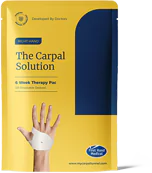
Created by renowned Harvard health care professionals.


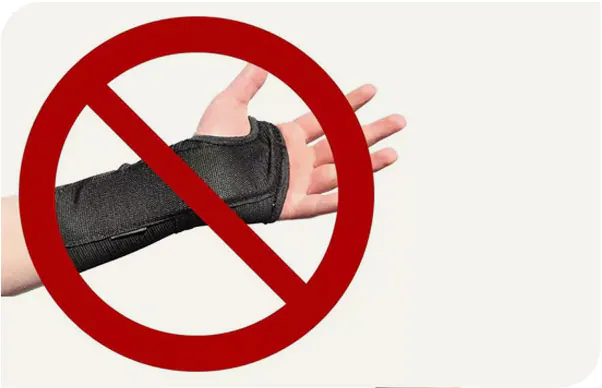
Not an Immobilizing Carpal Tunnel Wrist Brace or Night Splint
A soft, non-immobilizing carpal tunnel wrist brace developed by doctors: how the Carpal Solution differs from rigid night splints, what our doctors think of splints, and what to expect over the 6-week protocol.
Written by Jeff Conley, President, First Hand Medical · Clinically reviewed by Alan Ward, MOT, OTR, Master Occupational Therapist and Vice President of Precision Rehabilitation · Last reviewed: November 2026
If you are shopping for a carpal tunnel wrist brace, most of what you will find are rigid splints that lock the wrist in one position. The Carpal Solution is a different kind of carpal tunnel wrist brace. It is soft, it does not immobilize the wrist, and it gently stretches the soft tissue around the carpal tunnel while you sleep, so the swelling pressing on the median nerve can disperse.
Doctors developed it, and it has earned 97% patient satisfaction over 21 years, with 4.9 out of 5 stars on independent review sites like Google Reviews. Over 100,000 people have used it over two decades. This guide explains how a non-immobilizing wrist brace differs from a night splint, what our doctors think of splints, what to expect night by night, and when to see a doctor.
Table of Contents
Carpal Tunnel Wrist Brace: Why the Carpal Solution Is Not an Immobilizing Brace
Most carpal tunnel wrist brace products are built from rigid plastic or metal stays. Their job is to hold the wrist still in a neutral position, usually overnight. The Carpal Solution operates with a completely different mechanism. Instead of holding the wrist still, it holds the soft tissue of the palm and wrist in a gentle stretch, while your wrist and fingers stay free to move.
That difference matters because of what causes the symptoms. Carpal tunnel syndrome is driven by entrapped swelling and inflammation inside a tight tunnel. Nine tendons from the forearm muscles (four flexor digitorum superficialis, four flexor digitorum profundus and the flexor pollicis longus) pass through it beside the median nerve. When the tissue swells, the nerve is squeezed, and you feel numbness, tingling, pain and weakness in the thumb and fingers.
A treatment that helps the swelling disperse addresses the cause. A treatment that only stops movement can reduce pain from movement, but it leaves the swelling where it is. For general medical background, see the NINDS fact sheet on carpal tunnel syndrome, and ask your doctor whether a carpal tunnel wrist brace is right for you.
Our Doctors’ Position on Wrist Splints
A wrist splint holds the hand and wrist in a neutral position. That immobilization can reduce discomfort from movement, but it does not promote healing from carpal tunnel syndrome. It only reduces pain from movement.
The disadvantages are real. Immobilization causes muscle atrophy and stiffness. In one study, just 14 days in a cast cost about 8% of muscle size and 23% of strength (Wall, Acta Physiologica, 2014). The forearm muscles that bend the thumb and fingers share in that loss, and their tendons run through the carpal tunnel, so the weakness shows up as lost grip strength and dexterity.
A tight splint also compresses the hand, wrist and forearm, restricting blood circulation and lymphatic fluid exchange. That slows the dispersion of swelling and entrapped lymphatic fluid, the root cause of carpal tunnel syndrome. Our medical team has observed that splints often give some relief in the beginning, but in the long run they aggravate carpal tunnel symptoms. Immobilization is great for fractures and sprains, not for treating carpal tunnel syndrome.

Rigid cock-up night splints also tend to interrupt sleep, restrict free movement and annoy partners sharing the same bed. A non-immobilizing wrist brace avoids those problems. Read more about why to avoid wrist splints and braces, or see how published splint research compares with our doctors’ experience.

How a Non-Immobilizing Wrist Brace Works
The Carpal Solution is a comfortable, soft, non-immobilizing wrist brace. Its materials are Hypoallergenic (No Latex): a thin polymeric film and adhesive film straps chosen for comfort so you can sleep. There are no rigid parts to restrict movement, cause muscle atrophy, annoy a sleeping partner, or irritate and compress already injured tissue.
It uses Soft Tissue Reshaping Therapy, a form of passive stretching. Applied at bedtime, the straps hold the palm and wrist tissue in a gentle, sustained stretch all night. Over the full protocol that adds up to over 220 hours of targeted stretching, far more than anyone could do with daytime exercises alone. That is the advantage over exercise: it works while you sleep, so it does not depend on willpower.
Because the wrist is never locked, the forearm muscles keep working, circulation is not squeezed off, and the swelling has a chance to disperse. That is why our doctors call it a non-immobilizing wrist brace rather than a splint. See how the Carpal Solution works for application photos and details.

The 6-Week Protocol and What to Expect
Unlike a rigid carpal tunnel wrist brace or night splint, which many people wear for years, the Carpal Solution has a short, defined protocol. You apply it every night for two weeks, then every other night for four weeks.
| Phase | Schedule | What most people notice |
|---|---|---|
| Weeks 1–2 | Every night | Most people are better from their worst symptoms in two to three weeks. |
| Weeks 3–6 | Every other night | Continued improvement; over 90% of people reach remission by 6 weeks. |
| Higher inflammation | 8 to 12 weeks | About 10% of people, usually with excess systemic inflammation, are 50–70% better at 6 weeks and need 8 to 12 weeks. |
| After remission | Once a week to once every six months | Prevention nights if repetitive hand use continues. |
Remission usually lasts 5 to 7 years for most people, but everyone is different. Hand-use patterns and each person’s systemic inflammation profile matter; people have gone as long as 17 years and as little as 1 year between treatments. And who has any intention of giving up the full use of their hands? The goal is to return to fully active hand use with minimal therapeutic interference.
If you have had carpal tunnel surgery, wait 3 months after surgery before starting the Carpal Solution.
Switching From a Night Splint to a Non-Immobilizing Wrist Brace
Cock-up splints sometimes offer marginal relief from night symptoms, but at a high price: a rigid carpal tunnel wrist brace worn to bed every night for as long as the repetitive stress continues, essentially for life.
Dr. Clyde E. Morgan, the inventor of the Carpal Solution, has noticed that patients switching from night splints and other rigid hand and wrist braces often have a couple of days of increased discomfort as the tissue begins to stretch. The discomfort is short-lived. Most people with carpal tunnel syndrome are eager to get back to full hand use without pain and to restful, unencumbered sleep, and they readily go through this short transition.
During the day, keep moving your fingers and wrist normally. Avoid grip, squeeze-ball and putty exercises while healing. Gentle daytime stretches (up to 6 sets of 10, holding each for 15 seconds with 30 seconds of rest) are a bonus, not a requirement. Compression gloves worn during the day can also help by increasing blood circulation, and gloves by day with the Carpal Solution at night is one of the best combination therapies.
What Patients Say About This Carpal Tunnel Wrist Brace
“Having suffered from Carpal Tunnel Syndrome Symptoms for six years, I have tried the old wrist braces and night splints, plus resting my hands and wrists forever with no success. After wearing the Carpal Solution for three nights, the complete numbness that I have had in both hands (especially at night) completely disappeared. In addition, my aching, almost non-functioning wrists felt like new. I am sending all of my friends to the local pharmacy.” Ceil, Pianist/Organist for 40 years, Massachusetts
“My Carpal Tunnel pain was so bad that I had tingling sensations in my hand all day and night. I’ve tried other conventional carpal tunnel techniques, including the braces and splints and have not had any success. The Carpal Solution is the only non-surgical technique that really works well. I began to see relief after the first night of use. I wore it every night for two weeks and now wear it every three or four nights.” Jim, Airline Pilot, Georgia
Results vary. Some people, like Ceil and Jim, notice relief within days; for most people the worst symptoms ease in two to three weeks.

RIGHT HAND INSTRUCTIONS:
Apply the Carpal Solution before Retiring to Bed in 3 Easy Steps
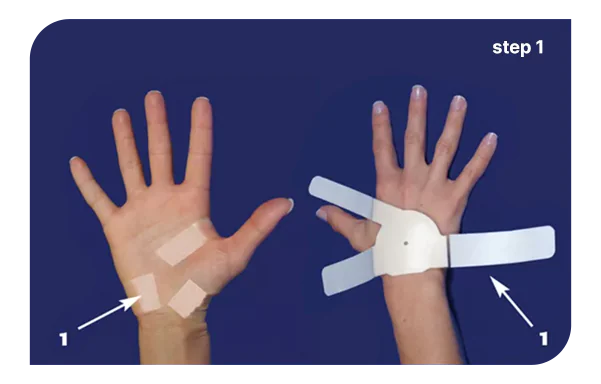
STEP 1: Place the Carpal Solution on the Back of the hand as shown with adhesive side down. Attach 1st strap below little finger securing it on the palm. Tear away excess tape to prevent overlap of straps on palm.
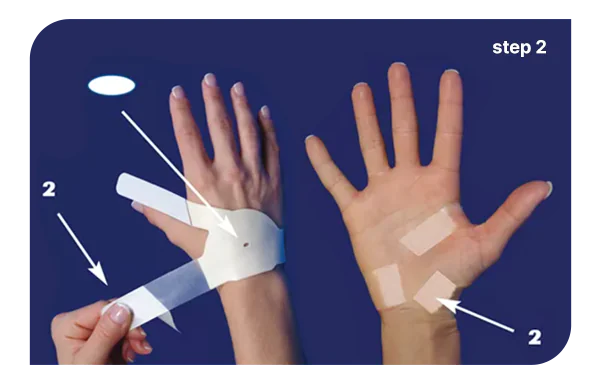
STEP 2: Self apply the appropriate tension to the Carpal Solution with 2nd strap below the thumb and attached on palm side of hand as shown. Adjust tension by stretching circular hole on back of hand in the elastic centerpiece to an oval shape. The diameter should be at least 1.5 times the original.
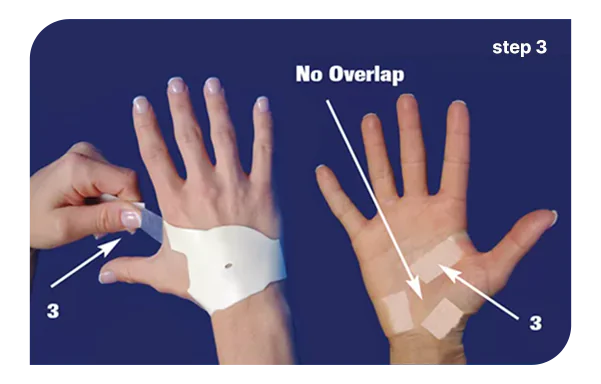
STEP 3: Self apply the appropriate tension to the Carpal Solution with 3rd strap above the thumb. Tear-away straps should be aligned so there is no overlap of straps on palm side of hand. The Carpal Solution begins to relieve symptoms usually within twenty minutes of placement.
Rigid Splint vs. the Carpal Solution
Here is how a rigid carpal tunnel wrist brace (a splint) compares with the soft, non-immobilizing Carpal Solution on the points that matter most to patients.
| Feature | Rigid wrist splint | Carpal Solution |
|---|---|---|
| How it works | Holds the wrist still in a neutral position | Holds soft tissue in a gentle overnight stretch; the wrist stays free |
| Effect on healing | Reduces pain from movement; does not promote healing | Helps entrapped swelling disperse |
| Muscles | Muscle atrophy and stiffness from immobilization | No immobilization, so no splint-related atrophy |
| Circulation | Tight straps can restrict blood and lymphatic flow | No rigid compression |
| Materials | Rigid plastic or metal stays | Hypoallergenic (No Latex) soft polymer film |
| How long you wear it | Often every night, indefinitely | 6-week protocol, then occasional prevention nights |
| Sleep | Bulky; can interrupt sleep and bother a partner | Thin and soft for restful sleep |

Neurologists, including Dr. James S. Zu, MD, PhD, of Edison, New Jersey, call the Carpal Solution a better first line of defense for carpal tunnel syndrome. Many patients call it a carpal tunnel “cure.” Carpal tunnel syndrome is chronic and recurring and cannot be cured, by surgery or anything else. The Carpal Solution is the next best thing, controlling symptoms at home without downtime, risks, scar tissue or complications.
Where Surgery Fits
Conservative care comes first, and surgery is the last resort. Carpal tunnel surgery has a patient satisfaction rate lower than 69%. About 31% of patients report lingering or recurring symptoms, and no patient is satisfied with lingering symptoms (see the 31% Problem). About 8% say their condition is worse after surgery (Bland, Muscle & Nerve, 2007). Second surgeries have a patient satisfaction rate of only 16% to 40%.
Even after a successful surgery, symptoms often return: 57% had at least some symptoms come back within 5.5 years in one study (Nancollas, 1995). Our doctors estimate 80 to 90% within 10 years from two decades of clinical experience. That is their best estimate, not a statistically researched figure, because almost no one follows patients that long. Read more about recurrence after surgery and the 6 carpal tunnel surgery myths.
Insurance, Guarantee and Waiting for an Appointment
The Carpal Solution comes with a 30-Day Patient Satisfaction Guarantee. It is billed under HCPCS code L3924 (Hand Finger Orthosis), and many health insurance plans reimburse 70 to 80%. There is no risk of surgical complications, downtime or scar tissue, and First Hand Medical has taken away the financial risk of trying it.
If you are waiting to see a doctor, a neurologist or a hand surgeon, you are not alone. The average wait for a new-patient physician appointment is 31 days (AMN Healthcare, 2025). A safe, non-invasive carpal tunnel wrist brace like the Carpal Solution can relieve lost sleep, numbness and dropped objects while you wait. Read more about waiting for carpal tunnel treatment.
Not sure it is carpal tunnel? In our doctors’ two decades of clinical experience (not a published statistic), people with three or more of the classic carpal tunnel symptoms can be about 95% confident they have it. Still get an in-person evaluation, and see a doctor promptly for constant numbness, weakness or thinning of the thumb muscle.
When Healing Needs a Doctor’s Help and Professional Medical Evaluation
- Constant numbness that does not improve or loss of feeling in the fingertips that does not improve in 4 to 8 weeks.
- Extreme loss of the muscle at the base of the thumb, with loss of grip strength that does not improve over 6 to 8 weeks.
- Worsening symptoms over 6 to 8 weeks while using the best conservative treatments
- Symptoms that begin suddenly after hand or wrist trauma, a fracture or severe sprain from a fall or auto accident.
- Odd Symptoms that are not consistent with the Carpal Tunnel Symptoms listed on this website, that might be indicative of other nerve issues. A nerve conductivity study can clear up the confusion with minimal costs and not too much pain and no risk.
These signs may mean more advanced nerve involvement or a different condition and deserve professional medical evaluation and in person consultation. Home treatment can be used alongside professional in-person medical care while you wait for the healthcare delivery system to fit you into their schedule. There is no reason to wait doing nothing. You can start proven natural conservative treatment with good patient reviews while you wait for your appointments. If your symptoms start improving over 6 to 8 weeks, then you know you are on the right track and surgery is not necessary.
Carpal Tunnel Wrist Brace FAQ
Should I wear a carpal tunnel wrist brace at night?
Night is when symptoms often wake people up, so night treatment with a carpal tunnel wrist brace makes sense. Our doctors prefer a non-immobilizing wrist brace like the Carpal Solution over a rigid night splint, because a splint only reduces pain from movement and can cause muscle atrophy, while passive stretching helps the swelling disperse.
Is the Carpal Solution a splint?
No. It has no rigid parts and does not hold the wrist still. It is a soft, Hypoallergenic (No Latex) polymer film with adhesive straps that holds the soft tissue of the palm and wrist in a gentle stretch while you sleep.
How soon will I feel better?
With the Carpal Solution, most people are better from their worst symptoms in two to three weeks. Over 90% of people reach remission by 6 weeks; about 10% need 8 to 12 weeks and are usually 50–70% better at 6 weeks.
Does a rigid wrist brace cause muscle atrophy?
Yes. Immobilizing any extremity causes muscle atrophy over time. In one study, 14 days in a cast cost about 8% of muscle size and 23% of strength. The forearm muscles that move the thumb and fingers are affected, which is why grip and dexterity suffer.
Can I use it with a compression glove?
Yes. Compression gloves by day can increase circulation and protect the hand from everyday bumps, and wearing them by day with the Carpal Solution at night is one of the best combination therapies.
Is a carpal tunnel wrist brace covered by insurance?
For the Carpal Solution, many plans reimburse 70 to 80% under HCPCS code L3924, and the Carpal Solution comes with a 30-Day Patient Satisfaction Guarantee. Check with your insurer for your plan’s details.
Can I use it after carpal tunnel surgery?
Yes, a carpal tunnel wrist brace like the Carpal Solution can help, but wait 3 months after surgery before starting. Many people with lingering or recurring symptoms after surgery use it, along with the wrist brace guide and the best wrist brace for carpal tunnel comparison.
Sources
- National Institute of Neurological Disorders and Stroke. Carpal Tunnel Syndrome fact sheet.
- Wall BT et al. Muscle disuse during immobilization. Acta Physiologica, 2014. doi:10.1111/apha.12190.
- Bland JDP. Patient-reported outcome of 1,268 carpal tunnel operations. Muscle & Nerve, 2001. PubMed 11410921.
- Bland JDP. Review of 209 studies (32,936 operations) of carpal tunnel surgery outcomes. Muscle & Nerve, 2007.
- Louie D, Earp B, Blazar P. Long-term outcomes of carpal tunnel release: a critical review of the literature. Hand, 2012 (reviews Nancollas 1995). PMC3418353.
- Journal of Ultrasound, 2012: anatomy of the carpal tunnel. PMC3558235.
- AMN Healthcare. 2025 Survey of Physician Appointment Wait Times.