 Created by renowned Harvard health care professionals.


Carpal Tunnel Career Impact: Don’t Let a Detour Derail Your Work
Carpal tunnel can cost a month of work, but it does not have to end a career. A gentle overnight treatment lets you keep working, and many people in demanding jobs keep symptoms in check with just two to three nights per month.

Written by Jeff Conley, President, First Hand Medical · Medically reviewed by William Shucart, MD, neurosurgeon, clinical professor of neurosurgery at New England Medical Center and former chair of neurosurgery at Tufts · Last reviewed: November 2026
The carpal tunnel career impact often starts small: you drop a tool during an important task, your grip weakens, and fine motor control in your fingers fades. Left alone, those small changes can threaten work you spent years mastering. This page looks at how carpal tunnel and your career collide, why surgery is not the only path, and how to protect your work without downtime.
On this page:
- How Hand Symptoms Affect Your Work
- The Cost in Lost Time
- Who Is Most at Risk
- Do You Have to Change Careers?
- Protecting Your Career
- What to Expect While You Keep Working
- Real Stories
- Talking With Your Employer
- Keeping Symptoms in Check Long Term
- When to See a Doctor
- FAQ
Carpal Tunnel Career Impact: How Hand Symptoms Affect Your Work
Carpal tunnel syndrome starts with pressure. Swelling and entrapped inflammation in the soft tissue around the carpal tunnel squeeze the median nerve and restrict blood flow and lymph fluid transport. The nerve becomes irritated and short of oxygen, and the symptoms show up at work in predictable ways:
- Dropping things, from tools and instruments to pens and coffee cups.
- Weaker grip and pinch, especially with small objects. Many people can still hold large objects but feel pain gripping something small.
- Loss of fine motor control, so detailed work becomes slower and less accurate.
- Numbness and tingling in the thumb, index and middle fingers, often worse during repetitive tasks.
- Poor sleep, because symptoms wake you at night, which drags down focus and energy the next day.
- Forearm aching and fatigue. The muscles that bend the fingers and thumb sit in the forearm, and their nine tendons pass through the carpal tunnel, so the whole forearm can tire and weaken.
The National Institute of Neurological Disorders and Stroke notes that carpal tunnel syndrome is especially common among people who perform repetitive work tasks.
The Carpal Tunnel Career Impact in Lost Time
Carpal tunnel and your career are tightly linked because the condition is unusually costly in time. The U.S. Bureau of Labor Statistics has reported a median of 28 days away from work for carpal tunnel cases, among the longest of any workplace injury or illness, and second only to fractures in its 2007 data (BLS, 2008).
That carpal tunnel career impact means a month of lost income, lost productivity and lost momentum, often followed by weeks of reduced duty. For self-employed people and small business owners, it can mean lost clients. Read more about carpal tunnel and lost time at work.
Who Feels the Carpal Tunnel Career Impact Most
Any job that combines repetitive hand use, forceful gripping, awkward wrist positions or vibration can bring on carpal tunnel. A few groups feel the carpal tunnel career impact most, because carpal tunnel and your career depend on the same hands:
- Musicians. A drummer may squeeze a water bottle at the gym without trouble, yet feel pain every time he picks up a drumstick. A pianist may wash dishes normally but struggle to play a fast chord sequence cleanly.
- Computer professionals. A website designer working at high speed on a mouse and keyboard can lose productivity when accuracy drops.
- Dental and medical professionals. Hours of precise work with small instruments put heavy demands on the hands; read how a dentist’s career was saved.
- Skilled trades. Electricians, mechanics, construction workers and assembly-line workers combine force, vibration and repetition.
- Hair stylists and other hands-on service workers, like the stylist whose career was saved.
For skilled professionals, losing control of something they do well is especially frustrating. See more jobs linked to carpal tunnel.
Do You Have to Change Careers Because of Carpal Tunnel?
Some surgeons suggest changing careers or having surgery, but that is not easy when you have spent years becoming good at your work. Surgery carries risks, downtime and rehabilitation, and symptoms can return.
Carpal tunnel surgery has a patient satisfaction rate lower than 69%: about 31% of patients report lingering or recurring symptoms, and no patient is satisfied with lingering symptoms. Second surgeries have a patient satisfaction rate between 16% and 40%. Even after a successful surgery, 57% had at least some symptoms come back within 5.5 years in one study (Nancollas, 1995, reviewed by Louie et al., 2012), and our doctors estimate 80 to 90% within 10 years from clinical experience (not a statistically researched figure).
So many people look for less invasive options first. You can read more about carpal tunnel surgery and its risks and about returning to work after surgery before deciding.
Protecting Carpal Tunnel and Your Career: The Treatment
The Carpal Solution is a gentle nighttime stretching treatment developed by doctors. You put it on before bed and take it off in the morning, so it fits around your work schedule instead of interrupting it. It is soft, Hypoallergenic (No Latex), and does not lock the wrist the way a rigid splint does.
Its targeted passive stretching restores flexibility to the injured soft tissue, relieves pressure on the median nerve, frees blood circulation and lets lymph fluid clear out the swelling. Your body does the healing; the Carpal Solution jump-starts it. Over the six-week protocol, it delivers over 220 hours of stretching while you sleep.
| Stage | Schedule | What most people notice |
|---|---|---|
| Weeks 1–2 | Every night | Most people are better from their worst symptoms in two to three weeks. |
| Weeks 3–6 | Every other night | Over 90% of people reach remission by 6 weeks. |
| Higher inflammation | 8 to 12 weeks | About 10% of people are 50–70% better at 6 weeks and need 8 to 12 weeks. |
| After remission | Once a week to once every six months | Prevention nights keep symptoms away. |
Pair it with better ergonomics at work, short breaks to stretch, and attention to early carpal tunnel symptoms such as numbness and tingling, so you can act sooner. Use the carpal tunnel ergonomic checklist to set up your workstation, and if your symptoms are work-related, see our page on workers’ comp and carpal tunnel.
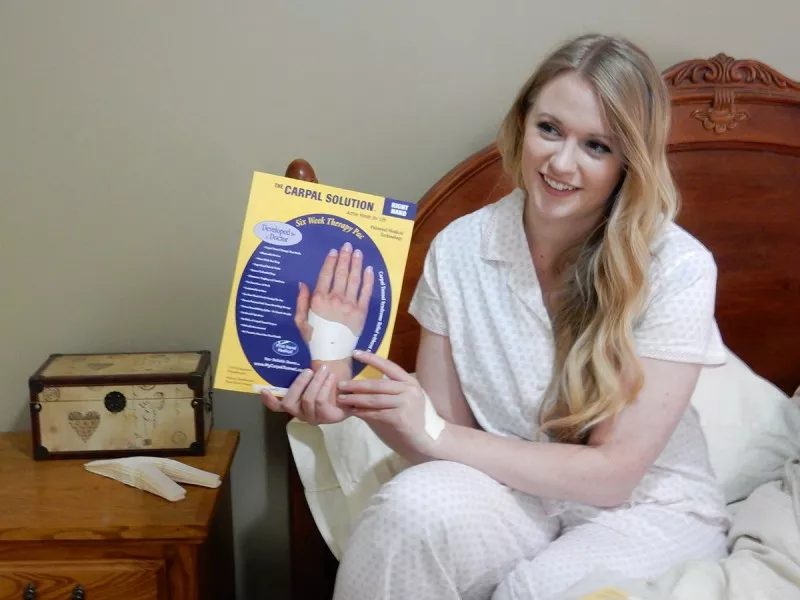
Carpal Tunnel and Your Career: What to Expect While You Keep Working
Because the Carpal Solution works at night, it limits the carpal tunnel career impact: most people keep working normally during the protocol. Our doctors share two observations from years of treating patients:
A brief adjustment. Some participants reported a slight increase in discomfort after 2 to 5 nights, in the area where the wrist and hand join on the palm side. Our doctors believe this comes from decompression of the soft tissue around the tendons, blood vessels and nerve passing through the carpal tunnel. The increase lasted only one or two nights before consistent symptom relief followed.
Heavy-use jobs need maintenance. Patients who continue the same demanding duties that brought on their symptoms will often find that, over several months, symptoms start to return, even after a successful protocol. In those cases, patients have kept symptoms in check by applying the Carpal Solution for just two to three nights per month. That lets them carry on with their regular routines without interrupted sleep or lost time at work.
Daytime Habits That Reduce the Carpal Tunnel Career Impact
- Keep your wrists straight at the keyboard, mouse, workbench or chair.
- Use a lighter grip and tools or instruments with wider, softer handles.
- Take micro-breaks every 30 to 60 minutes to open and relax your hands. Gentle stretches are a bonus: up to 6 sets of 10 a day, holding 15 seconds and resting 30 seconds.
- Skip grip trainers, squeeze balls and putty while healing; they add pressure inside the carpal tunnel.
- Wear compression gloves by day. They can spur natural healing by increasing blood circulation and insulate the hand from everyday bumps and bruises; gloves by day with the Carpal Solution at night is one of the best combination therapies.
Why a Splint Is a Poor Fit for Carpal Tunnel and Your Career
A splint holds the wrist in a neutral position, which can reduce pain from movement, but it does not promote healing from carpal tunnel syndrome. It causes muscle atrophy and stiffness, and a tight splint restricts blood circulation and lymphatic fluid exchange. For anyone whose career depends on strong, precise hands, that matters: in one study, 14 days in a cast cost healthy young men about 8% of muscle size and 23% of strength (Wall et al., 2014). Our medical team has observed that splints give some relief at first but aggravate symptoms in the long run.
Careers Kept on Track: Real Stories
The carpal tunnel career impact is easiest to understand through the people who lived it. These patient stories, in their own words, show carpal tunnel and your career can coexist when symptoms are treated early:
- Dentists who kept practicing without time away from patients.
- An electrician in Milwaukee who looked for an alternative to surgery.
- A hair stylist who kept her chair full.
- A tennis instructor who stayed on the court.
- An eSports competitor who kept competing.
- A financial manager and a hotel manager who kept up with long days at the desk.
Many of these patients call the Carpal Solution their “cure.” Carpal tunnel syndrome is chronic and recurring and cannot be cured, by surgery or anything else; the Carpal Solution is the next best thing, controlling symptoms at home without downtime, risks, scar tissue or complications.
Talking With Your Employer About Carpal Tunnel and Your Career
You do not have to manage the carpal tunnel career impact alone. Many employers are glad to help when an employee raises a problem early, before it turns into lost time. Simple, low-cost changes often make the biggest difference:
- An ergonomic review of your workstation, chair height, keyboard and mouse position.
- Tools or instruments with better grips, or powered tools that reduce force and vibration.
- Rotating tasks so the same hand motions are not repeated all day.
- Scheduled micro-breaks during repetitive work.
If your symptoms are work-related, ask about workers’ compensation and documentation; see our page on workers’ comp and carpal tunnel. Raising the issue early protects both your health and your career.

Keeping Carpal Tunnel and Your Career in Balance Long Term
Balancing carpal tunnel and your career is a long game. The Carpal Solution enables proactive control of carpal tunnel symptoms with a non-invasive therapy. For most people, remission lasts 5 to 7 years, ranging from 1 to 17 years depending on hand use and personal inflammation. Prevention nights from once a week to once every six months help keep it, and people in demanding jobs may need the more frequent end of that range.
Neurologists, including Dr. James S. Zu, MD, PhD, of Edison, New Jersey, call the Carpal Solution a better first line of defense for carpal tunnel syndrome. It has 97% patient satisfaction over 21 years and 4.9 out of 5 stars on independent review sites like Google Reviews. It comes with a 30-Day Patient Satisfaction Guarantee and is billed under HCPCS code L3924; many plans reimburse 70 to 80%.

In our doctors’ clinical experience, people with three or more classic symptoms can be about 95% confident they have carpal tunnel syndrome, but you should still see a doctor for an evaluation. The average new-patient appointment wait is 31 days (AMN Healthcare, 2025), and you can start protecting your work while you wait; read about relief while waiting for carpal tunnel treatment. Also see complementary therapy for carpal tunnel and the doctors’ advice on carpal tunnel treatment.
When Healing Needs a Doctor’s Help and Professional Medical Evaluation
- Constant numbness that does not improve or loss of feeling in the fingertips that does not improve in 4 to 8 weeks.
- Extreme loss of the muscle at the base of the thumb, with loss of grip strength that does not improve over 6 to 8 weeks.
- Worsening symptoms over 6 to 8 weeks while using the best conservative treatments
- Symptoms that begin suddenly after hand or wrist trauma, a fracture or severe sprain from a fall or auto accident.
- Odd Symptoms that are not consistent with the Carpal Tunnel Symptoms listed on this website, that might be indicative of other nerve issues. A nerve conductivity study can clear up the confusion with minimal costs and not too much pain and no risk.
These signs may mean more advanced nerve involvement or a different condition and deserve professional medical evaluation and in person consultation. Home treatment can be used alongside professional in-person medical care while you wait for the healthcare delivery system to fit you into their schedule. There is no reason to wait doing nothing. You can start proven natural conservative treatment with good patient reviews while you wait for your appointments. If your symptoms start improving over 6 to 8 weeks, then you know you are on the right track and surgery is not necessary.
Carpal Tunnel Career Impact: FAQ
Can the carpal tunnel career impact end my career?
It does not have to. Treated early, most people keep working. The Carpal Solution works at night, so there is no time off, and over 90% reach remission by 6 weeks.
How much work does carpal tunnel usually cost?
The Bureau of Labor Statistics has reported a median of 28 days away from work for carpal tunnel cases, among the longest of any workplace condition.
Should carpal tunnel and your career concerns make you change careers?
Usually not. Try conservative treatment and better ergonomics first. Surgery has a patient satisfaction rate lower than 69%, and symptoms often return.
Can I keep working while using the Carpal Solution?
Yes. You wear it while you sleep and take it off in the morning, so it fits around your work schedule.
What if the carpal tunnel career impact keeps returning in my job?
Many people in demanding jobs keep symptoms in check with the Carpal Solution two to three nights a month, plus good daytime habits.
Does it hurt at first?
Some people notice a slight increase in discomfort at the base of the palm after 2 to 5 nights, lasting a night or two before consistent relief.
How can I reduce the carpal tunnel career impact right now?
Start treatment early, fix your workstation, take micro-breaks and protect your sleep. The earlier you relieve pressure on the nerve, the less the carpal tunnel career impact will grow.
Is carpal tunnel and your career a problem only for office workers?
No. Musicians, dental and medical professionals, skilled trades, stylists and anyone who uses their hands hard all day can be affected.
Will my employer help with carpal tunnel and your career concerns?
Many will, especially if you raise the issue early. Ask about an ergonomic review, better tools, task rotation and scheduled breaks, and about workers’ compensation if your symptoms are work-related.

Order Your Six Week Carpal Tunnel Treatment Now
The ONLY treatment for carpal tunnel that comes with a no questions asked 30-Day Patient Satisfaction Guarantee and in-house dedicated pain relief team.


